A hair transplant result should not be judged only by how the hairline looks in one photograph.
The more important questions are:
- How many grafts were used?
- Was the donor area protected?
- Were the facial proportions planned correctly?
- How much of the result depends on medication?
- Will the treatment plan remain sustainable over the next 10 or 20 years?
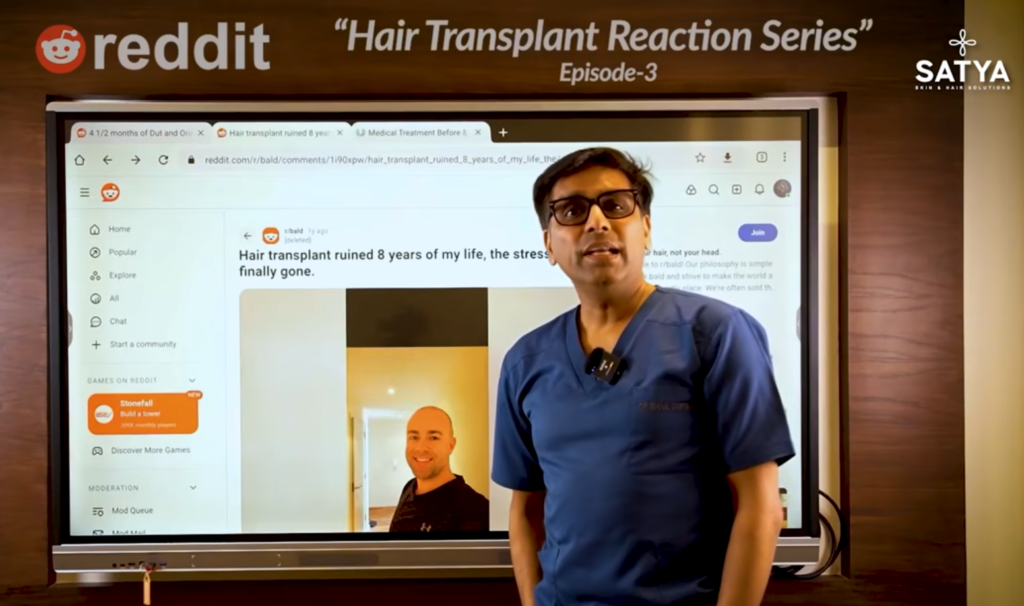
In a recent Instagram video, Dr. Shail Gupta reviewed a hair transplant case shared on Reddit. The patient had undergone two separate FUE hair transplant procedures at two different clinics.
Although the frontal area appeared to have received considerable coverage, the case raised important concerns about repeated surgery, donor management, hairline planning and the patient’s extensive medication regimen.
This article discusses the case from an educational perspective. It is not a diagnosis of the individual, as a complete assessment would require an in-person examination, donor evaluation and detailed medical history.
The Patient’s Hair Transplant History
According to the information shared with the case, the patient underwent two FUE hair transplant procedures.
First FUE procedure
The first clinic reportedly transplanted: 1,541 grafts
Second redo FUE procedure
The patient later visited another clinic for a corrective or redo procedure involving: 1,592 grafts
This means that approximately 3,133 grafts were used across the two procedures.
During the second surgery, the frontal hairline was extended and the temple areas were reconstructed. Despite the relatively limited recipient area, the patient had already consumed more than 3,000 donor grafts.
That is the first major concern highlighted by Dr. Shail Gupta.
Why Is Using More Than 3,000 Grafts in a Small Area Concerning?
Every patient has a limited donor supply.
The hair available on the back and sides of the scalp cannot be treated as an unlimited resource. Once a graft has been extracted through FUE, it does not regenerate in its original location.
Therefore, the success of a hair transplant should not be measured by the highest possible graft count. It should be measured by how effectively the available grafts are used while preserving enough donor hair for the future.
Using more than 3,000 grafts for a relatively small frontal area may create several concerns:
- Unnecessary consumption of limited donor grafts
- Reduced donor availability for future hair loss
- Visible thinning or patchiness in the donor area
- Difficulty performing another corrective procedure
- Increased dependence on medicines to protect untreated hair
- Poor long-term planning if baldness progresses
A patient may feel satisfied with immediate density, but androgenetic alopecia can continue to progress behind the transplanted area. If too much donor hair has already been consumed, treating future baldness becomes more difficult.
The Problem With Repeated FUE Procedures
FUE can provide natural results when it is performed with proper extraction patterns, correct graft selection and conservative donor planning.
The concern is not FUE itself. The concern is performing repeated FUE procedures without considering the cumulative effect on the donor area.
During an FUE hair transplant, individual follicular units are extracted from across the donor region. If the extraction density is too high—or if multiple clinics extract from overlapping areasthe donor can , gradually become depleted.
A second surgeon may also not have complete information about:
- The extraction pattern followed during the first surgery
- The exact number of grafts previously removed
- Whether grafts were taken from safe or potentially unstable areas
- The patient’s original donor density
- The percentage of donor capacity already consumed
This is why a redo hair transplant requires more detailed planning than a first procedure.
In suitable patients with higher graft requirements or a history of previous FUE, FUT may sometimes help access grafts from the central safe donor zone without creating further scattered FUE depletion. However, the appropriate technique can only be selected after examining scalp laxity, donor density, scarring, hair characteristics and future requirements.
Could the Existing Hairline Have Been Repaired Differently?
Dr. Shail Gupta observed that the second procedure extended both the hairline and temple areas.
However, if the original transplanted hairline was positioned incorrectly or did not suit the patient’s facial proportions, simply placing more grafts around it may not always be the most donor-efficient solution.
In selected repair cases, poorly positioned grafts can sometimes be extracted and carefully re-implanted at more appropriate angles or locations. Laser removal or a combination of corrective methods may also be considered depending on the nature of the problem.
This approach can potentially help:
- Correct an unnatural hairline
- Improve facial proportions
- Reduce the need for additional grafts
- Recycle selected misplaced grafts
- Preserve the remaining donor supply
However, graft extraction and re-implantation is technically demanding. Not every graft can be safely removed or reused, and the treatment must be planned according to the individual case.
The central principle is simple: a repair should correct the existing problem—not merely hide it by adding more grafts.
Dr. Shail Gupta’s Concern About the Medication Regimen
According to the case details, the patient was reportedly using:
- Oral minoxidil: 2 mg
- Topical minoxidil
- Oral finasteride: 1 mg every day
- Oral dutasteride: 0.5 mg three times per week
Each of these medicines may have a role in managing androgenetic alopecia in appropriately selected patients. However, combining multiple systemic and topical treatments creates a substantial medication burden that should be periodically reviewed by a qualified dermatologist.
Oral minoxidil is used off-label for hair loss. Research suggests that low-dose oral minoxidil can be effective and is generally well tolerated in selected patients, but reported adverse effects include unwanted body hair, light-headedness, fluid retention, and increased heart rate. Patient selection and monitoring remain important.
Finasteride 1 mg daily is an approved treatment for male androgenetic alopecia, but possible adverse effects include reduced libido, erectile dysfunction and ejaculation-related concerns. Its prescribing information also recommends periodic reassessment of continued therapy.
Dutasteride provides broader suppression of the enzymes involved in DHT production. Although research supports its effectiveness for male-pattern hair loss, its use and dosage should be individualized rather than automatically added to an existing finasteride plan.
The concern is not that every patient receiving combination therapy will experience harm. The concern is whether every component is necessary and whether the benefit justifies the cumulative exposure.
More Medication Does Not Automatically Mean a Better Plan
When a hair transplant result is being supported by several medicines simultaneously, it becomes difficult to determine how much improvement is coming from:
- Transplanted hair
- Existing native hair
- Oral minoxidil
- Topical minoxidil
- Finasteride
- Dutasteride
This distinction matters because transplanted and medicine-supported hair do not behave in exactly the same way.
If medication is stopped, hair preserved or improved by treatment may gradually be lost. This should not automatically be described as a dangerous “rebound.” In many cases, it represents the loss of the benefit that the medication had been maintaining.
Patients should not reduce or stop finasteride, dutasteride or oral minoxidil suddenly based on an online video. Any adjustment should be supervised by the prescribing doctor.
A responsible plan aims for the minimum effective treatment required for that particular patient, with regular assessment of response, side effects and long-term necessity.
What Could Have Been Planned Differently?
Based only on the information shown online, several questions deserve consideration:
1. Was the first hairline evaluated before adding more grafts?
If the existing grafts were incorrectly positioned, selective removal and redistribution might have been considered before expanding the recipient area.
2. Was the total donor capacity calculated?
A patient’s future baldness pattern should be considered before using another 1,500 grafts.
3. Were the temples appropriate for the patient’s face?
Temple reconstruction is one of the most technically demanding aspects of a hair transplant. Incorrect angles, excessive density or an overly low design can make the result appear unnatural.
4. Were alternatives to another FUE procedure discussed?
Depending on donor condition, previous scarring and future needs, FUT, selective graft recycling or a combined repair strategy may have been considered.
5. Was the medication plan reviewed as one complete regimen?
Adding medications individually over time can result in an unnecessarily complex routine. The entire plan should be periodically reviewed rather than assessing each medicine in isolation.
Dr. Shail Gupta’s Opinion on This Case
Dr. Shail Gupta’s primary concern is not simply that the patient underwent two FUE procedures.
His concern is that over 3,000 grafts appear to have been used for a relatively small area while the patient is simultaneously following an intensive medication regimen.
A technically successful hair transplant must balance three factors:
- A natural-looking result
- Long-term donor preservation
- The patient’s overall health and treatment sustainability
A dense-looking frontal result today should not come at the cost of an exhausted donor area or an unnecessarily heavy lifelong medical plan.
The objective should be to create the best possible result using the donor responsibly and only the amount of medication genuinely required for that patient.
Lessons for Anyone Considering a Redo Hair Transplant
Before undergoing a second or corrective hair transplant, ask your surgeon:
- How many grafts were removed during my first procedure?
- How much safe donor capacity is still available?
- Will the original hairline be corrected or simply covered?
- Can any misplaced grafts be extracted and reused?
- Is another FUE procedure safe for my donor?
- Should FUT or a combination approach be considered?
- How will future hair loss be managed?
- Which medicines are essential for me?
- How will my treatment be monitored?
- What happens if I cannot continue the medication?
A redo transplant should begin with a donor audit and long-term plan—not just another graft quotation.
Final Takeaway
The biggest lesson from this Reddit hair transplant case is that more grafts and more medicines do not necessarily represent better treatment.
Hair restoration requires balance.
The surgeon must balance density with donor preservation, hairline design with facial proportions, and medical support with the patient’s health and comfort.
If you have already undergone an FUE procedure and are considering a redo or repair hair transplant, obtain a detailed evaluation before committing more grafts. Sometimes the right decision is another surgery; sometimes it is selective correction, medical stabilization or simply preserving what remains.
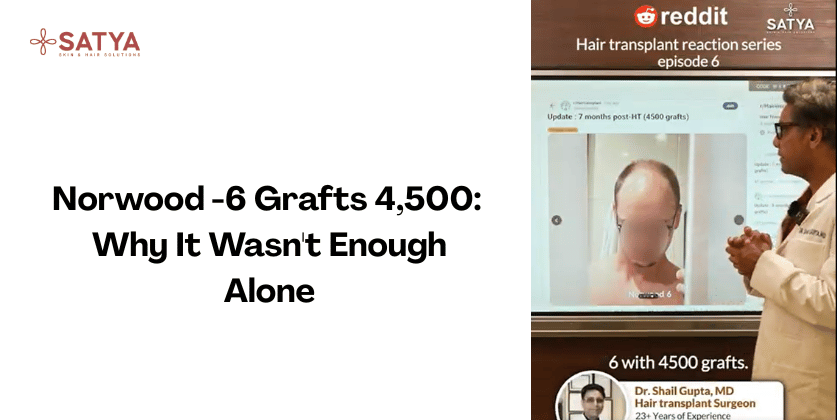
4,500 Grafts, Norwood Grade 6, Still Visible Gaps, Here’s Why
A real case, seven months out, shows why extensive hair loss rarely gets solved by…
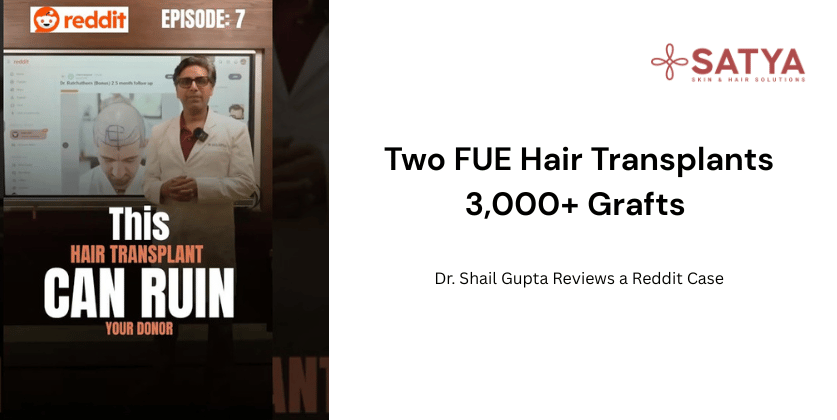
Two FUE Hair Transplants and Over 3,000 Grafts: Dr. Shail Gupta Reviews a Reddit Case
A hair transplant result should not be judged only by how the hairline looks in…
Is Finasteride Really Mandatory After a Hair Transplant?
Most hair transplant stories end at the “after” photo. This one didn’t. A Reddit user…
Every graft has long-term value. It should be used with a plan.
It may be safe in selected patients if adequate donor capacity remains. The surgeon must assess previous extraction, current donor density, scarring and future hair-loss progression.
Not necessarily in every case. The required number depends on the size of the area, existing hair, desired density and hair characteristics. However, using over 3,000 grafts in a small area deserves careful donor assessment.
Selected grafts can sometimes be extracted and re-implanted, but survival is not guaranteed. The feasibility depends on their position, angle, scarring and extraction technique.
Combination treatment has been described, but it is not necessary or suitable for everyone. It should only be used under specialist supervision after considering benefits, risks and alternatives.
Some clinicians may use both in selected cases, but the added benefit and treatment burden should be reviewed individually. Oral minoxidil requires appropriate medical screening and monitoring.
Do not stop prescribed medication without consulting your doctor. Stopping treatment may gradually reverse the benefit it was providing to existing hair.