A real case, seven months out, shows why extensive hair loss rarely gets solved by grafts alone. Dr. Shail Gupta explains the surgery-plus-medicine balance, and where the dosing line has to be drawn.
With Dr. Shail Gupta · Satya Skin & Hair Transplant Clinic
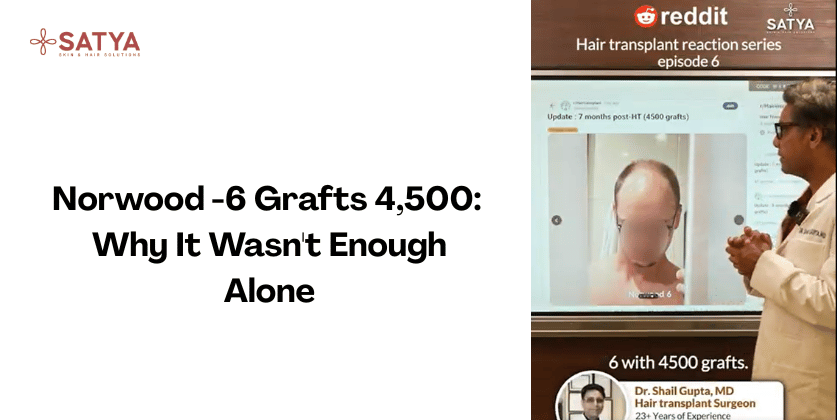
A Reddit result at 4,500 grafts and seven months looks strong at first glance, better hairline, filled-in temples. But look closer and the gaps are still there. For a Norwood Grade 6, that’s not a failed surgery. It’s math, and it’s exactly why medication has to be part of the plan.
Reddit Case · Norwood Grade 6
4,500 Grafts, Seven Months In
The hairline and temples show real progress, density has clearly improved in those zones. But visible gaps remain across the hairline, and Dr. Shail is upfront about why: 4,500 grafts is a large surgery, but for a Grade 6 pattern it is not enough, on its own, to deliver full coverage.
Supporting Regimen: Oral Minoxidil + Finasteride + PRP
Why 4,500 Grafts Rarely Finishes a Grade 6 Story
Graft count gets treated like a scoreboard, bigger number, better result. That logic breaks down fast once the loss pattern is extensive. A Norwood Grade 6 has lost hair across a much larger surface area than a Stage 2 or 3, and the donor area supplying those grafts hasn’t grown to match. Even a well-executed 4,500-graft session is being asked to cover ground that would need considerably more density than the donor can safely give up in one sitting, or, in many cases, ever.
That’s the gap this case is showing: not a surgical shortfall, but the honest limit of what grafts alone can do for advanced loss. Filling that gap with more and more grafts isn’t the answer either, it risks the donor itself, which is the one resource that can’t be replaced.
The Medication Layer Holding the Result Together
This is where the patient’s regimen comes in. Alongside the transplant, he is on oral minoxidil, finasteride, and periodic PRP sessions, a combination designed to support the native hair that’s still miniaturizing, not just the transplanted grafts. The temple and hairline improvement visible at seven months is very likely a blend of both: grafts providing new hair where there was none, and medication reviving follicles that were shrinking but not yet gone.
Comparison Case · Medicine Alone
Significant Growth Before a Single Graft Was Placed
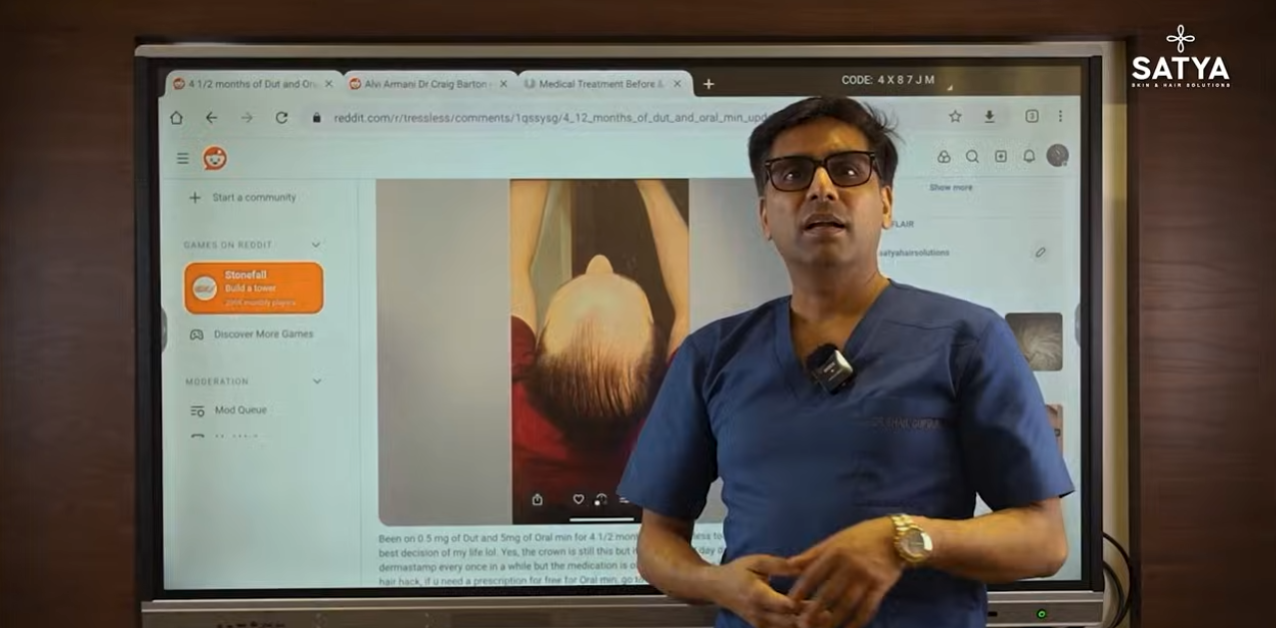
To make the point concrete, Dr. Shail points to a separate patient who saw substantial regrowth from finasteride alone — before any transplant surgery took place. It’s the same principle seen throughout this series: medication can do real, visible work on its own, which means it’s also doing real work whenever it’s combined with surgery.
Finasteride Only – No Surgery Yet
The Dosage Trap: More Growth, More Risk
Higher doses of finasteride generally produce more growth. That’s the appeal, and it’s also the trap. Dr. Shail cites a patient on a 1 mg daily dose who experienced sexual side effects, a recognized, if uncommon, risk of the medication at standard and higher doses. The response wasn’t to abandon the drug. It was to reduce the dose, aiming for a level that still supports hair growth while protecting the patient’s broader health.
Why Dose Reduction | Not Discontinuation | Is Often the Right Call
Stopping finasteride outright removes side-effect risk but also removes its benefit, and hair that was being maintained by the drug can begin to shed again. Reducing the dose, under medical supervision, is often the middle path: enough of the medicine to keep doing its job, at a level the patient’s body tolerates well. This is a decision for a qualified doctor to make with the patient, never a fixed rule applied to everyone.

The Minimum Approach: Two Decades of Balancing Grafts and Medicine
This is the philosophy Dr. Shail has refined over twenty years of practice, and cases like this one are exactly why it exists. Instead of chasing the maximum possible graft count or the maximum tolerable medication dose, the goal is the optimal balance between the two, enough surgery to build a durable structural result, and enough medication, at the lowest effective dose, to support it.
In practice, that means combining techniques rather than defaulting to one: FUE and FUT used together where each serves the case best, beard grafts brought in to extend a donor area that scalp hair alone can’t stretch far enough to cover, and a moderate, consistent medication routine rather than an aggressive one. The aim isn’t to avoid medicine, it’s to avoid relying on high doses of it to compensate for a surgical plan that tried to do too much, too fast, from a limited donor.
“The right dose isn’t the one that grows the most hair.
It’s the one a patient can carry safely for the rest of their life.”
Reading an Extensive Case (Norwood 5–7)
Before judging a result like this one, or assessing your own plan, ask:
- Is the graft count realistic for the total area of loss, or is it being asked to cover more ground than it reasonably can?
- Is medication part of the plan, and if so, at what dose?
- Has the donor area been protected, or stretched thin to chase a bigger number today?
- Are combination techniques, FUE, FUT, beard or body hair, being used where they genuinely help, or is one method being forced onto every case?
- Is there a monitored plan for adjusting medication dose if side effects appear?
The Honest Bottom Line
A Norwood Grade 6 result at seven months with visible hairline gaps isn’t a story about a surgery that fell short. It’s a story about what extensive hair loss actually requires: a graft count sized to what the donor can safely give, medication carrying the rest of the load, and a dosing strategy that protects the patient as carefully as it protects the hairline. That balance, not a bigger number, is what makes an extensive case sustainable for the long term.
Dr. Shail Gupta
Hair Transplant SurgeonDr. Shail leads Satya’s hair restoration practice with an education-first, transparency-driven philosophy, balancing surgical planning, donor preservation, and medication safety for even the most extensive cases.
4,500 Grafts, Norwood Grade 6, Still Visible Gaps, Here’s Why
A real case, seven months out, shows why extensive hair loss rarely gets solved by…
Two FUE Hair Transplants and Over 3,000 Grafts: Dr. Shail Gupta Reviews a Reddit Case
A hair transplant result should not be judged only by how the hairline looks in…
Is Finasteride Really Mandatory After a Hair Transplant?
Most hair transplant stories end at the “after” photo. This one didn’t. A Reddit user…
Frequently Asked Questions
Grade 6 loss covers a much larger area than earlier stages, and the donor supply available to fill it doesn’t grow to match. A large session can meaningfully improve the hairline and temples without being able to fully cover every affected zone — that’s a donor-math limit, not a sign the surgery was done poorly.
These are commonly used together to support both transplanted and native hair, but the right combination and dosing depends on the individual’s health profile and response. This should always be decided and monitored by a qualified doctor.
Don’t adjust the dose yourself. Speak to your doctor, reducing the dose is often enough to resolve side effects like the sexual side effects seen at 1 mg daily, while still preserving much of the hair-growth benefit. Stopping abruptly can also cause shedding, so any change should be supervised.
Developed over two decades, it’s the practice of finding the optimal balance between graft count and medication dose for each patient, using combination techniques like FUE, FUT, and beard grafts where they genuinely help, rather than maximizing either grafts or drug dosage in isolation.
When scalp donor supply can’t stretch to cover extensive loss, beard or body hair can extend the usable graft pool, a way to add coverage without over-harvesting the scalp donor area, which has to last a lifetime.