Hair transplant recovery is shorter than most people fear and longer than most people hope. The visible healing, meaning redness, swelling and small crusts, usually settles within 10 to 14 days. The biological recovery takes far longer: transplanted hairs commonly shed in the first two months, new growth begins at around three to four months, and the final result takes about 12 months to show at the front and up to 18 months at the crown.
What you do in the first ten days has a direct effect on how many grafts survive. This guide explains what is happening under the skin at each stage, what is normal, what is not, and the specific precautions that protect your result.
Quick Answer
Most patients return to desk work in 2 to 3 days and look socially presentable in about 10 to 14 days.
The first 7 to 10 days are the critical window: grafts are still anchoring, so the scalp must not be rubbed, scratched, pressed or soaked. Gentle washing usually begins within 48 to 72 hours, because delayed washing is linked to more folliculitis and redness [1]. Shedding of transplanted hairs between weeks 2 and 8 is expected, new growth starts at around 3 to 4 months, and the result matures over 12 to 18 months [1, 2, 3].
What Hair Transplant Recovery Actually Involves
A hair transplant moves follicular units, natural groups of one to four hairs, from the donor area at the back of the scalp into tiny incisions in the thinning area. Each graft arrives without its own blood supply and survives the first days on nutrients diffusing from surrounding tissue while new capillaries grow in.
Until that happens, friction, pressure or picking at a crust can dislodge it. Once the tissue has healed around it, commonly by about day 10, the graft is secure [3].
The moved follicle also typically drops its hair shaft and enters the telogen (resting) phase before starting a new anagen (growth) phase. The follicle stays alive under the skin, which is why early shedding is not a sign of failure.
Hair Transplant Recovery Timeline: What to Expect and When
| Stage | What is commonly seen | What matters most |
|---|---|---|
| Day 0 to 3 | Tightness, mild oozing, small crusts forming. Swelling begins in up to about half of patients, peaking around day 2 to 3 [1] | Protect the grafts; sleep with the head raised; no touching |
| Day 4 to 7 | Swelling settles by about day 5 to 7 [1]. Itching may start around day 3 to 7 [1] | Gentle washing as instructed; do not scratch |
| Day 7 to 14 | Crusts soften and fall away, usually within 10 to 14 days [1]. Grafts are commonly considered secure by about day 10 [3] | Let crusts shed in the wash; never pick them |
| Week 2 to 8 | Transplanted hairs shed; some nearby native hair may shed too [1, 3] | Expect it; do not judge the result now |
| Month 3 to 4 | Fine new hairs begin to appear [2, 3] | Patience; follow any medical treatment plan |
| Month 6 | Hair is long enough to style, still thickening [3] | A useful midpoint review, not the final result |
| Month 12 to 18 | About 90% of the result is usually visible by 12 months; the crown can take up to 18 [3] | The final assessment of density |
Pain and swelling are covered in more detail in our guide to hair transplant pain and the first week. For judging growth from month 3 onwards, see reading hair transplant results.
The First 72 Hours: How to Protect Your Grafts
The first three days carry the highest risk of accidental graft loss. The precautions are simple, but they need to be followed without exception.
Oozing and Bleeding
Light pink or clear oozing from the donor area is normal for 24 to 48 hours. If a site bleeds, press clean gauze on it steadily for 5 to 10 minutes rather than wiping [1]. Never press on the recipient area unless your clinic tells you to.
Sleeping Position
Sleep on your back with the head raised at about 45 degrees for the first several nights, using a travel pillow to stop you turning onto your side.
Hands Off the Recipient Area
Do not touch, rub or scratch the grafts. Car roofs, cupboard doors, children and pets cause most accidental knocks in the first week.
Medicines to Check
Blood thinners, aspirin, some painkillers, vitamin E and herbal supplements such as ginkgo can increase bleeding [1]. Never stop a prescribed medicine on your own; your surgeon decides case by case.
Washing After a Hair Transplant: The First Head Wash and Beyond
Many patients are afraid to wash their scalp after a transplant. The evidence points the other way: in a 2026 review of complications after FUE, washing delayed beyond three days was a risk factor for folliculitis and for moderate to severe persistent redness [1]. The review recommends gentle cleansing within 48 to 72 hours [1].
How Gentle Washing Is Usually Done
- Dilute the cleanser your clinic provides in a cup of lukewarm water.
- Pour or gently dab it over the recipient area. Do not rub.
- Rinse by pouring water from a mug, not under strong shower pressure.
- Let the scalp air dry. No towel rubbing and no hair dryer on the grafts.
The donor area can usually be cleaned a little more firmly, as it holds no grafts. If your clinic prescribes a saline spray to keep grafts moist, follow the frequency on your aftercare sheet; it supports washing but does not replace it.
Scabs and Crusts
Crusts commonly form between days 2 and 10 and soften away with regular gentle washing [1]. Crusts persisting beyond 10 to 14 days warrant a clinical check [1]. Picking one early can pull out the graft beneath it.
When Can You Use Normal Shampoo?
Normal, gentle shampooing commonly resumes at around 10 to 14 days [3]. Vigorous massage, styling products and hair oils on the recipient area should wait until your clinic confirms the crusts have cleared.
Hair Transplant Aftercare: What You Can Do, and When
The table below shows timings commonly advised in published post-operative protocols [2, 3]. Clinics differ, and your surgeon’s written instructions take precedence over any general guide, including this one.
| Activity | Commonly advised earliest point | Why it matters |
|---|---|---|
| Desk or remote work | 2 to 3 days | Low risk to grafts; redness and crusts may still be visible [2, 3] |
| Client-facing work | About 7 to 10 days | Mainly about visible redness and crusting [3] |
| Walking | From day 1 to 2 | Gentle movement aids circulation |
| Light exercise without heavy sweating | About 7 days | Sweat and raised blood pressure can irritate healing sites |
| Heavy weights, running | About 2 weeks | Straining raises scalp blood pressure and risks bleeding |
| Contact sports, martial arts | About 4 weeks | Direct impact can dislodge or damage grafts |
| Sexual activity | About 5 to 7 days | Exertion raises blood pressure; avoid any pressure on the scalp |
| Swimming pools, sea, steam, sauna | About 3 to 4 weeks | Chlorine, salt water, heat and bacteria on healing skin |
| Loose, clean cap | Usually after 3 to 5 days, if your clinic allows | Lift it straight on and off; avoid tight or woollen caps [3] |
| Two-wheeler helmet | About 10 to 14 days, if it does not press the grafts | Pressure and friction on the recipient area |
| Direct sun | Cover the scalp for at least 2 weeks; sunscreen once healed | Sunburn on healing skin can prolong redness [3] |
| Alcohol | Avoid for at least 3 days | Oozing and swelling [3] |
| Smoking | Stop before surgery and stay off it for at least 2 weeks after; quitting is better | Smoking reduces blood flow to healing tissue [1, 3, 4] |
| Haircut with scissors | About 3 to 4 weeks | Clippers on the recipient area should wait for your surgeon’s review |
| Hair dye or chemical treatments | About 4 to 6 weeks | Chemical irritation of healing skin [3] |
Smoking Deserves a Separate Word
Nicotine narrows blood vessels, and a new graft depends on the small vessels around it. The 2026 FUE review lists smoking as a risk factor for tissue necrosis and advises stopping at least one month before surgery [1]. A small study of 120 patients reported more implant-site bleeding and lower hair counts in smokers, though its statistics are inconsistent [4]. Even with limited data, the message is clear: the less you smoke around surgery, the better your grafts’ chances.
Shedding After a Hair Transplant: Expected or a Problem?
Shedding is the stage that worries patients most, and the one that most often looks like failure when it is not.
Shedding of Transplanted Hairs
Most transplanted hairs fall out between weeks 2 and 8 as the follicles enter their resting phase [1, 3]. The follicle stays in the skin. New growth commonly begins at around three months [1, 2].
Shock Loss of Native Hair
Shock loss, also called postoperative effluvium, is temporary shedding of existing hair near the transplanted or donor area. Reported incidence ranges widely, from 0.15% to 15% [1]. It typically starts 2 to 8 weeks after surgery, and regrowth usually begins at around three months [1]. Risk is higher in women, in older patients, with high implantation density and with psychological stress [1]. Shedding in the donor area typically resolves within 3 to 6 months [1].
When Shedding Is Not Normal
Hair that has already miniaturised (thinned by pattern hair loss) may not return after shock loss. This is one reason medical treatment to stabilise native hair is often part of a transplant plan. If you see no new growth at all by six months, or shedding continues to spread beyond the treated areas, ask for a review rather than waiting.
Normal Healing vs Warning Signs
Serious complications after a hair transplant are uncommon. Large series report overall complication rates of about 1.2% to 4.7% [1]. Knowing what normal healing looks like makes it easier to recognise the rare cases that need attention.
| Usually normal | Contact your clinic |
|---|---|
| Swelling of the forehead peaking at day 2 to 3, settling by day 5 to 7 [1] | Swelling that is still increasing after day 5 or spreads around the eyes and keeps worsening |
| Pink skin in the recipient area for several weeks | Spreading redness, warmth or pain that worsens instead of improving |
| Itching between days 3 and 7 [1] | Yellow pus, foul smell or fever: infection occurs in under 1% of cases, usually in weeks 1 to 4 [1] |
| Small, scattered pimple-like bumps as hairs break through | Many painful pustules: folliculitis affects about 12% of patients, usually in weeks 1 to 4, and responds to treatment [1] |
| Numbness in donor or recipient areas, usually resolving within 4 to 8 months [1] | Bleeding that does not stop after 10 to 15 minutes of steady pressure |
| Crusts that clear within about 10 to 14 days [1] | Dark or black areas of skin, or crusts persisting beyond 2 weeks |
Long-term numbness was reported in about 2% of patients in one large series, and small cysts occasionally form weeks later [1]. For a broader view of risks, see the side effects of hair transplants in India; if a past procedure has gone wrong, see bad hair transplant repair.
Dr. Shail Gupta on the First Ten Days
Most of the result is decided in the operating room: how gently each graft is handled, how quickly it goes back in, how densely we place it. But the first ten days afterwards are the patient’s part of the surgery. I would rather a patient call us about a crust that looks odd than wait and worry. Picking, rubbing and skipping the first wash cost more grafts than any other mistake I see in follow-up.
Medicines, Supplements and Aftercare Products
Minoxidil
Topical minoxidil is commonly restarted or started at about 10 days to 4 weeks after surgery, once the scalp has healed [3]. Starting earlier can irritate healing skin. The 2026 review notes that minoxidil may help regrowth after shock loss [1]. Use it only when your surgeon advises, at the strength they prescribe.
Finasteride and Other Prescribed Medicines
A transplant moves hair; it does not stop pattern hair loss in the native hair around it. Whether to continue an oral medicine is a medical decision for each patient. See is finasteride mandatory after a hair transplant and can I stop taking medicines after a hair transplant.
Antibiotics, Supplements and Aftercare Products
Routine antibiotics are not recommended for every patient, though they may be used in larger sessions or higher-risk cases [1]; if prescribed, complete the course. There is no strong evidence that a general hair supplement speeds healing in a well-nourished person, so testing for a genuine deficiency, such as iron or vitamin D, is more useful. In the first weeks, the key aftercare product is the gentle cleanser your clinic supplies. Extra PRP sessions are not automatically needed; see the truth about multiple PRP sessions after a transplant.
Dr. Ruchi Agarwal on Scalp Health During Recovery
Recovery is also a skin-healing process. Redness, itching and small bumps are usually the scalp settling, but they can also be folliculitis or contact irritation from a product, and these need different treatment. Please do not self-treat with creams or oils from the internet. Show us, and we will treat the scalp so the hair can grow. Health bhi, hair bhi.
Recovering in Delhi NCR: Heat, Sweat, Pollution and Commuting
Recovery advice written for cooler climates does not always fit life in Delhi and Gurgaon:
- Summer heat and sweat: summer procedures are a listed risk factor for folliculitis [1]. Keep the scalp clean and cool, and avoid heavy sweating for two weeks.
- Dust and winter smog: a loose, clean cap outdoors, once your clinic allows it, limits dust on healing skin.
- Two-wheeler commuting: a helmet presses on the grafts; plan other transport for about 10 to 14 days.
- Hair oiling: keep oils off the recipient area until your clinic confirms the skin has healed.
How Recovery Is Supported at Satya Skin & Hair Solutions
At our clinics in DLF Phase 4, Gurgaon and Pitampura, Delhi, recovery planning begins before surgery:
- Pre-operative review: medicines, smoking and medical conditions that affect healing are discussed in advance
- Written aftercare instructions: covering washing, sleep, activity and medicines, with timings specific to your procedure
- First wash: [confirm: performed or supervised at the clinic, and on which day]
- Follow-up reviews: [confirm schedule, for example day 1, day 10 and months 3, 6 and 12]
- A direct line for concerns: [confirm how patients reach the team after hours]
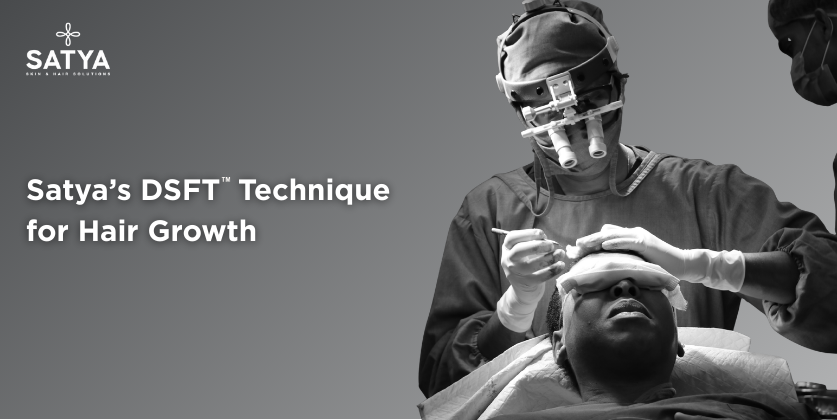
Donor-area care differs by technique: FUT leaves a linear wound with sutures, while FUE leaves small, scattered extraction sites. Our DSFT technique page explains how grafts are handled during surgery.
Plan Your Recovery Before You Plan Your Surgery
A safe recovery depends on the right plan for your scalp, donor area, health and routine. Schedule an evidence-based consultation with our hair restoration team at Satya Skin & Hair Solutions in DLF Phase 4, Gurgaon, or Pitampura, Delhi. We will explain what your recovery would involve, week by week, before any decision is made. Results and recovery vary from person to person.
Frequently Asked Questions
Visible healing usually takes about 10 to 14 days, and most people return to desk work in 2 to 3 days. Full recovery of the result takes longer: transplanted hairs commonly shed in the first two months, new growth begins at around three to four months, and the final result is usually assessed at 12 to 18 months.
Gentle washing usually begins within 48 to 72 hours, using the cleanser and method your clinic provides. A 2026 review found that delaying washing beyond three days was linked to more folliculitis and persistent redness. Normal shampooing commonly resumes at around 10 to 14 days.
Grafts are commonly considered secure by about day 10, once the surrounding tissue has healed. Until then, avoid rubbing, scratching, pressure and strong water pressure on the recipient area.
Yes. Most transplanted hairs shed between weeks 2 and 8 as the follicles enter a resting phase, and regrowth typically begins at around three months. Some patients also have temporary shock loss of nearby native hair, which usually recovers in the same timeframe.
Light exercise without heavy sweating is commonly allowed after about a week, heavy weights and running after about two weeks, and contact sports after about four weeks. Your surgeon may adjust this based on your procedure.
A loose, clean cap is usually allowed after 3 to 5 days, if your clinic agrees; lift it straight on and off. A helmet presses on the grafts, so most clinics advise waiting about 10 to 14 days.
Avoid alcohol for at least three days, as it can increase oozing and swelling. Stop smoking before surgery and stay off it for at least two weeks afterwards, because nicotine reduces blood flow to healing grafts. Stopping completely is better for both your scalp and your health.