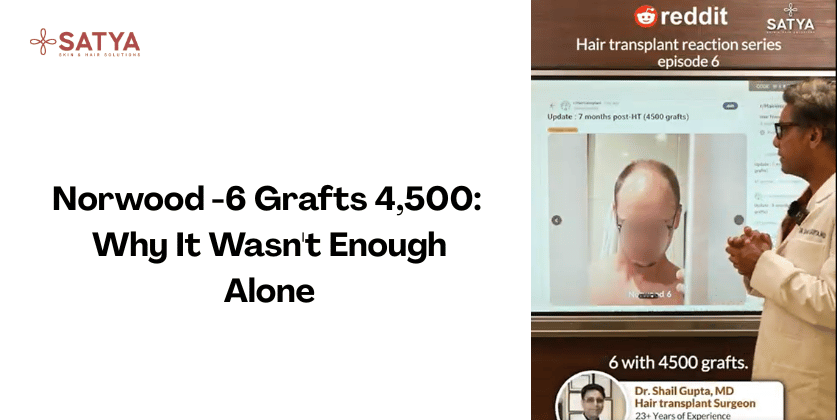

One case used 4,000 grafts and still ended with an artificial hairline. Another claims 7,500. Dr. Shail Gupta puts both next to a 3,000-graft Satya result on a fraction of the medication, and asks what the extra grafts actually bought.
With Dr. Shail Gupta · Satya Skin & Hair Transplant Clinic
Dr. Shail Gupta compares two Reddit transplants with a 3,000-graft, low-dose Satya case.
“How many grafts do I need?” is usually the first question a patient asks, and often the wrong one to anchor on. A bigger number doesn’t guarantee a better result, and a poorly designed transplant doesn’t become a good one just because medication makes the rest of the scalp look fuller. This review lines up three cases to show where results really come from.
Case 1: 4,000 Grafts and a Hairline That Looks Made
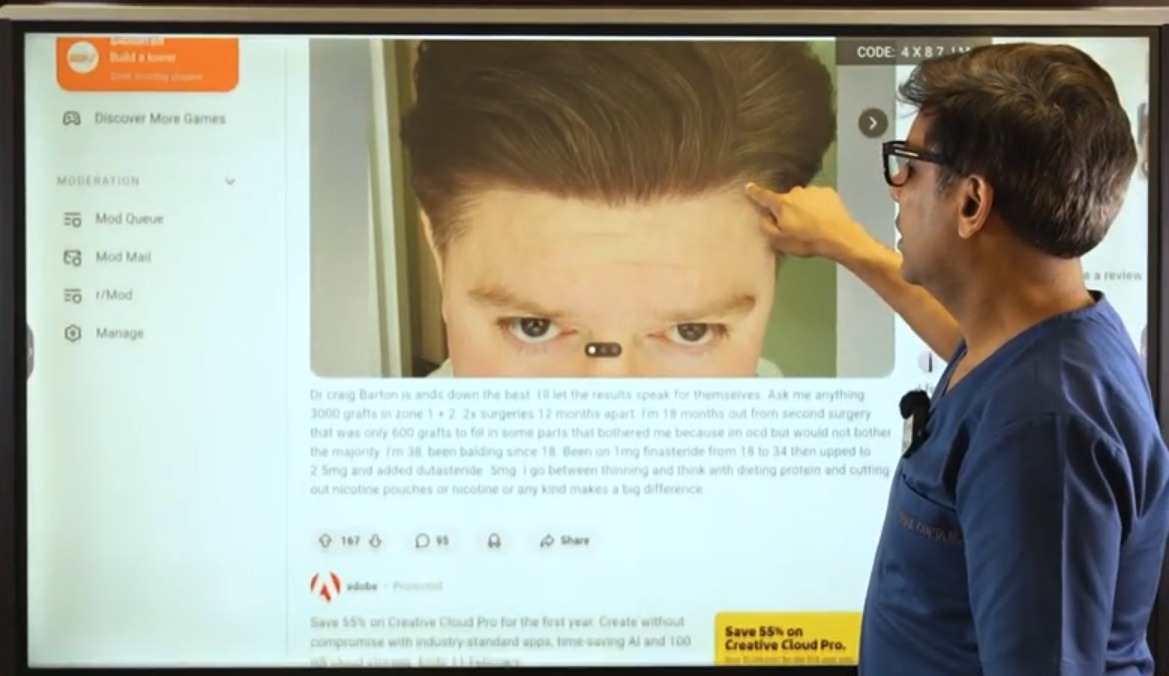
The first Reddit case involves roughly 4,000 grafts. The hairline is the problem. Dr. Shail describes it as artificially created and shabby the kind of front line that reads as “transplanted” rather than grown, because the design and placement don’t follow how a natural hairline behaves.
Reddit Case 1
4,000 Grafts, Unnatural, Artificial-Looking Hairline
The patient is on oral minoxidil and finasteride. Those medicines visibly improved the areas that received no surgical work at all. But the transplanted hairline itself stayed poor, medication thickened the native hair around it, it did not fix the design.
Regimen: oral minoxidil + finasteride
This is the part patients most often miss. Medication can lift density across the scalp and make an overall photo look better, but it cannot redraw a hairline. Placement angle, direction, irregularity and the soft transition zone at the front are decided on the operating day. If those are wrong, no pill corrects them later.
Case 2: 7,500 Grafts, Were They All Necessary?
The second case claims around 7,500 grafts. That’s a very large number for a single restoration plan, and Dr. Shail questions whether it was needed at all. His view: with proper surgical technique and the same medication regimen this patient was already on, something closer to 3,000 grafts would likely have delivered a comparable result.
Reddit Case 2
7,500 Grafts Claimed, Likely Far More Than Required
On the same oral minoxidil and finasteride combination, much of the visible density would be supported by medication anyway. With good design and placement, Dr. Shail estimates roughly 3,000 grafts could have achieved a similar outcome, leaving thousands of donor grafts untouched for the future.
Regimen: oral minoxidil + finasteride
⚠ Why Excess Grafts Carry a Real Cost
Donor hair at the back and sides of the scalp is finite, once extracted, it doesn’t grow back. Every graft used unnecessarily today is a graft unavailable if hair loss progresses in 10 or 20 years, or if a repair is ever needed.
Heavy extraction can also thin the donor area visibly. A high graft count is not a bonus; it is a withdrawal from an account that cannot be refilled.
The Benchmark: 3,000 Grafts on a Fraction of the Medication
To show what the alternative looks like, Dr. Shail presents one of his own patients at Satya. This patient received 3,000 grafts to the frontal portion of the scalp and achieved a strong result, on a far lighter medication plan than either Reddit case.
Satya Case
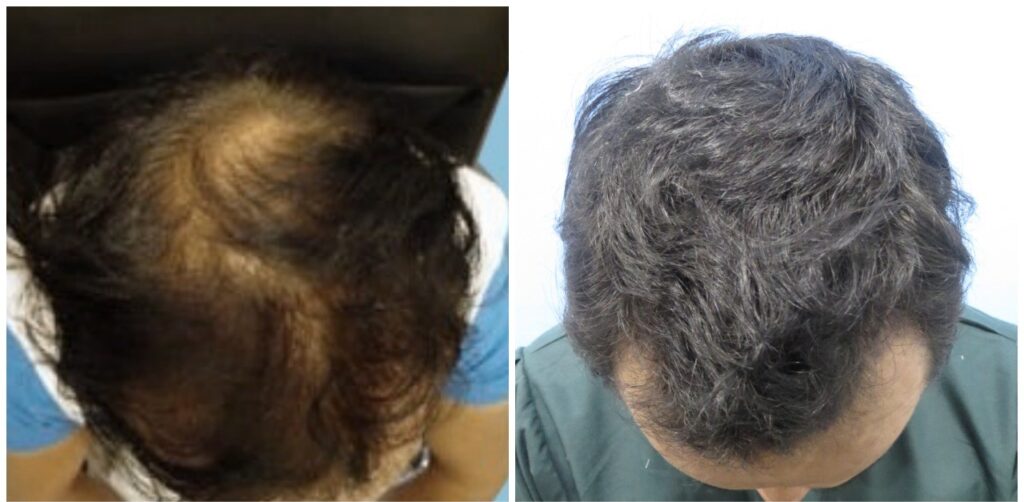
3,000 Grafts, Frontal Area, Low-Dose Support
A strong frontal result using 3,000 grafts, supported by finasteride at just 2 mg per week and no oral minoxidil. Because the medication load was so low, the result reflects the surgery itself, planning, design and placement, rather than a heavy drug regimen doing the work in the background.
Regimen: finasteride 2 mg/week · no oral minoxidil
7,500
Grafts claimed in Reddit Case 2
3,000
Grafts in the Satya frontal case
2 mg
Finasteride per week, vs 7 mg/week at the common 1 mg daily dose
For context, the commonly prescribed finasteride dose for hair loss is 1 mg a day, 7 mg a week. The Satya patient took less than a third of that, with no oral minoxidil. That’s the “less is more” principle in practice: the lowest effective dose, a sensible graft count, and the skill to make both count.
A hair transplant is judged by design and placement, not by the
size of the graft number printed on the package.
And Sometimes, No Surgery at All
Medication-Only Case
Visible Density Gain, No Grafts Used
Using finasteride with topical minoxidil, this patient saw meaningful improvement in density without surgical intervention. For the right candidate, medication can deliver real change on its own, and every graft stays in the donor bank.
Regimen: finasteride + topical minoxidil · no surgery
This matters for two reasons. First, it shows how much of the fullness in any post-transplant photo can be medication-driven, which is exactly why heavy-regimen cases are hard to judge. Second, it reminds patients that surgery is not the only starting point. Some are better served by beginning with medicine and reassessing before touching the donor at all.
What Patients Should Take From This
Building Your Own Road Map
Before you commit to any graft count, make sure you can answer these:
- Has the surgeon shown you hairlines that look natural up close, not just dense in a wide photo?
- Why this specific graft number? Ask how it was calculated and what would happen with fewer.
- How much of the expected density depends on medication, and at what dose?
- What is left in your donor area afterwards for future loss or repair?
- Would medication alone be worth trying first in your case?
Three principles run through all of these cases. Surgical skill and artistic planning decide how natural a result looks. Donor preservation protects your options for the decades ahead. And long-term health means medication at the lowest dose that genuinely works, not the highest one you can tolerate.
Dr. Shail’s advice is simple: research thoroughly before you decide. Satya publishes case studies that explain the technique used, the medication and dosage, and the reasoning behind each treatment choice, so patients can compare real plans and build a road map suited to their own hair loss, rather than chasing the biggest number on offer.

Frequently Asked Questions
No. Results depend far more on hairline design, graft placement and technique than on the raw number. In this review, a 4,000-graft case still produced an artificial-looking hairline, while a 3,000-graft Satya case achieved a strong frontal result. Unnecessary grafts also use up donor hair you may need later.
Medication can thicken native hair around and behind a transplanted area, but it cannot change the shape, angle or placement of transplanted grafts. A poorly designed hairline usually needs corrective planning, not more medicine.
In this Satya case, finasteride at 2 mg per week supported a strong 3,000-graft result without oral minoxidil. Lower-dose regimens are chosen individually by the treating doctor to balance benefit and tolerability. Dosing is personal, never change or start finasteride without medical supervision.
For some patients, yes. The medication-only example in this review showed meaningful density gains with finasteride and topical minoxidil and no surgery. Whether that route suits you depends on your stage of loss and should be assessed by a doctor.
Ask for the reasoning behind the number: the area to be covered, your donor capacity, your expected future loss, and how much medication is part of the plan. A transparent surgeon should be able to explain what a smaller procedure would and wouldn’t achieve.
Get a Graft Plan You Can Understand
We’ll explain how many grafts your case genuinely needs, what medication can contribute at the lowest effective dose, and how to protect your donor for the future.Book Your Consultation 📞 +91-99100 94945 ·
📍 Galleria Market, DLF Phase 4, Gurugram | Pitampura, New Delhi