Author: Dr. Shaiil Gupta, MBBS, MD (Dermatology), Founder and Hair Restoration Surgeon, Satya Skin and Hair Solutions, Gurgaon and Delhi
Medically Reviewed By: Dr. Ruchi Agarwal, MD Dermatologist, Co-founder, Satya Skin and Hair Solutions
QUICK ANSWER
There is no single best hair transplant technique that suits every patient. FUE (Follicular Unit Excision) and DHI (Direct Hair Implantation) are both scar-minimizing, graft-by-graft extraction methods, generally cited in the range of 35 to 45 grafts per square centimeter of achievable density, each with its own trade-offs around precision, session size, and procedure time. Satya’s Balanced Hair Transplant (BHT) approach does not compete with these as a fifth technique. It is a planning framework that combines FUE, FUT, MHT (Maximum Harvesting Technique), and conservative medical management based on an individual donor assessment, rather than defaulting to one method for every case. The right technique, or combination, depends on your Norwood grade, donor density, and long-term goals, not a generic ranking.
What “Best Hair Transplant Technique” Actually Means
Search for “best hair transplant” and most results imply a single winner. Clinically, that framing is misleading. FUE, FUT, and DHI are extraction and implantation methods, each with measurable trade-offs in scarring, session size, and graft handling. MHT and BHT, by contrast, are not alternative extraction methods; they are planning approaches that decide how and when those methods are used for a specific donor area and hair loss pattern.
A technique that performs well for a Norwood 3 hairline case can be the wrong choice for a Norwood 6 or 7 case needing several thousand grafts across multiple zones. Judging “best” without reference to graft count, donor supply, and the patient’s long-term hair loss trajectory is the most common source of mismatched expectations in hair restoration.
The comparison below evaluates each approach on the factors that actually determine outcome quality: donor yield, scarring, graft survival, procedure time, and suitability by baldness grade.
FUE (Follicular Unit Excision): Mechanism and Where It Fits
How FUE Works
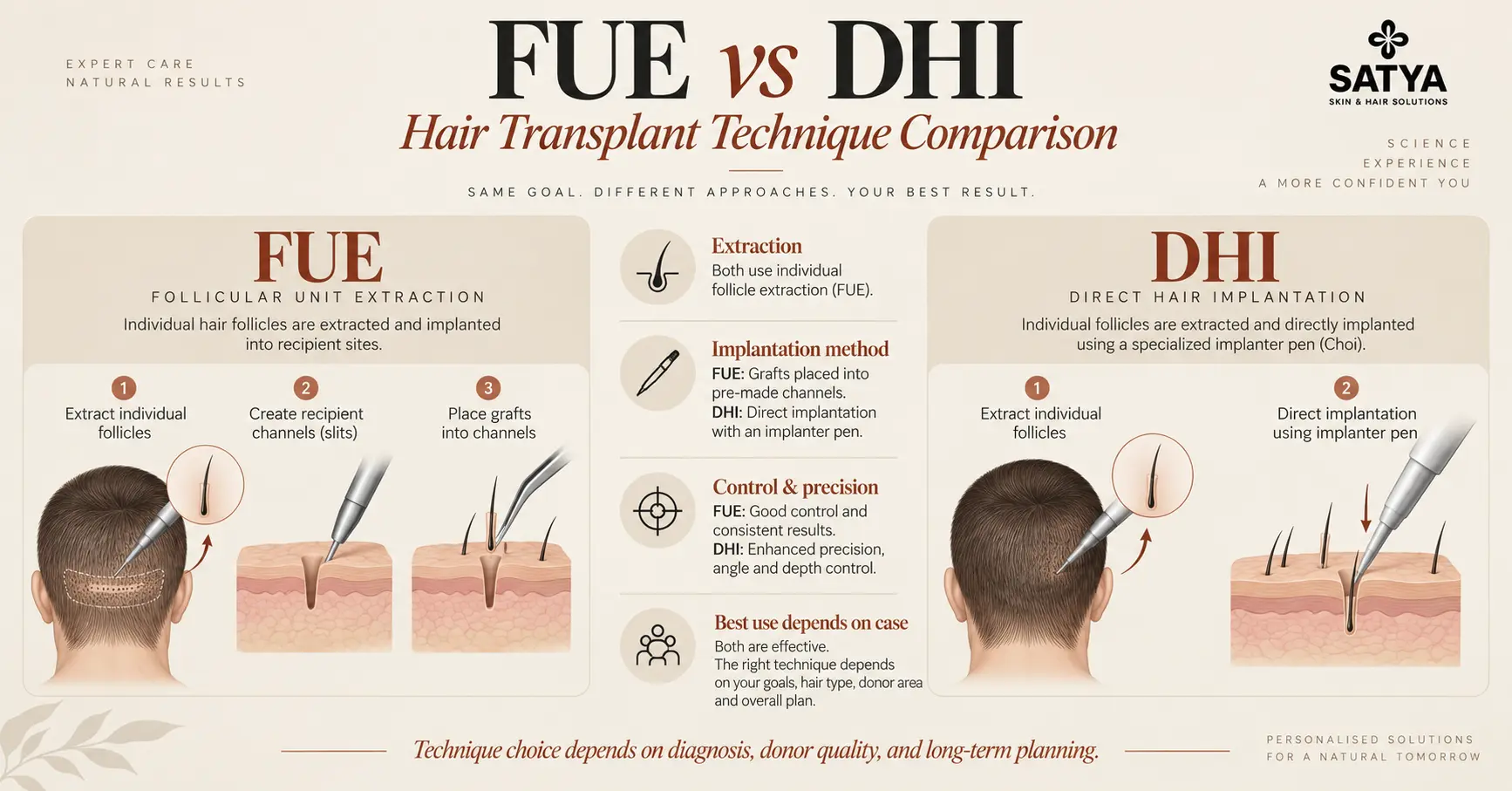
FUE extracts individual follicular units directly from the donor area using a small circular punch tool, without a linear incision. Each extraction site heals as a tiny, dot-like scar scattered across the donor zone rather than concentrated in one line.
FUE’s Strengths and Limitations
- No linear scar, which suits patients who prefer wearing their hair very short.
- Commonly cited density ranges sit around 35 to 40 grafts per square centimeter for standard sessions, though exact yield depends on donor characteristics and surgeon technique.
- Because grafts are extracted one at a time, very large single sessions extend total procedure time, which increases how long grafts spend outside the body before implantation.
- Surgeons typically cap single-session extraction to protect donor density, which is why very high graft count cases often require staged sessions with FUE alone.
DHI (Direct Hair Implantation): Mechanism and Where It Fits
How DHI Works
DHI uses a specialized implanter tool, sometimes called a Choi pen, to extract and place each graft without pre-creating recipient channels. The surgeon controls the angle, direction, and depth of each follicle at the point of implantation.
DHI’s Strengths and Limitations
- Precise control over individual graft placement, generally considered an advantage for hairline design and small, detail-sensitive areas.
- Commonly cited density ranges run slightly higher than standard FUE, often referenced around 40 to 45 grafts per square centimeter in favorable donor conditions.
- The implanter-based workflow is typically slower per graft than punch-and-place FUE, which can make DHI less time-efficient for very large sessions covering extensive balding areas.
- Best suited to hairline definition and localized density work rather than full-scalp coverage for advanced baldness in a single session.
MHT (Maximum Harvesting Technique): Satya’s Donor-Yield Protocol
MHT is not a replacement for FUE, FUT, or DHI. It is Satya’s planning protocol applied within whichever extraction method is used, aimed at maximizing usable graft yield from a donor area while protecting long-term donor safety, not maximizing the raw number of grafts pulled in a single sitting.
| DR. SHAIIL GUPTA ON MHT Maximum Harvesting Technique means planning extraction density across the donor area so that today’s session does not compromise what the donor zone can still provide five or ten years from now. It is a discipline applied during FUE, FUT, or a combined plan, not a separate transplant method competing with them. |
In practice, this means spacing extraction sites to avoid visible thinning in the donor zone, rotating extraction patterns across sessions, and treating the donor supply as a finite, non-renewable resource that should be planned across a patient’s lifetime rather than spent entirely on one procedure.
Balanced Hair Transplant (BHT): Satya’s Combination Approach
Balanced Hair Transplant is Satya’s proprietary planning framework for cases where a single technique is unlikely to serve the patient’s long-term interests on its own. Rather than defaulting to FUE or FUT for an entire case, BHT assesses which donor zones and techniques best serve each part of the plan, combining FUT, FUE, MHT-guided harvesting, and conservative, individually assessed medical management.
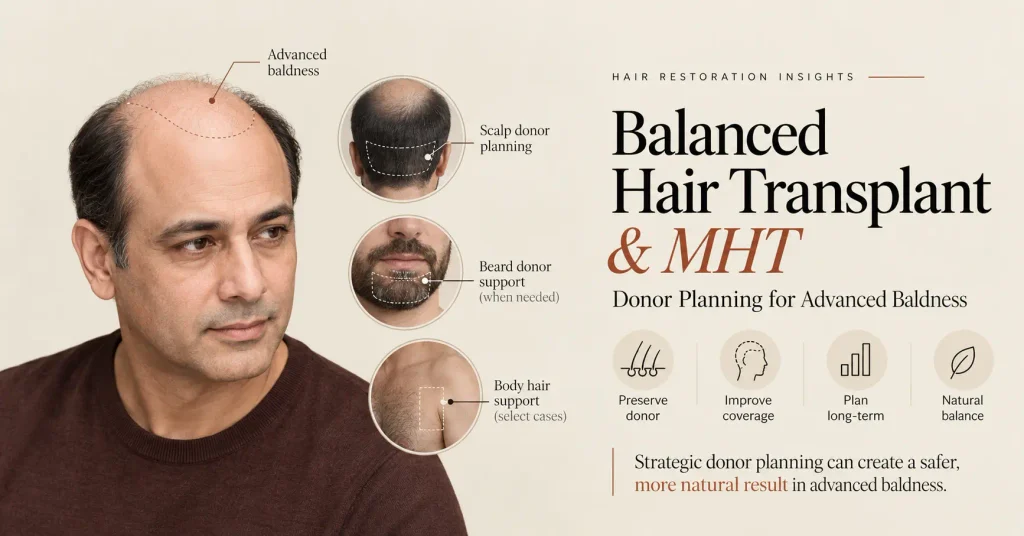
| DR. SHAIIL GUPTA ON BALANCED HAIR TRANSPLANT Balanced Hair Transplant is a philosophy before it is a procedure. We assess donor density, scalp laxity, baldness grade, and the patient’s likely future hair loss pattern, then combine techniques and a conservative medication protocol specifically for that case. It is considered when the donor assessment shows it would genuinely protect long-term results and donor capacity, not applied as a default to every patient. |
This approach is intended to apply across baldness grades, including advanced Norwood 6 and 7 cases, by combining methods rather than requiring a single technique to cover the full graft requirement. The aim is to preserve donor capacity for the future and to rely primarily on surgical skill and precise planning rather than on higher medication volumes to produce a visible result.
BHT vs MHT vs FUE vs DHI: Head to Head
| Factor | FUE | DHI | MHT | BHT |
|---|---|---|---|---|
| What it is | Extraction and implantation technique | Extraction and implantation technique | Donor harvesting protocol applied within a technique | Combination planning framework across techniques |
| Scarring | Multiple small dot scars across donor area | Multiple small dot scars across donor area | Depends on the technique it is applied within | Depends on which techniques are combined for the case |
| Typical density range | Commonly cited 35 to 40 grafts per sq cm | Commonly cited 40 to 45 grafts per sq cm | Not a density metric; a donor-planning discipline | Varies by case, planned across zones and sessions |
| Best suited for | Most patients seeking scar-minimal restoration | Hairline design and small, detail-sensitive areas | Any case where donor preservation is a priority | Advanced or complex cases needing more than one method |
| Session time for large areas | Efficient per graft, extends with very large sessions | Slower per graft than FUE, less efficient at scale | Not applicable on its own | Planned across sessions and techniques |
Who Should Choose Which Technique?
Generally Suited to FUE Alone
- Early to moderate hair loss (commonly Norwood 2 to 4) with a graft requirement that fits comfortably within a standard session.
- Patients who want to keep donor-area hair very short without a visible linear scar.
Generally Suited to DHI, Often Alongside FUE
- Hairline redesign or density work in a focused, smaller area where precise angle and direction control matter most.
- Patients prioritizing meticulous placement over covering very large areas in one session.
Generally Suited to a BHT or MHT-Guided Plan
- Advanced baldness (Norwood 5 to 7) where total graft requirement exceeds what a single technique can safely provide in one or two sessions.
- Patients who have had a prior transplant elsewhere and need corrective or repair work alongside new graft placement.
- Patients who want to preserve donor capacity for a possible future procedure as their hair loss pattern continues to evolve.
Risks and Realistic Expectations Across All Techniques
- Standard surgical risks apply across FUE, DHI, and combination plans, including infection, temporary numbness, swelling, and shock loss of existing native hair.
- Graft survival for well-executed procedures is commonly cited in the range of 90 to 98 percent, while poor technique or excessive time outside the body can reduce this meaningfully. No responsible clinic should claim 100 percent survival.
- Visible results take time regardless of technique. Most patients see meaningful density by months 6 to 9, with full maturation, especially at the crown, typically taking 12 to 18 months.
- Overharvesting the donor area with any technique reduces future options if hair loss progresses, which is the central reasoning behind MHT and BHT planning.
| 35 to 45 Grafts per sq cm, commonly cited range across FUE and DHI | 90 to 98% Typical graft survival for well-executed procedures | 12 to 18 Months typically cited for results to fully mature |
Where Satya Stands
We do not treat FUE, DHI, or any single technique as inherently superior. Each is a tool suited to specific donor conditions and goals. Our Balanced Hair Transplant framework, guided by MHT donor-yield planning, exists because advanced and corrective cases are frequently mismanaged by clinics committed to one method regardless of fit. A technique recommendation should follow a documented scalp and donor assessment, not a generic ranking of methods or a fixed package.
Frequently Asked Questions
There is no universal best technique. FUE and DHI are both scar-minimizing extraction methods with different trade-offs in density and session efficiency. For advanced or complex cases, a combination planning approach such as Satya’s Balanced Hair Transplant is often more suitable than committing to a single method.
Balanced Hair Transplant is Satya’s planning framework that combines FUT, FUE, MHT-guided donor harvesting, and conservative medical management based on an individual assessment, rather than relying on one technique for an entire case.
MHT is a donor-harvesting protocol, not a standalone transplant method. It focuses on maximizing usable graft yield while protecting long-term donor capacity, and can be applied within FUE, FUT, or a combined BHT plan.
FUE extracts grafts with a punch tool and implants them into pre-made or simultaneously created recipient sites, while DHI uses an implanter tool to extract and place each graft directly, offering more precise angle control but generally taking longer per graft at scale.
BHT is intended to apply across baldness grades, including advanced cases, specifically because combining techniques can address higher total graft requirements more effectively than a single method alone. Suitability is confirmed through an individual donor assessment.
Commonly cited ranges put DHI slightly above standard FUE, around 40 to 45 grafts per square centimeter versus 35 to 40 for FUE, though actual yield depends on donor density, scalp laxity, and surgeon technique in each individual case.
Only a trichoscopic donor and scalp assessment can confirm this. Factors include your Norwood grade, donor density, scalp laxity, prior procedures, and how you expect your hair loss to progress, none of which can be judged from a generic comparison.
| NEXT STEP Don’t choose a hair transplant technique based on a generic comparison alone. The right approach, including whether a Balanced Hair Transplant plan or MHT-guided single technique fits your case, can only be confirmed through an individual donor and scalp assessment. Book Your Consultation with our hair restoration team at Satya Skin and Hair Solutions, Gurgaon and Delhi. Call +919999570494 or book online . Results vary from person to person, and any recommendation you receive will be based on your donor assessment, not a generic technique ranking. |