Reviewed by Dr. Shail Gupta, MD (Lead Hair Transplant Surgeon) and Dr. Ruchi Agarwal, MD (Dermatologist and Co-founder) · Satya Skin & Hair Solutions, Gurgaon and Delhi
QUICK ANSWER
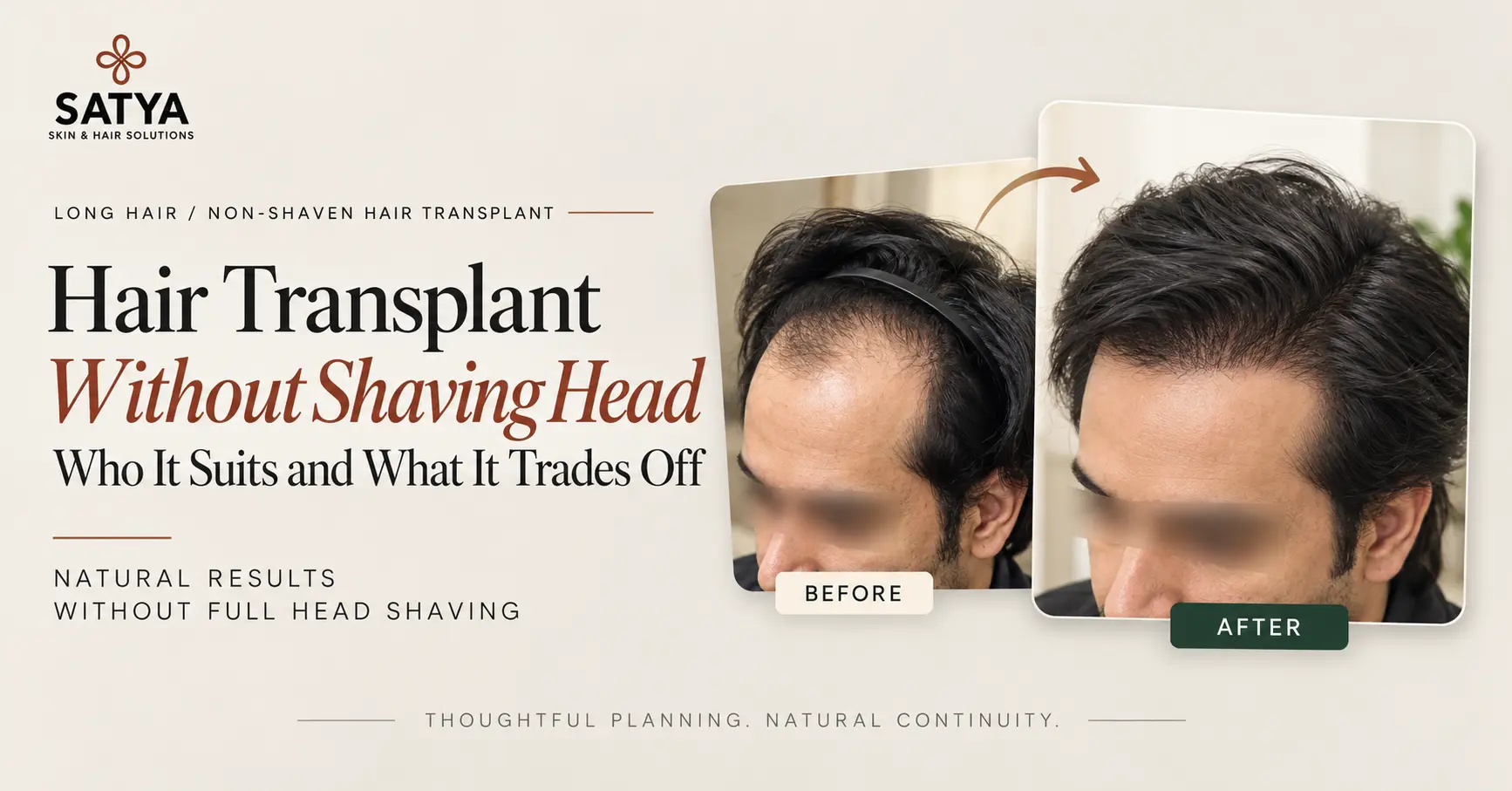
A hair transplant without shaving the head, often called a no-shave hair transplant, moves your own hair follicles into thinning areas without shaving the donor or recipient sites. This lets you keep your existing hairstyle and return to normal life with little sign that you had surgery. It suits people who cannot take social downtime or have an event coming up. The trade-offs are a higher cost, a limit on how many grafts can be placed comfortably in one session, and the need for a highly skilled surgical team.
For a lot of people, the single biggest reason they delay a hair transplant is not the surgery or even the cost. It is the thought of walking around with a shaved head for weeks while colleagues, clients, and family notice. A hair transplant without shaving the head removes that barrier, letting you keep your look through the whole process. It is a genuinely useful option, but it is not the right fit for everyone, and honesty about the trade-offs matters. This guide explains who it suits and what you give up in return.
What Is a Hair Transplant Without Shaving the Head?
It is a hair transplant in which the surgeon works between your existing hair, so neither the donor area nor the area being treated is shaved, and your hairstyle stays intact.
In a standard transplant, the back of the scalp is trimmed short so follicles are easy to see and extract. In a no-shave hair transplant, that hair is left long and worked through carefully, which hides the surgery almost completely once you leave the clinic. At Satya we offer this as our long hair transplant approach, designed for patients who want restoration without the social downtime.
No-Shave, Unshaven, and Long Hair Transplant: Are They the Same?
These terms overlap and are often used to mean the same thing: a transplant done without shaving your visible hair. Some clinics shave only a tiny hidden strip in the donor area and call it no-shave, while a true long hair transplant leaves even the donor hair long. What matters for you is the result: you walk in and out looking like yourself, with your hairstyle undisturbed.
How Does a No-Shave Hair Transplant Work?
The steps mirror a normal transplant, but every stage is slower and more delicate because the hair is left long throughout.
- Planning: the hairline and density are designed, and the donor area is assessed while the hair is still full.
- Extraction: follicles are removed one by one from between your existing long hairs, which takes more time and precision.
- Site creation: tiny recipient sites are made among your current hair at the correct angle and direction.
- Placement: grafts, often with the hair shaft still attached, are placed carefully so they are not dislodged.
- Recovery: because your hair covers the area, scabs and redness are hidden as they heal.
Who Is a Good Candidate for a No-Shave Hair Transplant?
It suits people with early to moderate hair loss who cannot afford visible downtime, rather than those needing very large coverage.
You may be a strong candidate if you recognise yourself in any of these.
- You have a public-facing job or run a business and cannot explain a shaved head for weeks.
- You have an important event, such as a wedding or a work milestone, within a few weeks.
- Your hair loss is early to moderate, so the number of grafts needed is small to medium.
- You are a woman who does not want any part of your hair shaved, which is a common and understandable preference.
It is a weaker fit for very advanced baldness that needs a very high graft count, where a standard or staged approach is usually more practical.
What a No-Shave Hair Transplant Trades Off
The discretion of a no-shave hair transplant comes with real trade-offs, and an honest clinic will tell you about them up front.
- Higher cost: the extra time and skill involved make it more expensive than a standard shaven transplant.
- Fewer grafts per session: it is best suited to small and moderate sessions, so very large cases may need staging or a partial shave.
- Specialised expertise required: it is a demanding technique, and not every clinic can perform it safely and well.
- Slightly higher graft handling risk: because the hair is left long, there is a small risk of grafts being pulled or dislodged, so careful handling is essential.
- Longer procedure time: expect a longer day in the chair than a shaven session of the same size.
What it does not trade off, in skilled hands, is the final result. Once grown, a no-shave transplant looks and lasts the same as a shaven one. The trade-offs are about the process, not the long-term outcome.
No-Shave vs Standard Shaven Transplant
Seeing the two side by side makes the choice clearer.
| Feature | No-shave transplant | Standard shaven transplant |
|---|---|---|
| Look after surgery | Hairstyle kept, discreet | Visibly short for some weeks |
| Social downtime | Minimal | Usually two to three weeks |
| Grafts per session | Best for small to moderate | Handles large sessions easily |
| Procedure time | Longer | Shorter |
| Cost | Higher | Standard |
| Final result | Same when done well | Same when done well |
The Satya Approach
A no-shave transplant is only as good as the hands performing it, so at Satya it is treated as a skill-led procedure, not a marketing label. Our philosophy stays the same across every technique: Less Medicine. Less Donor. Maximum Skill.
| FROM DR. SHAIIL GUPTA, LEAD HAIR TRANSPLANT SURGEON“ A no-shave transplant is one of the most demanding ways to work, because you are extracting and placing grafts through a full head of hair without disturbing it. I am honest with patients about when it is the right choice and when it is not. If someone needs very heavy coverage, I will explain why a standard or staged plan may serve them better. When it does fit, the discretion it offers can be life changing for people who simply cannot take time away from public life.” |
With more than twenty years of experience and a focus on natural hairline design, our team plans each case around your real needs. You can read more on our long hair transplant page, or compare it with standard FUE and FUT techniques.
Recovery, Scabs, and Aftercare
One of the quiet advantages of keeping your hair is that healing is far less visible, but good aftercare still matters.
| FROM DR. RUCHI AGARWAL, DERMATOLOGIST AND CO-FOUNDER“ Because your existing hair covers the treated area, the small scabs and redness that follow any transplant are hidden while the scalp heals, which is a real comfort for patients. The flip side is that you must be gentle. Washing has to be careful so grafts are not disturbed under the longer hair, and the scalp still needs the same clean, calm healing environment as any transplant. Follow the aftercare closely and the hidden healing works in your favour.” |
Timeline and Results
You leave looking like yourself, but the real growth still takes months, exactly as it does with any transplant.
Here is the honest timeline to expect.
- First few weeks: scabs and redness heal, hidden under your existing hair, and the transplanted hairs shed, which is normal.
- Three to four months: new growth begins to appear.
- Six to nine months: density builds and the result starts to look natural.
- Twelve months: the final result matures and blends fully with your own hair.
Taking the Next Step
If keeping your hairstyle through recovery matters to you, the next step is a simple assessment to see whether a no-shave hair transplant fits your hair loss, your graft needs, and your timeline. Learn more on our long hair transplant page, or book a consultation to discuss your options.
Book an evidence-based consultation with the team at Satya Skin & Hair Solutions in Gurgaon or Delhi. We will assess your hair honestly and tell you whether a no-shave approach is the right fit, or whether another technique would serve you better.
Call: +919999570494 | Book online
Frequently Asked Questions
It is a transplant performed between your existing hair so that neither the donor nor the recipient area is shaved. You keep your hairstyle and the surgery is hard for others to notice, which is why it is also called a no-shave or long hair transplant.
It suits people with early to moderate hair loss who cannot take social downtime, such as those in public-facing roles or with an event coming up within a few weeks. It is a weaker fit for very advanced baldness that needs a very large number of grafts.
Usually, yes. Because it takes more time and a higher level of skill, a hair transplant without shaving the head generally costs more than a standard shaven procedure. A precise figure depends on the number of grafts and is given after an assessment.
In skilled hands, yes. The final grown result looks and lasts the same as a standard transplant. The difference is in the process and recovery, not the long-term outcome. The main limitation is that fewer grafts can be placed comfortably in a single no-shave session.
Yes. A no-shave approach is often ideal for women with thinning or a receding hairline who do not want any part of their hair shaved, since it preserves their length and style throughout the procedure.
It is safe when performed by an experienced surgical team using the right technique. The main technical point is careful graft handling, since the hair is left long, so choosing a clinic that performs this procedure regularly is important.