A patient’s due-diligence guide to verifying qualifications, inspecting safety standards, and judging a consultation before you commit to any procedure in India.
Most people choose a hair transplant clinic the way they choose a restaurant: scrolling reviews, comparing prices, and trusting the most polished photographs. But a hair transplant is a surgical procedure, and the clinic you pick decides who operates, how safely, and who answers if something goes wrong. These seven checks turn a marketing decision into a medical one.
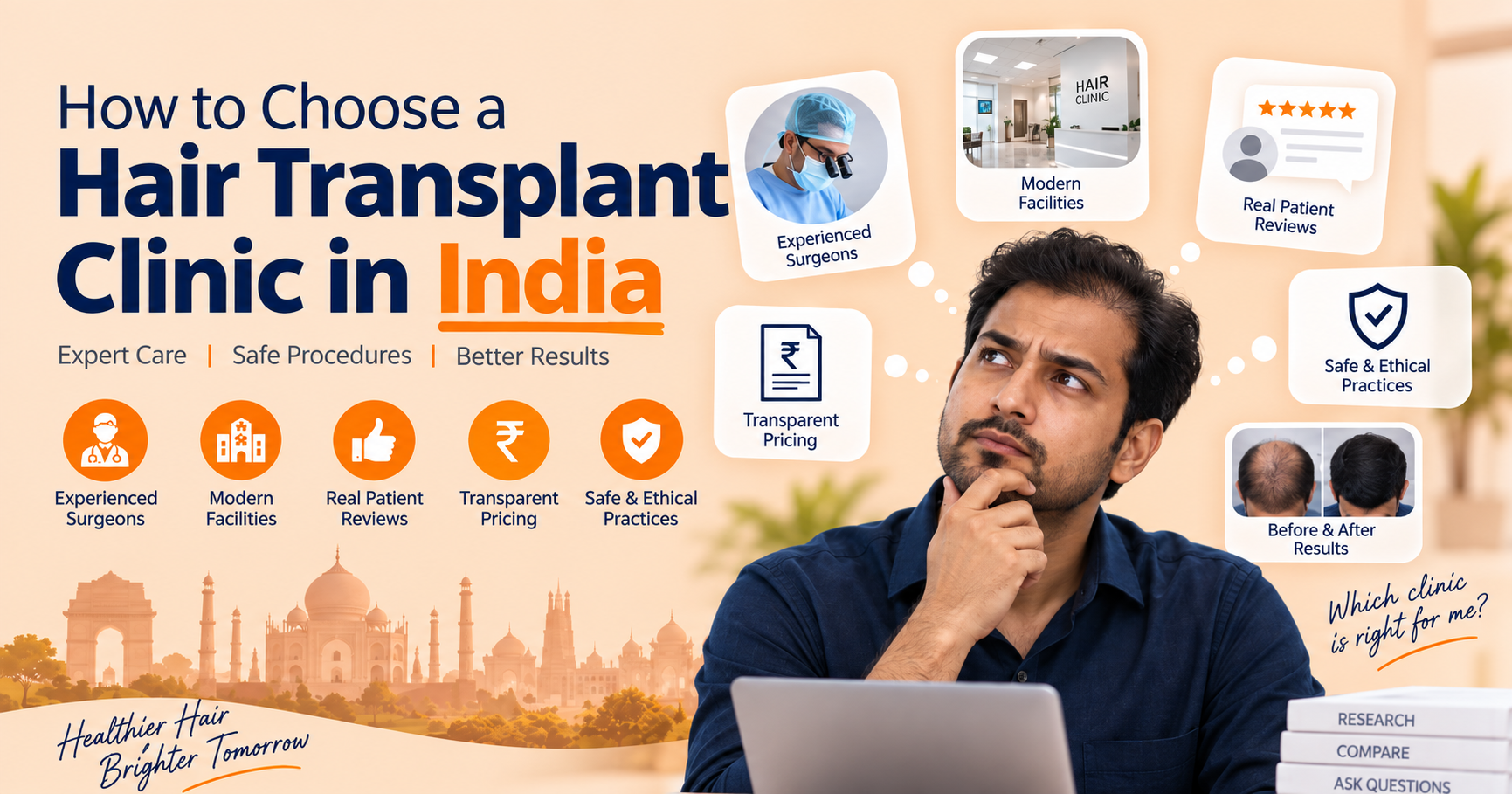
How to Choose a Hair Transplant Clinic?
Start with qualifications, not photographs: confirm the operating doctor’s registration on the National Medical Register and the State Medical Council, and check that their training matches National Medical Commission (NMC) guidance for hair transplantation.Ask who performs each stage of the procedure, then inspect the setup for sterile technique, anaesthesia monitoring, and emergency readiness.
A trustworthy consultation measures your donor density before naming a graft number, and a trustworthy quote itemises what is and is not included.Prefer a clinic that puts follow-up, an emergency contact, and a revision policy in writing, because aftercare is where accountability shows.
Why Choosing a Clinic Is a Medical Decision
Hair transplantation is a surgical procedure performed under local anaesthesia, so the clinic you choose affects safety as much as appearance. Serious complications reported in India have often been linked to inadequate training or unsuitable settings rather than to a particular technique.
The Delhi High Court has previously expressed concern about salons offering hair transplants without qualified medical supervision, and medical associations urge patients to verify a practitioner’s registration first. The stakes are lasting too: donor hair is finite, and a poorly planned session can use up grafts you cannot regrow.
Step 1: Verify Who Is Qualified to Operate
NMC guidance treats hair transplantation as an aesthetic surgical procedure for properly trained, registered medical practitioners. The NMC’s Ethics and Medical Registration Board has recommended MD/DNB Dermatology or MCh/DNB Plastic Surgery, with training in dermatological surgical procedures, for this work.
Guidance has come from more than one professional body, so verify the specific doctor who will operate on you, not the clinic’s brand.
A ten-minute verification routine
- Ask for the operating doctor’s full name and registration number, which should appear on their prescriptions and documents.
- Search that name or number on the NMC’s National Medical Register and on the relevant State Medical Council register, such as the Delhi Medical Council for clinics in Delhi or the Haryana Medical Council for Gurgaon.
- Confirm the postgraduate qualification claimed, the institution, and the year, and ask what hair-restoration training the doctor has completed.
- Check any society membership, such as the ISHRS, in the society’s own member directory rather than trusting a logo on a website.
Step 2: Who Actually Performs the Procedure?
Clinics generally follow one of three operating models, and the difference lies in who performs each stage and who is accountable for the result. Ask which model applies to you before comparing prices.
| Factor | Surgeon-led clinic | Technician-led, high-volume clinic | Salon or unlicensed outlet |
|---|---|---|---|
| Extraction and implantation | Surgeon designs the hairline and performs critical stages; assistants handle defined tasks | Technicians perform most extraction and implantation; surgeon plans or supervises | Often unqualified staff, no medical supervision |
| Consultation | Operating doctor, with donor assessment | Often counsellors, with brief doctor input | Sales-led; rarely medical |
| Pricing pattern | Quote follows the assessment | Package price, sometimes before assessment | Low headline price; inclusions unclear |
| Emergency readiness | Surgical-grade setup and protocols | Varies; ask specifically | Frequently absent |
| Accountability | A named, registered doctor is answerable | Responsibility can be diffuse | Difficult to establish |
These are typical patterns, not statements about any individual clinic. Trained technicians have a legitimate role in many well-run clinics; what matters is which steps they perform, under whose supervision, and whether you were told in advance.
Step 3: What a Safe Clinic Looks Like Inside
A hair transplant clinic should operate like a surgical facility, not a salon. If you can visit before booking, these are the details worth observing.
| What to look for | Why it matters |
|---|---|
| A dedicated, clean operating theatre with sterile instruments and sealed disposables | Infection control at both the donor and recipient sites |
| Vital-sign monitoring, such as a pulse oximeter, during the procedure | Early detection of reactions to anaesthesia or stress |
| Emergency equipment and staff trained to use it | Rare reactions need an immediate response |
| Pre-operative screening of history, allergies, medications, and relevant tests | Identifies patients for whom surgery is unsafe |
| Written consent covering risks, shock loss, and realistic timelines | Informed consent is a safety step, not paperwork |
Step 4: A Good Consultation and a Transparent Quote
A good consultation is a clinical assessment first and a price discussion second. Your donor density, scalp laxity, hair loss pattern, and medical history should be examined before anyone names a graft count or a fee.
What should happen in the room?
- Your scalp is examined under magnification, and your donor supply is measured rather than estimated from a photograph.
- The doctor explains how your hair loss may progress, how donor hair will be conserved, and what alternatives exist, including medical therapy or waiting.
How to read the quote
- It states the technique, the estimated graft range, and who will perform the procedure.
- It itemises tests, medicines, follow-up visits, and any touch-up policy, so nothing surfaces later as an extra charge.
- It does not hinge on a same-day booking; time pressure is a sales tactic, not a clinical need.
For pricing, see our hair transplant cost guides for Delhi and Gurgaon; for technique comparison, see “Best Hair Transplant: How to Choose the Right One.”
Step 5: Judging Results, Reviews, and Before-and-After Photos
Photographs and reviews are useful only when they can be verified and compared fairly. Treat them as prompts for better questions, not as proof of quality.
- Look for dated photographs at 12 months or later, taken in consistent lighting and angles, with the donor area shown.
- Ask whether the pictured patient had a similar hair loss grade and donor supply to yours.
- Prefer reviews that describe follow-up and recovery in detail over bare star ratings, and be cautious where reviews look incentivised.
Step 6: Aftercare and Accountability
Aftercare is where a clinic’s accountability becomes visible. Before booking, you should know exactly who to contact, how quickly, and what happens if recovery or results fall short of expectations.
- A written aftercare plan covering washing, sleeping position, activity limits, and what each medicine is for.
- Scheduled follow-up through the first year, because results mature over 12 to 18 months.
- An emergency contact that works outside clinic hours.
- A written revision policy stating what qualifies, within what period, and at what cost.
- Remote follow-up, with milestone photographs reviewed by the doctor, if you live outside the city.
- Experience with corrective work: a surgeon who repairs other clinics’ results has seen how procedures fail.
Step 7: Your Pre-Booking Scorecard
Put these eight questions to every clinic on your shortlist. Strong answers are specific and verifiable; weak answers are vague, deflecting, or sales-led.
| Question | Strong answer | Weak answer |
|---|---|---|
| Who will operate on me, and what is their registration number? | A named doctor with a number you can verify | “Our team” or “our doctors” |
| Which steps will the surgeon personally perform? | A specific list that includes hairline design and critical stages | “The team handles everything” |
| How did you calculate my graft number? | From measured donor density and area of loss | Estimated from a photo or quoted before any assessment |
| What if I lose more hair later? | A long-term plan that conserves donor hair | No mention of progression |
| What does the quote include? | An itemised list covering tests, medicines, and follow-up | A single package figure |
| What anaesthesia and emergency protocols do you follow? | Clearly described and doctor-supervised | Not explained, or “it’s very safe” |
| Can I see 12-month results from similar cases? | Dated, consistent photos with donor area shown | Only recent or heavily styled images |
| What is your revision and follow-up policy? | Written, with timelines | Verbal reassurance only |
How Satya Approaches This Decision
We would rather you ask us the hard questions above than choose on trust alone. Our approach is summed up in one line: Less Medicine. Less Donor. Maximum Skill.
In practice, that means the lowest effective medication, conservative use of donor hair, and skill applied to planning as much as to surgery. We plan around the hair loss you may have in ten or twenty years, not only the area you want covered today, and we treat corrective cases where earlier procedures have fallen short.
Dr. Shaiil Gupta’s career experience
| 23+ years in hair restoration | 15,000+ transplants performed | 2,000+ corrective and repair cases | 80+ countries patients came from |
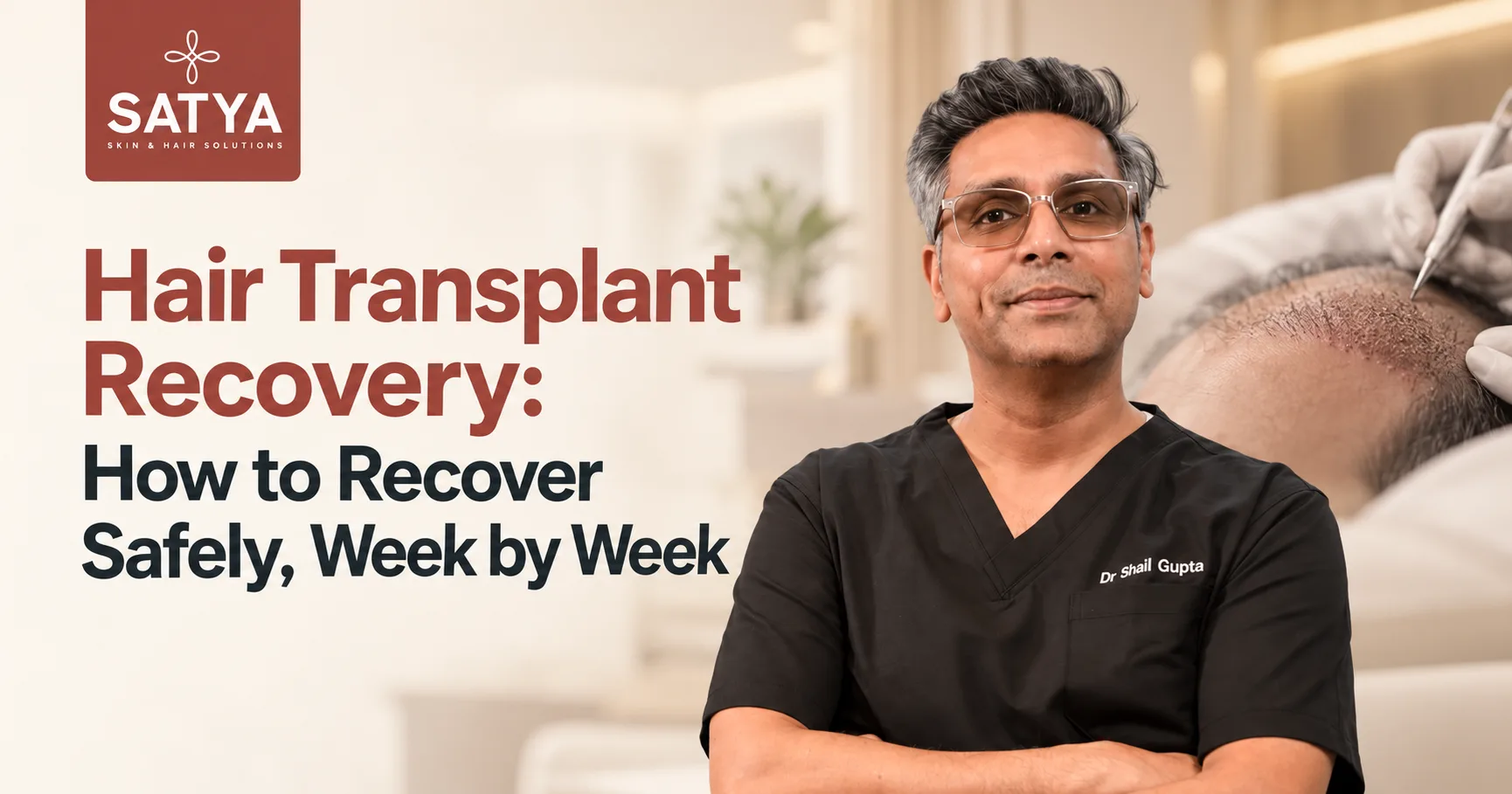
Dr. Shail Gupta, MBBS, MD (Dermatology), Lead Hair Transplant Surgeon
A clinic should be able to explain why it recommends fewer grafts as readily as why it recommends more. If every conversation ends at the largest possible number, ask what that number is protecting: your hair, or the invoice
Also Read: Best Hair Transplant Surgeon in Delhi
Frequently Asked Questions
Verify the operating doctor’s registration on the NMC’s National Medical Register and the State Medical Council, confirm the qualification, and ask who performs each stage. Reluctance to share registration details is a warning sign.
Who is qualified to perform a hair transplant in India?
NMC guidance reserves hair transplantation for properly trained, registered medical practitioners and recommends MD/DNB Dermatology or MCh/DNB Plastic Surgery with dermatological surgery training. Because guidance has come from more than one body, verify the specific doctor directly.
With a qualified doctor, a proper surgical setting, and appropriate screening, a hair transplant is generally considered a low-risk outpatient procedure under local anaesthesia, though no surgery is risk free. Risk rises with unsuitable candidates, poor monitoring or sterile technique, or an unqualified operator.
Not automatically, but a quote far below others deserves questions about who operates, what is excluded, and what follow-up is offered. Compare inclusions and accountability, not the headline figure.
Treat them as prompts for questions. Look for dated photographs at 12 months or later with consistent lighting and the donor area shown. Neither replaces verifying credentials.
Use the eight-question scorecard in Step 7: who operates and their registration number, which steps the surgeon performs, how your graft number was calculated, and what the quote, safety protocols, and revision policy cover.
Distance matters less than accountability. Travel can be reasonable for the right surgeon, provided there is a written follow-up plan, remote photo reviews, and clarity on whom to contact if a complication occurs.
Reviewed By
Dr. Shail Gupta, MBBS, MD (Dermatology), Lead Hair Transplant Surgeon, and Dr. Ruchi Agarwal, Dermatologist and Co-founder, Satya Skin & Hair Solutions.
A Clinical Next Step, Not a Sales One
If you are shortlisting clinics, bring the scorecard above to your consultation and use it with us too. Satya Skin & Hair Solutions offers evidence-based consultations with Dr. Shaiil Gupta in Gurgaon (DLF Phase 4, Galleria Market) and Delhi (Pitampura), including remote assessments for patients outside Delhi NCR.Schedule an evidence-based consultation: [schedule an evidence-based consultation]. Call the clinic: [+919971064917]