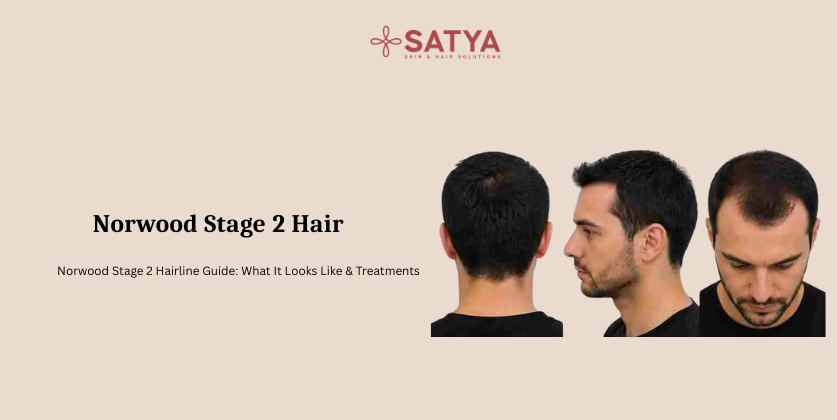
If you have noticed a slight but unmistakable recession at your temples a hairline that is beginning to form a subtle M or V shape there is a reasonable chance you are at Norwood Stage 2. On the seven-point Hamilton-Norwood scale, Norwood Stage 2 represents the earliest identifiable sign of male-pattern hair loss: minimal recession, no crown involvement, but a clear departure from the flat juvenile hairline. The good news is that Norwood Stage 2 is also the stage at which intervention is most effective and most straightforward.
This guide prepared by the clinical team at Satya Skin & Hair Solutions explains what Stage 2 actually means, how it is identified, and what treatment options are appropriate at this point in the progression.
Understanding the Norwood Scale: Where Stage 2 Sits
The Hamilton-Norwood scale, first described by Dr. James Hamilton and later refined by Dr. O’ Tar Norwood, remains the most widely used classification system for male androgenetic alopecia. It divides hair loss progression into seven stages, with Stage 1 representing a fully intact hairline and Stage 7 representing near-total loss of hair on the scalp crown and frontal region.
Norwood Stage 2: sometimes referred to as Norwood Class 2 in clinical literature sits at the very beginning of visible loss. It is characterised by slight recession at the temples, typically symmetrical on both sides, without any thinning at the crown. The recession at this stage is measurable but mild, and many patients are unaware they have crossed the threshold from Stage 1 until a dermatologist or hair transplant specialist points it out.
Below is a comparative overview of the Norwood stages to contextualise where Stage 2 stands:
| Norwood Stage | Key Visual Sign | Recommended Action |
| Stage 1 | No recession; intact juvenile hairline | Observation; preventive care if family history exists |
| Stage 2 | Slight recession at temples; M or V shape begins | Medical therapy; transplant evaluation if progressing |
| Stage 3 | Deeper temporal recession; hairline clearly affected | Medical therapy + transplant assessment |
| Stage 4 | Pronounced crown thinning begins | Combination approach usually indicated |
| Stage 5–7 | Extensive loss; crown and frontal merged | Larger graft sessions; donor management critical |
What Does Norwood Stage 2 Look Like?
The defining visual characteristic of Norwood Stage 2 is bilateral temporal recession meaning the hairline has begun to pull back at both temples simultaneously. The central hairline typically remains intact or close to intact, which is why the overall pattern often resembles a shallow M or a V shape when viewed from above.
At this stage:
- The recession is usually less than two centimetres back from the original juvenile hairline
- The crown and vertex remain unaffected
- Hair density in the frontal and mid-scalp regions is generally preserved
- In natural lighting, the recession may be subtle and easy to overlook
Many patients at Norwood Stage 2 notice the recession most clearly when their hair is wet or styled back. Photographs taken over months or years are often more revealing than any single observation, which is why clinical documentation at each consultation is essential.
What Causes Hair Loss at Norwood Stage 2?
The Role of DHT and Androgenetic Alopecia
Norwood Stage 2 hair loss is almost invariably androgenetic in origin. The underlying mechanism involves dihydrotestosterone (DHT), a derivative of testosterone, which binds to androgen receptors in genetically susceptible hair follicles at the temples and crown. Over time, this binding causes progressive miniaturisation of the follicle the hair shaft becomes progressively finer and shorter until the follicle eventually ceases to produce terminal hair.
The genetic predisposition to androgenetic alopecia can be inherited from either parent. Men with a first-degree family history of male-pattern hair loss are at significantly higher risk of progression, and early-onset recession such as that seen at Norwood Stage 2 in a 25-year-old often indicates a more aggressive overall trajectory if left untreated.
Is Norwood Stage 2 Permanent?
Without treatment, Norwood Stage 2 will, in the majority of cases, progress. The rate of progression varies considerably between individuals some men advance through the stages rapidly over a few years; others remain relatively stable at Stage 2 for a decade or more. However, the underlying mechanism of follicular miniaturisation does not reverse on its own.
This is precisely why Norwood Stage 2 is the ideal moment to seek a professional evaluation. At this stage, the donor zone is fully intact, the recession is limited, and the treatment options both medical and surgical are at their most effective.
| Clinical note from Dr. Shaiil Gupta, Hair Transplant Surgeon, Satya Skin & Hair Solutions: “Norwood Stage 2 is the stage we call the ‘window of opportunity.’ The follicles are still present, the donor zone is untouched, and medical therapy can genuinely slow or halt progression in a significant proportion of patients. Those who wait until Stage 4 or 5 lose that window. Early evaluation is never premature it is simply good judgement.” |
Treatment Options at Norwood Stage 2
1. Medical (Non-Surgical) Therapy
For most patients at Norwood Stage 2, the first line of management is medical, not surgical. Two treatments have strong, peer-reviewed evidence supporting their efficacy in androgenetic alopecia:
- Minoxidil (topical or oral): A vasodilator that prolongs the anagen (growth) phase of the hair cycle. Applied to the scalp or taken orally under medical supervision, it has demonstrated efficacy in slowing miniaturisation and, in some cases, improving density.
- Finasteride or Dutasteride: Oral 5-alpha-reductase inhibitors that reduce systemic DHT levels, thereby reducing the stimulus for follicular miniaturisation at the temples and crown. These are prescription medications and must be used under physician guidance.
At Satya Skin & Hair Solutions, Dr. Ruchi Agarwal leads the dermatological evaluation for all patients presenting with early-stage hair loss. Her approach is to establish a baseline using trichoscopy and scalp analysis before recommending any medical protocol, ensuring the treatment is evidence-based and appropriate for the individual patient’s profile.
2. Norwood Stage 2 Hair Transplant: Is It the Right Time?
A Norwood Stage 2 hair transplant is not the default recommendation, but it is a valid and increasingly common option particularly when the patient is in their late twenties or thirties, the hairline recession is visible and aesthetically concerning, and medical therapy has either not been pursued or has shown limited effect.
The decision to proceed with a transplant at Stage 2 requires careful planning for two primary reasons:
- Future progression: A 28-year-old at Stage 2 today may reach Stage 4 or 5 by their forties. The transplant plan must account for this, ensuring the design does not create an unnatural appearance as the surrounding native hair continues to thin.
- Donor management: The donor zone is finite. At Satya, our philosophy ‘Less Medicine. Less Donor. Maximum Skill.’ reflects a commitment to conservative, intelligent graft usage that preserves options for the future.
Dr. Shail Gupta and his team use the clinic’s proprietary DSFT (Direct Stimulated Follicular Transplant) technique and the Mimic Nature Hairline principle to design hairlines that are aesthetically natural, age-appropriate, and built to remain coherent as the patient ages. The Maximum Harvesting Technique (MHT) ensures that graft yield is maximised while donor integrity is protected.
Norwood Stage 2 vs. Stage 3: Why Early Action Matters
The clinical difference between Stage 2 and Stage 3 may appear minor in photographs, but it is significant in terms of treatment planning. At Stage 3, temporal recession deepens and the frontal hairline is more substantially affected. The number of grafts required to restore a natural frontal frame increases, the design becomes more complex, and the risk of an unnatural result if planning is inadequate rises.
Stage 2 is also the last stage at which medical therapy alone has a realistic chance of preserving the hairline without surgical augmentation. Beyond Stage 3, most patients who wish to restore their original hairline will require a transplant regardless.
Also Read: Norwood Stage 1
What to Expect at a Satya Consultation for Norwood Stage 2
Patients presenting at our Gurgaon or Delhi clinics with early-stage hair loss receive a structured evaluation that includes:
- Clinical history and family hair loss pattern assessment
- Trichoscopic scalp analysis to evaluate follicular miniaturisation and density
- Baseline photographic documentation for longitudinal comparison
- Hormonal and nutritional blood panel where indicated
- A personalised treatment roadmap medical, surgical, or a phased combination
There is no obligation to proceed with any treatment at the first consultation. Our role is to provide an honest, evidence-based assessment so that patients can make an informed decision with complete information.
Frequently Asked Questions
Is Norwood Stage 2 the beginning of permanent hair loss?
Not necessarily. Stage 2 shows early recession, but without intervention the progression can continue. Early medical treatment often slows or halts further loss effectively.
Do I need a hair transplant at Norwood Stage 2?
A transplant is rarely the first step at Stage 2. Most patients benefit initially from non-surgical treatments. A transplant is considered if the hairline continues to recede despite medical therapy.
What is Norwood Class 2 is it different from Stage 2?
No. ‘Norwood Class 2’ and ‘Norwood Stage 2’ refer to the same classification. Both terms describe early bilateral temporal recession on the Hamilton-Norwood scale.
Can a hair transplant fix Norwood Stage 2 hair loss?
Yes, a carefully planned Norwood Stage 2 hair transplant can restore a natural-looking hairline. At Satya, Dr. Shaiil Gupta uses the DSFT technique and the Mimic Nature Hairline principle to achieve aesthetically precise, permanent results.
Graft requirements are individual and depend on hairline design, density goals, and donor availability. A formal assessment at our clinic provides an accurate graft estimate. Attempting to predict this without examination risks inaccurate planning.
Onset varies, but bilateral temporal recession at Stage 2 is commonly observed in men between their mid-twenties and mid-thirties. Early-onset cases in the early twenties require careful monitoring before any surgical decision.
The Norwood scale was originally designed for male-pattern hair loss. Women with androgenetic alopecia tend to show diffuse thinning rather than temporal recession and are assessed using the Ludwig scale. Dr. Ruchi Agarwal at Satya specialises in female hair loss evaluation.