For many young men facing the early stages of frontal hair loss, the mirror can become a source of daily stress. Recognizing that your hairline is steadily shifting back often prompts a hasty search for immediate, high-density fixes. However, a truly successful hair restoration journey is measured by a fundamental clinical benchmark: the best hair transplant is the one that nobody ever notices.
In accordance with modern search framework guidelines, this expert-led case analysis moves away from superficial marketing promises to look directly at real-world clinical decision-making. At Satya Skin & Hair Solutions, our founder Dr. Shail Gupta approaches hair design as a permanent, customized medical art form.
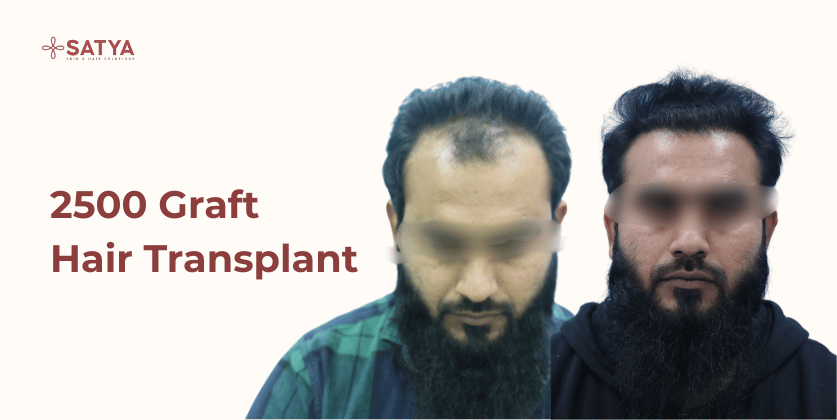
This educational guide explores the detailed patient journey of a 25-year-old individual facing frontal baldness. We will break down how a focused 2500 graft template, executed with advanced extraction technology and a strategic post-operative plan, achieved an age-appropriate, seamless result without relying on high-dose lifelong medications.
The Initial Consultation: Analyzing Frontal Baldness
When the patient first visited our Delhi NCR care center, he presented with a clear pattern of frontal recession. At 25 years old, the hair architecture is still dynamically changing, which makes long-term scalp mapping absolutely mandatory before selecting a clinical pathway.
Many low-cost commercial “hair mills” make the mistake of designing aggressively straight, low adolescent hairlines for young men. This short-sighted strategy exhausts thousands of precious hair roots early on, leaving the patient with an unnatural appearance and a depleted donor supply if genetic balding continues further back as they grow older.
Dr. Shail Gupta conducted a detailed trichoscopic scalp assessment to analyze the patient’s remaining donor hair density, look for active hair miniaturization, and determine his specific pattern boundaries. The primary goal was to construct a soft, feathered frame that would look completely natural at age 25 and continue to age gracefully with him into his 40s and 50s.
Designing the Frame: Why Graft Numbers Alone Don’t Determine Success
A common industry misconception is that a higher number of grafts automatically equals a superior cosmetic result. This perspective ignores the foundational rules of facial symmetry and hairline design.
The front hairline is a highly delicate transition zone. In nature, it consists entirely of fine, single-hair follicular units that exit the skin at sharp, acute angles. For this 25-year-old patient, a precise plan of 2500 grafts was selected. Rather than spreading these roots across an unrealistic surface area, Dr. Shail Gupta strategically allocated the units to create a natural gradient of density. Fine single hairs were meticulously placed at the front edge to soften the border, while stronger two-hair and three-hair units were packed immediately behind them to build deep structural volume.
The Surgical Execution: How DSFT Differs from Conventional FUE
To harvest and implant these 2500 grafts safely, our surgical team utilized the Direct Stimulated Follicular Transplant (DSFT) technique. DSFT is a highly refined, advanced version of the standard Follicular Unit Extraction (FUE) method, pioneered to maximize the survival rates of delicate hair roots.
[Conventional FUE] ---> Extended Out-of-Body Graft Storage ---> Higher Cellular Trauma Risk
[Advanced DSFT Technique] ---> Micro-Punch Extraction ---> Biostimulatory Enhancement ---> Immediate Strategic Implantation
During a conventional FUE session, harvested hair roots often spend hours outside the body in simple holding solutions, leaving them vulnerable to cellular trauma and dehydration. The DSFT technique solves this problem.
As individual follicular units are extracted using ultra-fine micro-punches, the grafts are immediately enhanced with specialized biostimulatory solutions. This specialized care keeps the hair roots healthy and strong, allowing them to adapt quickly and begin growing securely when precisely implanted into the recipient channels at their natural exit angles.
Post-Operative Management: The “More Skill, Less Pill” Philosophy
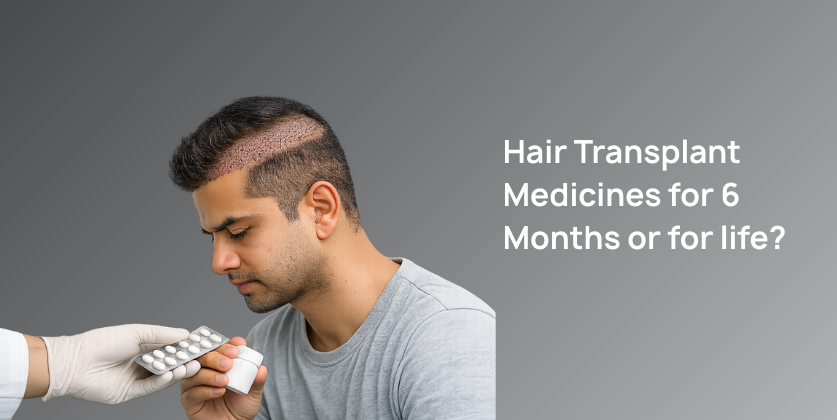
What truly sets this patient’s long-term result apart is our unique approach to post-operative medication. Many clinics rely on heavy, full-dose prescription medications indefinitely to mask poor surgical graft survival or force a thick appearance.
At Satya Skin & Hair Solutions, Dr. Shail Gupta operates on a strict medical philosophy: More Skill. Less Pill.
For this patient, we implemented a custom micro-dose medication plan rather than standard high-dose daily regimens. High-dose systemic treatments can sometimes push hair density to artificial levels early on, but they come with a higher risk of systemic side effects and can cause a rapid drop in coverage if the patient ever pauses their routine.
By relying on precise surgical placement, advanced DSFT technology, and careful donor management, we built a permanent hairline framework that maintains its natural fullness without making the patient’s long-term health dependent on heavy medication.
Navigating Environmental Variables in Delhi NCR
Recovering from a hair restoration procedure requires a customized approach to managing your local environment. For patients living in Gurgaon, Delhi, and the wider NCR area, the first ten days of healing are highly critical to graft survival. The extreme air pollution common in the region can introduce severe oxidative stress to a healing scalp, while the hard water prevalent across many residential sectors in Gurgaon can make the hair shaft brittle and irritate recovering tissue.
Our aftercare protocols are explicitly designed to address these North Indian environmental challenges. We provide specialized protective covers, sterile cleansing steps, and antioxidant solutions to keep your healing scalp safe and clean, ensuring your newly transplanted hair roots have the best possible environment to thrive.
Frequently Asked Questions (FAQs)
Direct Stimulated Follicular Transplant (DSFT) is an advanced version of FUE where harvested hair roots are treated with specialized biostimulatory solutions immediately after extraction. This custom step keeps the cells healthy and supports an exceptionally high graft survival rate.
A plan of 2500 grafts was ideal to completely fill the patient’s frontal baldness and reconstruct a natural hairline gradient. Choosing a targeted graft count allows us to deliver excellent density today while protecting his remaining donor hair reserves for the future.
Instead of prescribing standard high-dose medications indefinitely, our clinic utilizes a micro-dose routine tailored to your specific hair pattern. This balanced approach supports your hair growth while protecting your overall health and avoiding side effects.
Yes, a hair transplant is highly safe and effective at age 25, provided it is guided by a long-term plan. An expert surgeon will carefully place the grafts to ensure the hairline looks natural today and continues to age gracefully as the patient grows older.
Most patients can return to light office work within 3 to 5 days. The tiny circular micro-wounds in the donor zone close rapidly, and any minor redness or light scabbing along the new hairline typically clears away within 7 to 10 days.