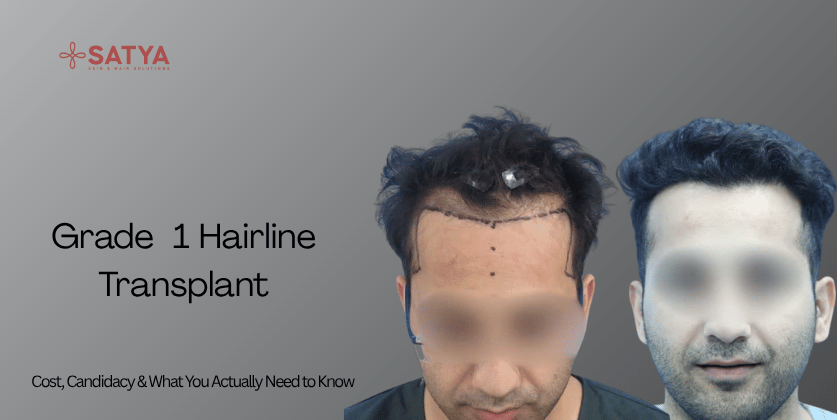
Before you read further: Clinically, “Grade 1” on the Norwood-Hamilton scale, the classification hair restoration surgeons use, means little to no visible hairline recession. Most people searching “Grade 1 hairline transplant” are actually asking about early-stage hair loss (Norwood 2–3), not true Grade 1. This guide explains the difference honestly, because it changes whether surgery is appropriate for you at all.
Grade 1 Hairline Transplant Cost
Cost for hairline-only transplant work in India typically ranges from ₹40,000 to ₹1,20,000, depending on graft count (usually 800–1,800 grafts for hairline and frontal work), technique, and surgeon involvement. However, this figure applies to genuinely early hair loss (Norwood 2–3), not true Norwood Grade 1, since a full, un-receded Grade 1 hairline is not typically a transplant candidate at all. A personalised scalp assessment is the only way to know which category applies to you, and what, if anything, a procedure would cost.
| Grafts Needed | Typical Cost Range in India |
|---|---|
| 800 – 1,200 (hairline definition only) | ₹40,000 – ₹80,000 |
| 1,300 – 1,800 (hairline + frontal) | ₹70,000 – ₹1,20,000 |
These are indicative Delhi NCR market ranges, not a Satya price list, and assume you are an appropriate candidate to begin with.
What Does “Grade 1” Actually Mean?
On the Norwood-Hamilton scale, the standard clinical tool for grading male pattern hair loss, Grade 1 describes a full, un-receded hairline with normal density, essentially the baseline before any pattern hair loss has started. It is not a stage of hair loss requiring treatment; it is the reference point every other grade is measured against.
Genuine early intervention candidates are almost always Norwood Grade 2 or 3: minor temple recession, a slightly higher hairline, or early thinning at the frontal tuft. This is very likely what most people typing “Grade 1 hairline transplant” are actually experiencing or concerned about, and it is a meaningfully different clinical picture from true Grade 1.
Who Actually Needs a Hairline Transplant at This Stage?
A hair transplant is generally not recommended for true Norwood Grade 1. Surgically harvesting donor grafts for a hairline that has not meaningfully receded means spending a finite, non-renewable resource, your donor supply, before it is clinically needed. If your hair loss progresses later, as it often does with androgenetic alopecia, you may need that donor capacity for a more advanced stage and no longer have it.
Early-stage candidates (Norwood 2–3) may be reasonable candidates when:
- Recession has been stable for at least 12–24 months, not actively progressing month to month.
- The pattern is confirmed as androgenetic alopecia via trichoscopic evaluation, not a temporary or reversible cause of hair thinning.
- Medical management (minoxidil, finasteride/dutasteride where appropriate) has been discussed, since these can slow or stabilize early loss without surgery for some patients.
- The patient understands this is an elective, donor-spending decision, not a medical necessity, and accepts the trade-off of using donor hair now versus preserving it for later.
If you have true Grade 1 hair, the honest answer is usually: monitor, don’t operate. We would rather tell you that than take you into surgery unnecessarily.
Grade 1 Hairline Transplant Before and After: What Photos Actually Show
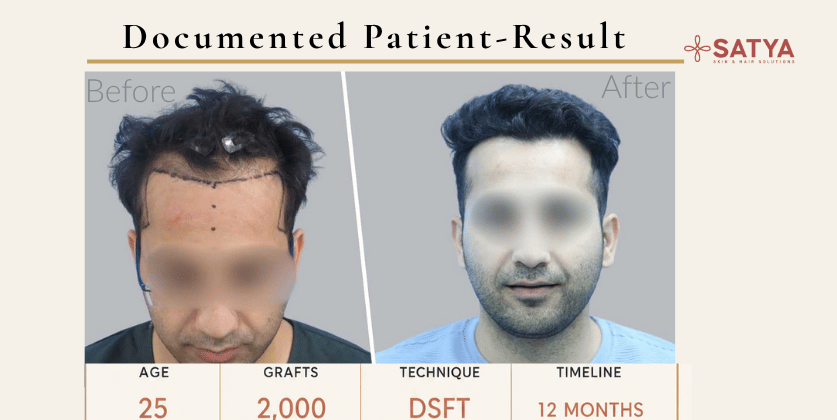
Before-and-after galleries labelled “Grade 1 hairline transplant” almost always show patients who started at Norwood 2 or 3, not true Grade 1, since operating on an unreceded hairline is rarely done and rarely photographed for a reason. When evaluating any before-and-after set:
- Check whether the “before” photo shows actual recession or thinning, not simply a hairline the patient found cosmetically undesirable.
- Ask how long after surgery the “after” photo was taken; hair transplant results take months to mature, not weeks.
- A single photo pair does not tell you about that patient’s donor planning, graft survival, or whether their case matches your hair loss pattern.
Documented Outcomes at Satya
We only publish patient results with documented, informed consent, and we do not use stock or non-clinic photography to represent outcomes.
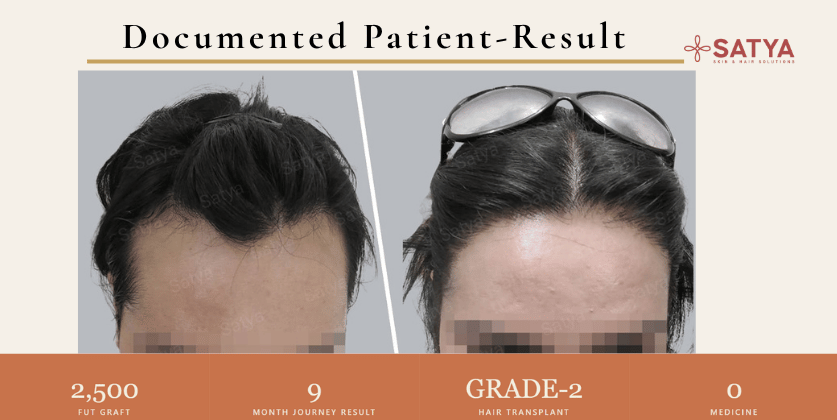
If you would like to see documented outcomes relevant to your specific hair loss pattern before deciding on anything, we can share appropriate case examples during an in-person consultation.
Also Visit- Hair Transplant Results
Grade 1 Hairline Transplant Results: Realistic Timelines
For patients who are appropriate early-stage (Norwood 2–3) candidates, not true Grade 1:
| Timeframe | What to Expect |
|---|---|
| Weeks 2–4 | Transplanted hairs typically shed (expected “shock loss,” not failure) |
| Months 3–4 | New growth begins to emerge |
| Months 6–9 | Progressive density gain |
| Months 9–12 | Results mature; final hairline density and pattern visible |
Results vary from person to person, and no responsible clinic can guarantee a specific density or timeline. Early-stage transplants also do not stop the progression of hair loss elsewhere on the scalp, ongoing medical management is usually still relevant.
The Procedure, Briefly
For confirmed early-stage candidates, the process follows standard FUE or FUT technique: donor extraction, careful hairline design matched to facial proportions and age-appropriate positioning, and graft implantation, typically completed in a single day session under local anaesthesia. Because graft counts are lower at this stage (800–1,800), procedure time is generally shorter than for more advanced cases.
Risks, Including the One Specific to This Stage
Standard transplant risks apply (infection, minor scarring, temporary swelling), but the risk we consider most relevant to “Grade 1” or very early hairline surgery is donor overspending: using grafts on a hairline that had not meaningfully receded, only to need more donor hair later as natural pattern loss continues, with a reduced remaining supply. Premature surgery is also one of the more commonly cited patient regrets in hair restoration literature, precisely because early results can look artificial as the surrounding native hairline continues to change with age.
What Actually Drives Cost
- Graft count, based on actual recession confirmed at assessment, not a fixed hairline package.
- Technique (FUT vs. FUE vs. DHI), each with different per-graft rates.
- Surgeon involvement, since hairline design at this stage requires particular judgment on density and shape.
- Medicines and follow-up, often bundled inconsistently across clinics.
Where Satya Stands
We do not perform hairline transplants on true Norwood Grade 1 hair. Our donor-preservation philosophy means we would rather assess your case, tell you that monitoring or medical management is the appropriate step now, and preserve your donor capacity for if and when you actually need it. When a patient is a genuine early-stage (Norwood 2–3) candidate, we plan conservatively, matching graft count and hairline design to long-term goals, not to what maximizes a single invoice.
Frequently Asked Questions
Technically, yes, some clinics will operate on minimally receded hairlines, but it is not something we or most responsible hair restoration surgeons recommend, since true Grade 1 hair has not experienced meaningful pattern loss.
If graft counts are similar to early hairline work, costs in India typically range from ₹40,000 to ₹1,20,000, but cost is not the right first question if you are not actually a suitable candidate for surgery.
Only a trichoscopic scalp assessment can confirm this accurately. Self-assessment from photos or online grading charts is frequently inaccurate.
Depends on individual suitability. Stable, confirmed early recession combined with realistic expectations may support an early procedure; active, unconfirmed, or minimal recession usually does not.
The Cost of an Uninformed Decision Is Higher Than a Consultation
Hair loss is progressive, and donor hair does not grow back once used. Deciding based only on an online price, without knowing whether you are truly Grade 1 or an early surgical candidate, risks either an unnecessary procedure or a missed window for effective non-surgical management.
Don’t choose a treatment based only on an online price. Get your individual hair-loss condition assessed and receive a personalised treatment recommendation and cost estimate before deciding anything. Schedule your evidence-based consultation with our dermatology and hair restoration team at Satya Skin & Hair Solutions, Gurgaon & Delhi. Results vary from person to person, and any recommendation is based on your scalp assessment, not a generic hairline package.