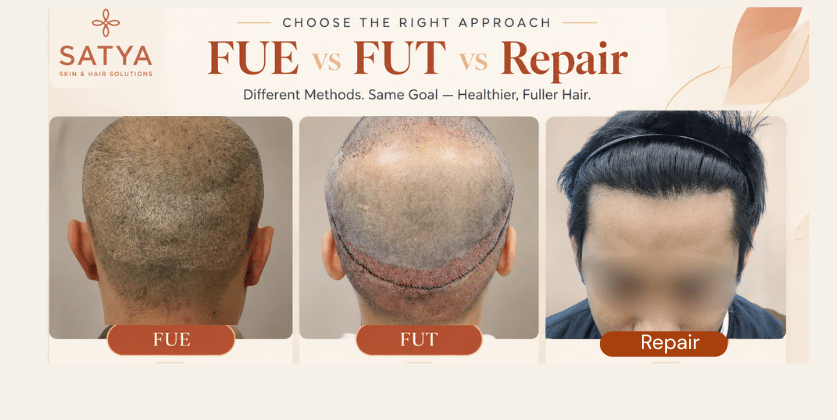
To judge hair transplant results fairly, first separate what the transplant did from what medication did, since medicine often thickens existing hair and can make a result look better than the surgery alone. Then check four things: timing (12 months minimum for the hairline, up to 18 months for the crown), the hairline (soft, irregular, single-hair grafts at the front, natural angles), density proportionate to the area, and the donor area (no thinning for FUE, a fine scar for FUT). Repair results are judged differently: against the starting problem and the donor hair left, not against a first-time transplant. Results vary from person to person.
Why Judging a Hair Transplant Result Is Harder Than It Looks
Most people judge a hair transplant the way they judge a photo: does the “after” look fuller than the “before”? That question misses almost everything that matters. A result that looks full can still be a poor result if the hairline will look wrong in ten years, if the donor area has been overharvested, or if most of the visible improvement came from medication rather than surgery.
A result that looks modest can be an excellent one if it was planned around a limited donor supply and will age naturally. This guide gives you a practical framework for judging any result, your own or one in a clinic’s gallery, across FUE, FUT, and repair cases. To see documented examples, visit our hair transplant before-and-after results page.
Step 1: Separate the Transplant Result From the Medicine Result
This is the most important step, and the one most consultations skip.
Many patients take medication such as finasteride, dutasteride, or minoxidil before or after surgery. Medication does not create new follicles, but it can:
- Thicken existing, miniaturised native hair in areas that were never transplanted.
- Thicken the transplanted hair itself and the native hair between grafts.
- Slow or stabilise ongoing hair loss, so the overall picture looks better over time.
So when a photo shows improvement in the mid-scalp or crown where no grafts were placed, that improvement came from medicine, not surgery. And in the transplanted zone, some of the visible thickness may also be medication working alongside the grafts.
How to tell the difference in photos
- Look at non-transplanted areas. If they have visibly improved, medication is contributing.
- Ask whether medication, PRP, or GFC was used, from when, and at what dose.
- Compare the transplanted zone with surrounding native hair. If both have thickened equally, part of the result is not from the grafts.
Why this matters for your graft count
Medication and grafts are linked in planning. When medication is effective and tolerated, fewer grafts may be needed to reach the same visual goal, which preserves donor hair for the future. When no medication is used, more grafts may be needed, and continued native hair loss can change the result over time.
This is a trade-off, not a rule. Medication has its own considerations, including side effects in some people, and suitability varies. At Satya, we follow a MIN-MED™ approach: the lowest effective dose for your case, discussed openly alongside the graft plan rather than added afterwards.
Dr. Shail Gupta, Surgical Note: “If your consultation does not discuss medication dose and graft number together, an important part of your planning is missing. You should pay for surgical skill, and you should know which part of your result that skill actually produced.”
Step 2: Check the Timing Before You Judge Anything
A result can only be judged when it has matured.
| Time After Surgery | What You Can Fairly Judge |
|---|---|
| Up to 3 months | Healing only; transplanted hairs usually shed in weeks 2 to 4 |
| 4 to 6 months | Early growth; too soon to judge density |
| 6 to 9 months | Hairline design and angles become visible |
| 12 months | Hairline result can be judged |
| 12 to 18 months | Crown result can be judged |
If you are judging your own procedure at 5 months and feel disappointed, that is common and usually premature. For the full growth sequence, read how long hair transplant results last.
Step 3: Judge the Recipient Area (Applies to FUE and FUT)
The recipient area, where grafts are placed, should be judged the same way whether the technique was FUE or FUT. The technique changes how grafts are harvested, not what a good hairline looks like.
The hairline
- Irregular, not straight. Natural hairlines have small zigzags and a soft transition zone.
- Single-hair grafts at the front edge, with two and three-hair grafts behind them.
- Age-appropriate height. A hairline that suits you at 25 must still suit you at 50.
- Temples framed naturally, not squared off.
Angle and direction
- Hair at the front should grow forward and low to the scalp.
- The crown should follow a natural swirl.
- Hair that sticks straight up or points in mixed directions suggests poor angle control.
Density and blending
- Density should be proportionate to the area and your donor supply, not maximised.
- Transplanted hair should blend with native hair in texture and caliber.
- There should be no visible gaps, rows, or “cornrow” patterns.
Step 4: Judge the Donor Area (Where FUE and FUT Differ)
The donor area is where FUE and FUT results genuinely differ, and where many poor outcomes hide.
Judging an FUE donor area
- Even extraction spread across the safe donor zone.
- No see-through patches or “moth-eaten” thinning at the back and sides.
- Small, dot-like marks that are not visible at a normal hair length.
- Red flag: thinning in the donor area, which suggests overharvesting. Donor hair does not grow back.
Judging an FUT donor area
- A single fine, flat scar, concealed by surrounding hair at a reasonable length.
- Healthy density above and below the scar.
- Red flag: a wide or stretched scar, often from excessive strip width or tension.
Just to make it easier to understand:-
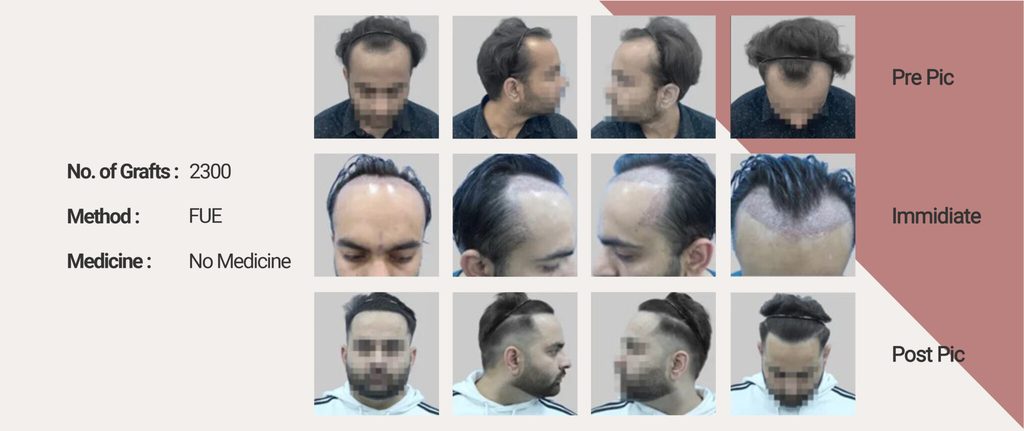
We are sharing some cases of our patients.
Case 1:
- Patient Profile: Grade 3 frontal thinning, age 28.
- Hair Loss: Stable or very slow (No medication initiated).
- Treatment: 2300 grafts by the DSFT method, without medication or PRP sessions.
- Hair Loss: Stable or very slow (No medication initiated).
For more case studies. Visit our Hair Transplant Result Page
FUE vs FUT: What to Check
| What to Check | FUE | FUT |
|---|---|---|
| Hairline quality | Same standard for both | Same standard for both |
| Donor appearance | Spread of small dot-like marks | One linear scar |
| Main donor red flag | Overharvesting and patchy thinning | Wide or stretched scar |
| Short haircut at back | Usually better concealed | Scar may show at very short lengths |
| Remaining donor for future | Depends on how much was extracted | Area outside the strip often remains untouched |
Neither technique is better for every patient. A good surgeon chooses based on your donor characteristics, scalp laxity, and hairstyle preferences.
Step 5: Judge Repair Results Differently
A repair (corrective) hair transplant cannot be judged against a first-time procedure. The surgeon is working with a problem someone else created, and usually with less donor hair.
Judge repair results against these questions
- Was the original problem corrected? For example, a pluggy hairline softened, a hairline raised or reshaped, or wrong angles hidden.
- Does it look natural now, even if density is modest? In repair, natural matters more than full.
- How much donor was used, and how much is left? A repair that uses the last of the donor supply may create future limitations.
- Were scars camouflaged or improved where that was part of the plan?
What repair realistically can and cannot do
Repair may involve removing or redistributing badly placed grafts, adding single-hair grafts to soften a hairline, or improving donor scars. It cannot create new donor hair. If a previous procedure has exhausted the donor supply, the honest goal may be improvement rather than full restoration.
Dr. Shail Gupta, Surgical Note: “In repair, the best result is often the one that stops drawing attention. Patients who come to us after a previous procedure rarely want more hair as much as they want hair that nobody notices.”
Your Hair Transplant Result Scorecard
Use this to judge your own result or any case you are shown.
| Question | FUE | FUT | Repair |
|---|---|---|---|
| Is the photo at least 12 months post-op? | Required | Required | Required |
| Was medication or PRP used, and is it disclosed? | Required | Required | Required |
| Does the hairline look natural up close? | Yes | Yes | Yes, even if less dense |
| Are angles and direction natural? | Yes | Yes | Improved from before |
| Is the donor area shown? | Check for thinning | Check scar width | Check remaining supply |
| Does the result suit your future hair loss pattern? | Yes | Yes | Yes |
Signs a Hair Transplant Result May Need Attention
Contact your surgeon if, after 12 to 18 months:
- Growth in the transplanted area remains patchy or very thin.
- The hairline looks unnatural, pluggy, or too straight.
- Hair grows at clearly wrong angles.
- The donor area shows visible thinning or a widened scar.
- Native hair around the transplant is thinning quickly, making the result look unbalanced.
Some of these can be addressed with medical management, a touch-up procedure, or repair, depending on the cause and the donor hair available.
Questions to Ask Before You Trust Any Result
- When was each “after” photo taken?
- How many grafts were used, and with what technique?
- Was medication, PRP, or GFC used, from when, and at what dose?
- Can I see the donor area for the same patient?
- Which improvement came from the transplant, and which came from medicine?
- How many grafts would I need with and without medication?
- How much donor hair would remain for the future after my plan?
If these questions are not answered clearly, you cannot fully trust the result you are being shown.
Where Satya Stands
We believe a result should be understood, not just admired. Every case we present discloses graft count, technique, timing, and whether medication was used, so you can see what the surgery achieved. We plan grafts and medication together, using the lowest effective dose, and treat donor hair as a finite resource that must serve you over decades. Our DSFT™ protocol focuses on careful graft handling, which directly affects how many grafts survive. Results vary from person to person, and every plan starts with a documented donor assessment.
Frequently Asked Questions
Judge it at 12 months for the hairline and up to 18 months for the crown. A successful result shows a natural hairline, correct angles, proportionate density, and a healthy donor area. Also consider how much of the improvement came from medication rather than the grafts.
Look at areas where no grafts were placed. Improvement there comes from medication. Ask your clinic what medication was used and at what dose, since medicine can also thicken transplanted and surrounding native hair.
The recipient area can look equally natural with either technique. The difference is in the donor area: FUE leaves small dot-like marks, while FUT leaves a fine linear scar. The right choice depends on your donor characteristics.
Common signs include very thin or patchy growth after 12 to 18 months, a pluggy or unnaturally straight hairline, hair growing at wrong angles, and visible thinning or a wide scar in the donor area.
Against the original problem and the donor hair available. A good repair result looks natural and no longer draws attention, even if density is more modest than a first-time procedure.
When medication is effective and tolerated, it can stabilise and thicken native hair, so fewer grafts may be needed for the same visual goal. This depends on your hair loss pattern, response, and suitability, and should be discussed together with the graft plan.
Before 12 months, most concerns are premature. After 12 to 18 months, patchy growth, unnatural hairline design, or donor thinning should be discussed with your surgeon.
An Evidence-Based Next Step
Whether you are planning a first procedure, questioning a result you already have, or considering repair, the answer depends on your donor supply, your hair loss pattern, and what medication can realistically contribute. If you would like an honest assessment, including which part of any result comes from surgery and which from medicine, schedule an evidence-based consultation with our hair restoration team at Satya Skin & Hair Solutions, Gurgaon & Delhi, or call +919971064917. Results vary from person to person.