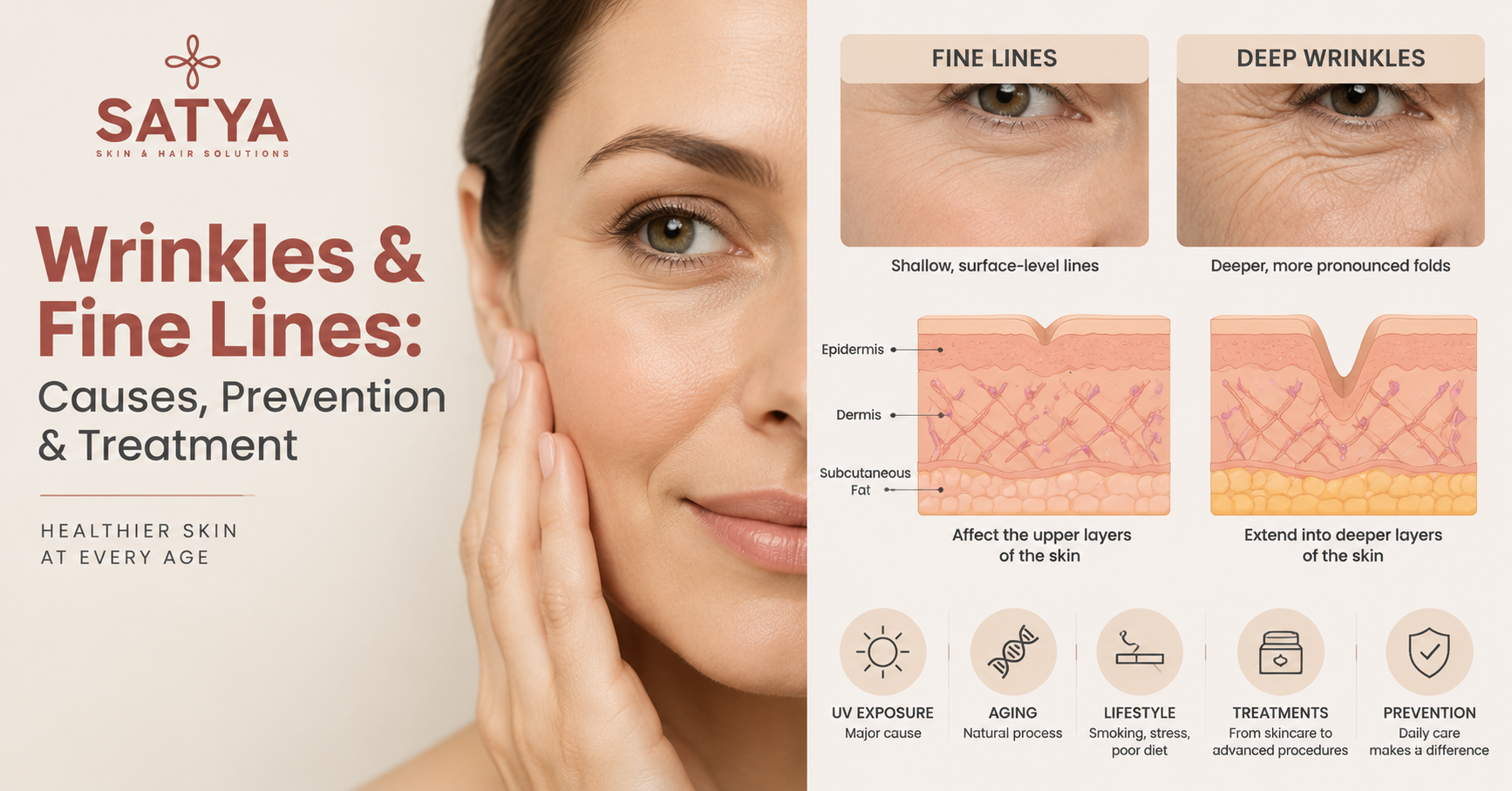
Wrinkles and fine lines form when the skin’s structural proteins (collagen and elastin) decline and the skin’s support layers thin with age, a process sped up significantly by sun exposure, smoking, pollution, and repeated facial movement. Fine lines are shallow and often visible only with expression or dehydration; wrinkles are deeper creases that remain at rest. Prevention rests on daily broad-spectrum sunscreen and a topical retinoid, both backed by clinical evidence. Treatment depends on the type of line: dynamic lines from muscle movement respond to botulinum toxin, while static wrinkles and texture loss respond to collagen-stimulating therapies such as lasers, microneedling, or fillers. Results vary from person to person, and the right choice requires a skin assessment.
The Myth We Hear Most Often: “Wrinkles Are Simply Age”
Many patients tell us wrinkles are inevitable, so there is little point doing anything until they appear. The first half of that statement is partly true. The second half is not.
Dermatology separates skin ageing into two processes:
- Intrinsic ageing: the genetically programmed, gradual slowing of cell renewal and collagen production. This produces fine, even lines and thinner skin over decades, and it is largely outside our control.
- Extrinsic ageing (photoageing): damage driven by the environment, primarily ultraviolet (UV) radiation, along with smoking and pollution. This produces coarse wrinkles, uneven texture, and pigmentation, and it is largely preventable.
The practical point is this: a significant share of the visible lines on an adult face are not “age” in the biological sense. They are accumulated environmental damage, and that portion can be slowed, and in part improved.
Fine Lines vs. Wrinkles: What Is the Difference?
Patients often use the two terms interchangeably, but the distinction matters clinically because it changes what treatment is appropriate.
| Feature | Fine Lines | Wrinkles |
|---|---|---|
| Depth | Superficial, within the upper skin layers | Deeper creases involving the dermis |
| Visibility at rest | Often visible only with expression or when skin is dry | Visible even when the face is relaxed |
| Common locations | Under the eyes, around the lips, forehead | Forehead, between the brows, nasolabial folds, crow’s feet |
| Typical onset | Late 20s to mid 30s | Mid 30s onward, earlier with heavy sun exposure or smoking |
| Main drivers | Dehydration, early collagen decline, repeated expressions | Cumulative collagen and elastin loss, sun damage, volume loss |
| Responds best to | Barrier care, retinoids, superficial resurfacing | Neuromodulators, collagen stimulation, fillers, deeper resurfacing |
Dermatologists further classify wrinkles into two types:
- Dynamic wrinkles form with muscle movement, such as frowning or squinting, and fade when the face relaxes (in the early stages).
- Static wrinkles remain visible at rest. Many begin as dynamic lines that, after years of repeated folding over weakening collagen, become etched in.
The Mechanism: What Happens Inside Ageing Skin
To understand why some treatments work and others are marketing, it helps to understand what is happening beneath the surface.
Collagen and Elastin Decline
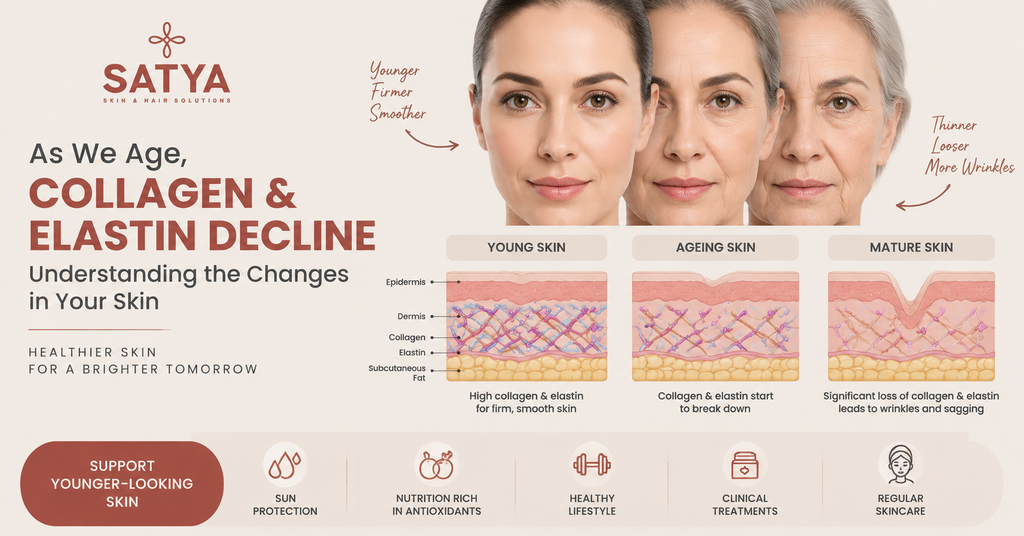
The dermis, the skin’s middle layer, is built largely from collagen (which provides strength and firmness) and elastin (which allows skin to spring back). From early adulthood, collagen production gradually slows; a decline of around 1% per year is a commonly cited estimate. Think of it as the steel reinforcement in a building slowly thinning while the walls above it stay the same weight. The surface begins to fold.
UV Damage Accelerates the Breakdown
UVA rays penetrate deep into the dermis, generate reactive oxygen species (free radicals), and activate enzymes called matrix metalloproteinases (MMPs), which actively break down existing collagen. At the same time, UV exposure suppresses new collagen formation. The skin is therefore losing collagen faster and replacing it more slowly.
Glycation
Excess sugar in the bloodstream binds to collagen fibres, forming advanced glycation end products (AGEs). These make collagen stiff and brittle, reducing the skin’s ability to repair itself. This is one reason metabolic health and skin ageing are more connected than most people assume.
Loss of Hydration and Support
Hyaluronic acid and other water-binding molecules in the dermis decline with age, so skin holds less moisture and looks less plump. Beneath the skin, facial fat pads shrink and shift, and facial bone gradually remodels. Some “wrinkles,” particularly the deepening folds from the nose to the mouth, are partly a consequence of this lost structural support rather than a surface problem alone.
Dr. Ruchi Agarwal’s clinical note:
“When a patient points to a line, my first question is not ‘what can we inject?’ but ‘why is this line here?’ A fold caused by volume loss, a crease caused by muscle movement, and crepiness caused by sun damage look similar in a mirror, but they need completely different approaches. Treating the wrong cause is how people end up with an overdone face and an unsolved problem.”
What Causes Wrinkles and Fine Lines?
1. Sun Exposure
UV radiation is the single largest modifiable cause of premature skin ageing. The damage is cumulative and largely silent: it occurs on cloudy days, through car windows (UVA passes through standard glass), and during short, everyday exposures, not only on beach holidays.
2. Smoking
Tobacco smoke reduces blood flow to the skin, depletes vitamin C, and increases collagen-degrading enzymes. The repeated pursing of the lips also contributes to vertical lines around the mouth, commonly called smoker’s lines.
3. Air Pollution
For patients in Delhi NCR, this factor deserves specific attention. Research has associated exposure to traffic-related particulate matter with more pigment spots and more pronounced facial folds. Pollutants generate oxidative stress in the skin in a way that adds to UV damage rather than replacing it.
4. Repeated Facial Expressions
Frowning, squinting, and raising the eyebrows fold the skin along the same lines thousands of times a year. Over time, as collagen weakens, these dynamic lines become static.
5. Sleep Position and Sleep Quality
Consistently sleeping on one side of the face can produce sleep lines that do not follow expression patterns. Separately, chronic sleep deprivation is associated with impaired skin barrier recovery.
6. Dehydration and Barrier Damage
Many early “fine lines,” particularly under the eyes, are dehydration lines rather than true structural wrinkles. Over-cleansing, harsh scrubs, and layering too many active ingredients damage the skin barrier and make these lines more visible. They often improve substantially once the barrier is repaired.
7. Diet, Glucose, and Metabolic Health
Diets high in refined sugar contribute to glycation. Rapid or significant weight loss can also make wrinkles appear more pronounced by reducing facial volume.
8. Genetics and Skin Type
Genetics influence collagen density, skin thickness, and how quickly visible ageing appears.
How Indian Skin Ages Differently
Most anti-ageing content online is written around fair, European skin types. That creates real problems for Indian patients.
- Indian skin (typically Fitzpatrick types III to V) has more melanin, which offers some natural protection against UV. Photoageing in Indian skin therefore often shows up first as pigmentation, uneven tone, and dullness, with deep wrinkling appearing later than in fairer skin.
- The trade-off is a higher risk of post-inflammatory hyperpigmentation (PIH). Aggressive peels, lasers, and resurfacing treatments that are routine for fair skin can leave dark patches on Indian skin if settings, depth, and pre-treatment preparation are not adjusted.
- Wrinkles and pigmentation often need to be treated together, since treating lines while ignoring pigment (or triggering new pigment) does not produce a healthy-looking result.
This is why treatment protocols copied directly from Western sources, or from salons without dermatological oversight, are a common cause of the complications we are asked to correct.
How to Prevent Wrinkles and Fine Lines
Prevention is where the evidence is strongest, and the cost is lowest.
Daily Broad-Spectrum Sunscreen
This is the most important anti-ageing step, and it is supported by direct clinical evidence. In a randomised controlled trial of 903 adults published in the Annals of Internal Medicine (Hughes et al., 2013), participants who applied sunscreen daily showed no detectable increase in skin ageing over four and a half years, and skin ageing was 24% less than in those who used sunscreen only occasionally.
Practical guidance:
- Use a broad-spectrum sunscreen of SPF 30 or higher, with good UVA protection, every morning, including indoors near windows and on cloudy days.
- Apply an adequate amount. Most people apply far less than the quantity used in SPF testing; the “two-finger” guide (two finger-lengths for the face and neck) is a useful reference.
- Reapply after sweating, swimming, or prolonged outdoor exposure.
- For melasma-prone skin, a tinted sunscreen containing iron oxides adds protection against visible light.
A Topical Retinoid
Retinoids (vitamin A derivatives) have the most robust evidence of any topical anti-ageing ingredient. They increase cell turnover, stimulate new collagen, and inhibit the enzymes that break collagen down.
- Tretinoin (prescription) has the strongest clinical evidence for treating photoageing.
- Retinol and retinal (over the counter) are gentler and convert to the active form in the skin, with more modest effects.
Retinoids commonly cause dryness, peeling, and irritation during the first 2 to 6 weeks. Starting slowly, a few nights a week, with a moisturiser, usually helps. Retinoids are not recommended during pregnancy or while trying to conceive.
Antioxidants
Topical vitamin C (L-ascorbic acid), used in the morning under sunscreen, helps neutralise free radicals from UV and pollution. It supports sunscreen; it does not replace it.
Barrier Care
A gentle cleanser and a moisturiser containing ceramides, glycerin, or hyaluronic acid keep the barrier intact and reduce dehydration lines. Barrier before brightening: an irritated barrier cannot tolerate the actives that actually build collagen.
Lifestyle Factors
- Stop smoking, the most impactful lifestyle change for skin ageing after sun protection.
- Prioritise consistent sleep, and consider sleeping on your back if you notice sleep lines.
- Limit refined sugar and maintain adequate protein intake, which supplies the building blocks for collagen.
- Wear sunglasses to reduce squinting.
Dr. Ruchi Agarwal’s clinical note:
“A patient who uses sunscreen every single day and a retinoid consistently for five years will usually look better than a patient who skips both and relies on procedures. Procedures can improve what has already happened. Daily habits decide what happens next.”
Treatment Options for Wrinkles and Fine Lines
Treatment should follow the cause and depth of the line, the patient’s skin type, and how much downtime they can accept. It is a ladder, not a menu.
Topical Prescription Treatment
For early fine lines and mild photoageing, prescription tretinoin, supervised by a dermatologist, may be all that is needed. Visible improvement in texture typically takes 3 to 6 months of consistent use.
Chemical Peels
Superficial to medium-depth peels (glycolic, lactic, TCA, or combination peels) remove damaged surface cells and stimulate modest collagen remodelling. They are best suited to fine lines, dullness, and pigmentation. For Indian skin, peel choice and depth must be conservative to limit PIH risk.
Microneedling and Radiofrequency (RF) Microneedling
Microneedling creates controlled micro-injuries that trigger the skin’s repair response and new collagen formation. RF microneedling (for example, Morpheus8) adds heat delivered at a set depth, which tightens collagen further. These are often well suited to Indian skin because they deliver energy below the surface pigment layer.
Fractional Laser Resurfacing
Fractional CO2 and other resurfacing lasers treat columns of skin while leaving surrounding tissue intact, driving significant collagen remodelling. They are among the most effective options for textural wrinkles and crepey skin, but carry meaningful downtime and a higher PIH risk in darker skin types, so settings and pre-treatment preparation matter.
Botulinum Toxin (Neuromodulators)
For dynamic lines (forehead lines, frown lines between the brows, crow’s feet), botulinum toxin temporarily relaxes the specific muscle creating the fold. It does not fill or “freeze” the whole face when correctly dosed; the aim is softened movement, not the absence of expression.
Dermal Fillers
Hyaluronic acid fillers restore volume where structural loss is the cause, such as deep nasolabial folds or hollowing that pulls the skin into creases. Fillers are a structural treatment, not a surface one, and are frequently overused. A filler placed to “erase” a line caused by something else tends to look unnatural.
Skin Boosters and Biostimulators
Skin boosters deliver fine hyaluronic acid into the skin to improve hydration and fine crepey lines. Biostimulators (such as polynucleotides and certain collagen-stimulating injectables) aim to improve skin quality gradually over months rather than fill a specific line.
HIFU and Skin Tightening Devices
High-Intensity Focused Ultrasound (HIFU) targets deeper supporting layers to encourage tightening. It is suited to mild laxity rather than fine surface lines, and results are gradual and modest.
Treatment Comparison
| Treatment | Best For | How It Works | Typical Downtime | When Results Appear | Typical Duration |
|---|---|---|---|---|---|
| Prescription retinoid | Fine lines, early photoageing | Increases cell turnover and collagen | None to mild peeling | 3 to 6 months | Ongoing with continued use |
| Chemical peel | Fine lines, dullness, pigmentation | Controlled surface exfoliation | 2 to 7 days, depending on depth | 2 to 6 weeks, improving over a course | Months, with maintenance |
| RF microneedling | Fine to moderate wrinkles, texture, mild laxity | Micro-injury plus heat stimulates collagen | 1 to 3 days of redness | 1 to 3 months, over a course | Often 1 year or more, with maintenance |
| Fractional CO2 laser | Moderate wrinkles, crepey texture | Ablative resurfacing and remodelling | 5 to 10 days | 1 to 3 months | Often years, varies with sun protection |
| Botulinum toxin | Dynamic expression lines | Temporarily relaxes targeted muscles | Minimal | 3 to 14 days | Typically 3 to 4 months |
| Hyaluronic acid filler | Volume-related folds and hollows | Restores lost structural volume | 1 to 3 days of possible swelling | Immediate, settling over 2 weeks | Typically 6 to 18 months, by product and area |
| Skin boosters | Fine crepey lines, dehydrated skin | Intradermal hydration | 1 to 2 days of small bumps | 2 to 4 weeks, over a course | Several months |
| HIFU | Mild laxity | Focused ultrasound heating of deeper layers | Minimal | 2 to 3 months | Often up to 1 year |
All figures above are typical, commonly cited ranges. Individual response depends on skin type, age, severity, and how well the skin is protected afterwards.
Who Is a Good Candidate, and Who Should Wait
Generally Suitable
- Adults with fine lines or wrinkles who have realistic expectations about gradual improvement.
- Patients willing to commit to daily sunscreen, since procedures without sun protection offer short-lived benefit.
- Patients with stable general health and no active skin infection in the treatment area.
Treatment Should Be Deferred or Modified
- Pregnancy and breastfeeding: retinoids, botulinum toxin, and most elective procedures are deferred.
- Recent oral isotretinoin use: many resurfacing procedures are postponed, and the timing should be discussed with your dermatologist.
- Active acne flares, cold sores, eczema, or infection in the treatment area.
- History of keloid scarring or significant PIH: energy-based and peel treatments need modified protocols or alternatives.
- Neuromuscular conditions or certain medications: relevant to botulinum toxin eligibility.
- Expectations of a dramatic change in one session, or of looking like a different person. Our goal is enhancement, not alteration.
Risks and Side Effects to Know Before Treatment
Every effective treatment carries some risk. We would rather you know them now than discover them afterwards.
- Retinoids: irritation, dryness, sun sensitivity.
- Peels and lasers: redness, prolonged swelling, infection, and, in Indian skin particularly, post-inflammatory hyperpigmentation. Rarely, scarring.
- Microneedling: temporary redness, pinpoint bleeding, and occasional breakouts.
- Botulinum toxin: bruising, headache, and, uncommonly, temporary eyelid or brow drooping if the product spreads to an unintended muscle.
- Fillers: swelling, bruising, lumps, and, rarely but seriously, vascular occlusion, which is why fillers should only be administered by a trained doctor who can recognise and manage it immediately.
Most side effects are temporary when treatment is performed by an experienced dermatologist with appropriate patient selection. None of these treatments is risk-free, and any clinic describing them that way is not giving you the full picture.
Realistic Timelines
| Timeframe | What to Expect |
|---|---|
| Weeks 1 to 6 | Retinoid adjustment period; skin may look worse (dry, flaky) before it looks better |
| Weeks 1 to 2 | Botulinum toxin effect develops; filler swelling settles |
| Months 1 to 3 | Collagen-stimulating treatments (lasers, RF microneedling) begin to show gradual improvement |
| Months 3 to 6 | Retinoid and procedure-driven collagen remodelling become more visible |
| Month 6 onward | Maintenance phase; sunscreen and topical care protect the result |
Collagen is rebuilt over months, not days. Treatments that promise instant, permanent reversal of wrinkles are not describing how skin biology works.
How We Approach Wrinkles at Satya
Our approach follows the same principle we apply across dermatology: diagnose before treating, and treat the cause rather than the symptom.
- Assessment first. We examine skin type, the pattern and depth of lines, pigmentation, barrier health, and volume changes before recommending anything.
- Barrier before brightening. Compromised skin is repaired first, since it tolerates active treatment poorly and pigments more easily.
- Less is more. We often begin with sun protection and a prescription topical, adding procedures only where they will make a meaningful difference.
- Combination, not escalation. Where procedures are appropriate, we combine modest, targeted treatments (for example, a neuromodulator for frown lines alongside collagen stimulation for texture) rather than using a single aggressive intervention.
- Protocols adjusted for Indian skin, to reduce the risk of post-inflammatory hyperpigmentation.
Dr. Ruchi Agarwal’s clinical note:
“The best compliment an anti-ageing treatment can receive is ‘you look rested,’ not ‘what have you had done?’ If a result draws attention to the treatment rather than the person, we have done too much.”
Frequently Asked Questions
Wrinkles result from a combination of natural collagen and elastin decline with age and environmental damage, of which UV exposure is the largest modifiable factor. Smoking, pollution, repeated facial expressions, and dehydration also contribute.
Fine lines commonly begin to appear from the late 20s to mid 30s, particularly around the eyes. Timing varies with genetics, skin type, and especially cumulative sun exposure.
Wrinkles can be significantly softened and skin quality improved, but no treatment permanently removes them or stops ageing. Most results require maintenance, and daily sun protection is essential to preserve them.
Daily broad-spectrum sunscreen and a topical retinoid have the strongest clinical evidence. Tretinoin, available on prescription, is the most studied retinoid for photoageing.
Adequate hydration supports overall health, but drinking extra water does not measurably reverse wrinkles. Dehydration lines on the skin surface respond better to barrier repair and topical moisturisers.
When administered by a qualified doctor at an appropriate dose, botulinum toxin has a well-established safety record for expression lines. Temporary side effects such as bruising or, uncommonly, brow drooping can occur, and it is not recommended during pregnancy or breastfeeding.
Laser and energy-based treatments can be used safely on Indian skin, but the risk of post-inflammatory hyperpigmentation is higher than in fair skin. Treatment choice, device settings, and pre-treatment skin preparation should be adjusted by an experienced dermatologist.
An Evidence-Based Next Step
Wrinkles are not a single problem with a single solution. The right approach depends on whether your lines come from sun damage, muscle movement, volume loss, or a compromised skin barrier, and on how your skin type responds to treatment. None of that can be determined from a mirror or an online quiz.
If you would like to understand what is driving the changes in your skin and which options, if any, are appropriate for you, schedule an evidence-based consultation with our dermatology team at Satya Skin & Hair Solutions, Gurgaon & Delhi, or call [+919999570494]. Results vary from person to person, and any recommendation you receive will be based on your skin assessment, not a standard package.