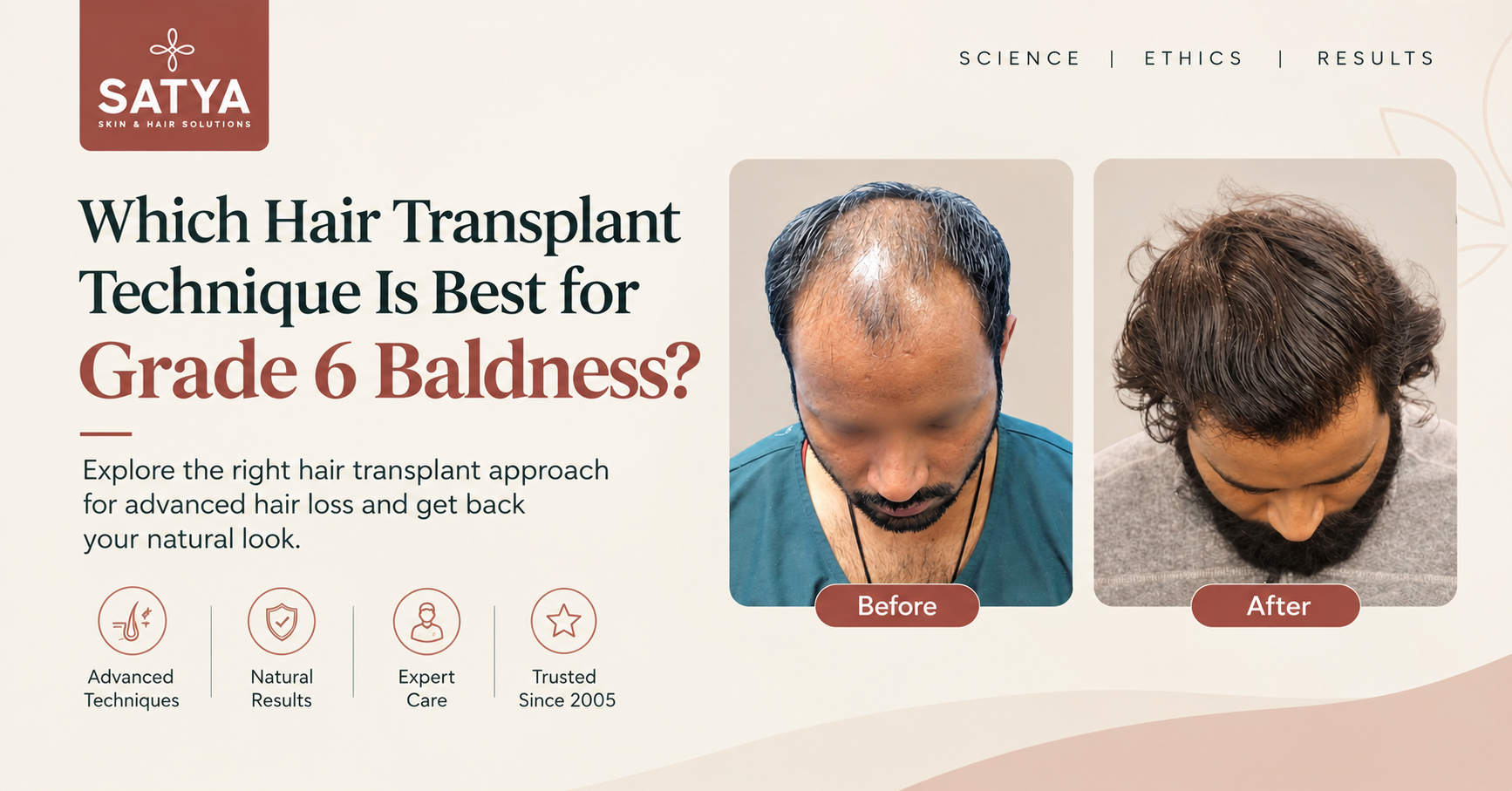
For Grade 6 (Norwood 6) baldness, most experienced surgeons recommend FUT (strip method), or a combination of FUT and FUE, because Grade 6 hair loss usually requires a high graft count (often 3,000–5,000+) that a single FUE session cannot always deliver without over-harvesting the donor area. FUE alone can still be an option for some patients, but it typically needs multiple sessions and a donor area assessment to confirm feasibility. The right choice depends on your donor density, scalp laxity, and long-term hair loss pattern, which is why Grade 6 cases should never be planned without an in-person scalp evaluation.
What Does Grade 6 Baldness Actually Mean?
Grade 6 on the Norwood-Hamilton Scale describes advanced male pattern baldness where the bald area on the crown and the receding frontal region have merged into one large zone, separated from the sides by only a band of hair. At this stage, hair loss is significant, and the amount of remaining donor hair (at the back and sides of the scalp) becomes the single biggest factor in what a transplant can realistically achieve.
This is important context before comparing techniques, at Grade 6, the limiting factor usually isn’t the surgeon’s skill, it’s donor supply.
Is FUT Better Than FUE for Advanced Baldness?
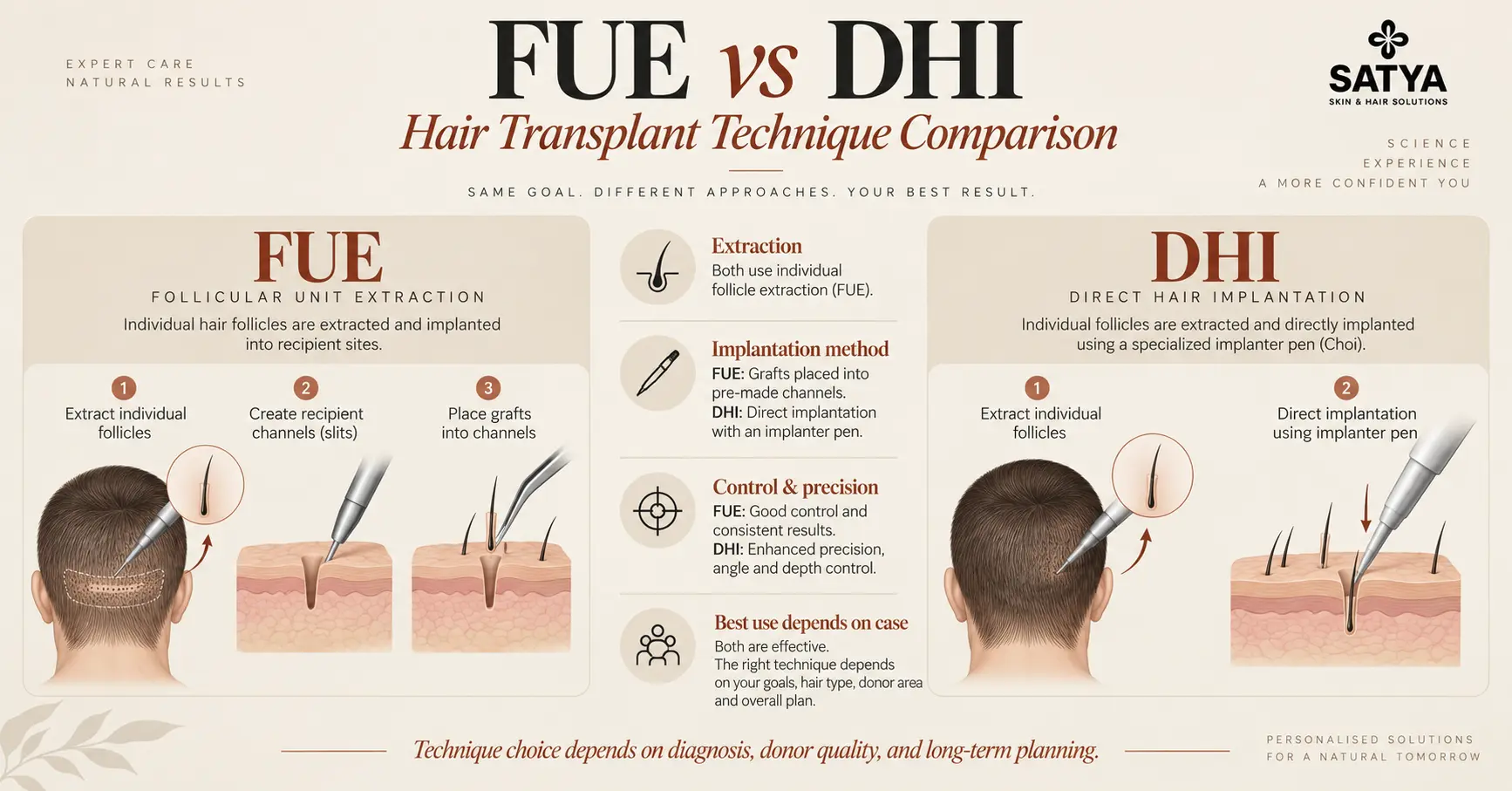
FUT tends to be more graft-efficient for large coverage areas, but “better” depends on your priorities.
| Factor | FUT (Strip Method) | FUE |
|---|---|---|
| Graft yield per session | Generally higher, can harvest 3,000 4,000+ grafts in one sitting | Lower per session; large numbers may need multiple sittings |
| Scarring | A thin linear scar at the back of the scalp | Tiny, scattered dot scars, less visible even with short hair |
| Recovery time | Longer; stitches/staples, more restricted activity initially | Generally shorter, less discomfort |
| Suitability for very short hairstyles | Linear scar can show with a buzz cut | Usually better concealed |
| Best suited for | Patients needing maximum grafts in one session (Grade 5–7) | Patients prioritising minimal scarring, or needing moderate graft numbers |
For Grade 6 baldness specifically, FUT is often favoured or combined with FUE because it can extract a larger, denser strip of donor tissue in a single procedure, which matters when you’re trying to cover a large bald area without depleting the donor zone. That said, FUE has improved significantly, and many surgeons now use a combination approach: FUT for bulk graft yield, followed by FUE in a later session to fine-tune density or the hairline.
Can FUE Alone Cover Grade 6 Baldness?
FUE can be used for Grade 6 baldness, but it comes with caveats:
- It usually requires multiple sessions rather than a single sitting
- Over-harvesting risk is higher, extracting too many grafts from a limited donor area in one go can thin out the donor zone and cause a patchy look
- Total achievable coverage is directly capped by your donor density, which needs to be measured, not estimated
Some patients specifically choose FUE despite these trade-offs because they want to keep their hair very short in the future and prefer to avoid a linear scar. This is a reasonable priority, but it should be a decision made with your surgeon after assessing your donor area, not before.
How Many Grafts Does Grade 6 Baldness Typically Need?
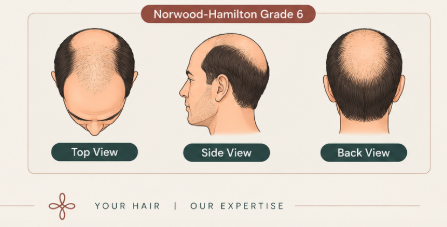
Published patient cases and clinical reports for Norwood 6 commonly cite graft counts in the range of roughly 2,800 to 5,000+ grafts, sometimes split across more than one session. However, this is a general range, not a prescription, your actual graft requirement depends on:
- The size of the bald area to be covered
- Your donor hair density (grafts per cm²)
- Whether you’re aiming for full density or a more conservative, natural-looking coverage
- Scalp laxity (how much the strip technique can safely harvest)
This is exactly where a “balanced hair transplant” approach, using the minimum effective graft count for a natural result rather than maximising numbers for visual impact, becomes especially relevant at advanced grades, where donor hair is a finite resource that needs to be planned for the long term, not just for one procedure.
Is a Hair Transplant Even Realistic at Grade 6?
For many patients, yes, but with managed expectations. At this stage, a hair transplant can meaningfully improve density and framing (particularly the frontal-to-mid-scalp region), but achieving full, youthful density across the entire crown and top of the scalp may not be realistic for everyone, simply due to donor limits. A qualified surgeon should be transparent about this during consultation rather than promising complete restoration.
It’s also worth noting that continued hair loss in non-transplanted areas can still occur after surgery, since pattern baldness is progressive. Many surgeons discuss medical management (like finasteride or minoxidil, where appropriate) alongside a transplant plan for Grade 6 patients, to help protect the results over time. Suitability for any medication depends on individual health assessment.
FAQs: Grade 6 Hair Transplant
Neither is universally “better” FUT generally allows a higher graft yield per session, which is often useful at Grade 6, while FUE offers less visible scarring. Many advanced cases use a combination of both.
If FUT was used, the linear donor scar may be visible with a very short buzz cut, depending on scar healing and hair density around it. FUE and combination approaches generally conceal better with short hairstyles.
Often not. Many Grade 6 cases require two sessions, either two FUT/FUE sessions, or an FUT session followed by FUE touch-ups, depending on donor availability and coverage goals.
It can, when planned around realistic density goals and a natural hairline design. Results vary based on donor characteristics, surgical technique, and individual healing, a consultation is needed to assess your specific case.
This requires a clinical scalp examination, sometimes with donor density measurement tools. It cannot be reliably estimated from photos alone.
How Satya Skin & Hair Care Approaches Grade 6 Cases
At advanced grades like Norwood 6, Dr. Shail Gupta’s clinic emphasises an honest, donor-first assessment before recommending FUT, FUE, or a combination approach, prioritising what the donor area can sustainably support over what maximises a single session’s visual result. This typically involves:
- A detailed donor density evaluation
- A transparent discussion of achievable coverage versus your expectations
- A staged plan (single or multi-session) based on what’s realistic for your scalp, not a fixed package
Also Visit: A grade 6 Hair Trasnsplant Result
If you’re at Grade 5, 6, or beyond and unsure which technique fits your case, the most reliable next step is an in-person or video consultation rather than relying on generic online graft estimates.