QUICK ANSWER
For advanced baldness (Norwood 5 to 7), neither FUT transplant surgery nor FUE hair transplant techniques used alone is consistently the better choice. FUT typically yields more usable grafts per session from the donor’s most permanent zone, while FUE avoids a linear scar but has a lower safe extraction ceiling per session. For patients who need very high total graft counts, many hair restoration surgeons, including at Satya, plan a combination of both techniques rather than committing to one exclusively. Suitability depends on an individual donor assessment, not a general preference for one method.
What Advanced Baldness Actually Requires From a Donor Area
Advanced baldness, generally Norwood 5 to 7 on the Norwood-Hamilton scale, involves extensive frontal, mid scalp and crown involvement. Restoring meaningful coverage across all three zones typically requires 3,500 to 6,000 or more grafts, sometimes across more than one session.
This is where advanced cases become a donor math problem as much as a technique choice. The typical donor area contains roughly 12,000 to 20,000 individual hair follicles, which commonly yields somewhere in the range of 3,000 to 5,000 safely harvestable grafts as a rough lifetime ceiling for most patients. Since hair cloning is not clinically available, this is a fixed, non-renewable resource that has to be planned around, not maximized in a single sitting.
This context matters before comparing FUT transplant surgery and FUE hair transplant techniques in isolation, because for advanced baldness the real question is not only which technique produces a better single result, but which approach uses this finite donor supply most efficiently over the course of a patient’s life.
FUT Transplant Surgery: Mechanism and Where It Still Matters at Scale
How FUT Works
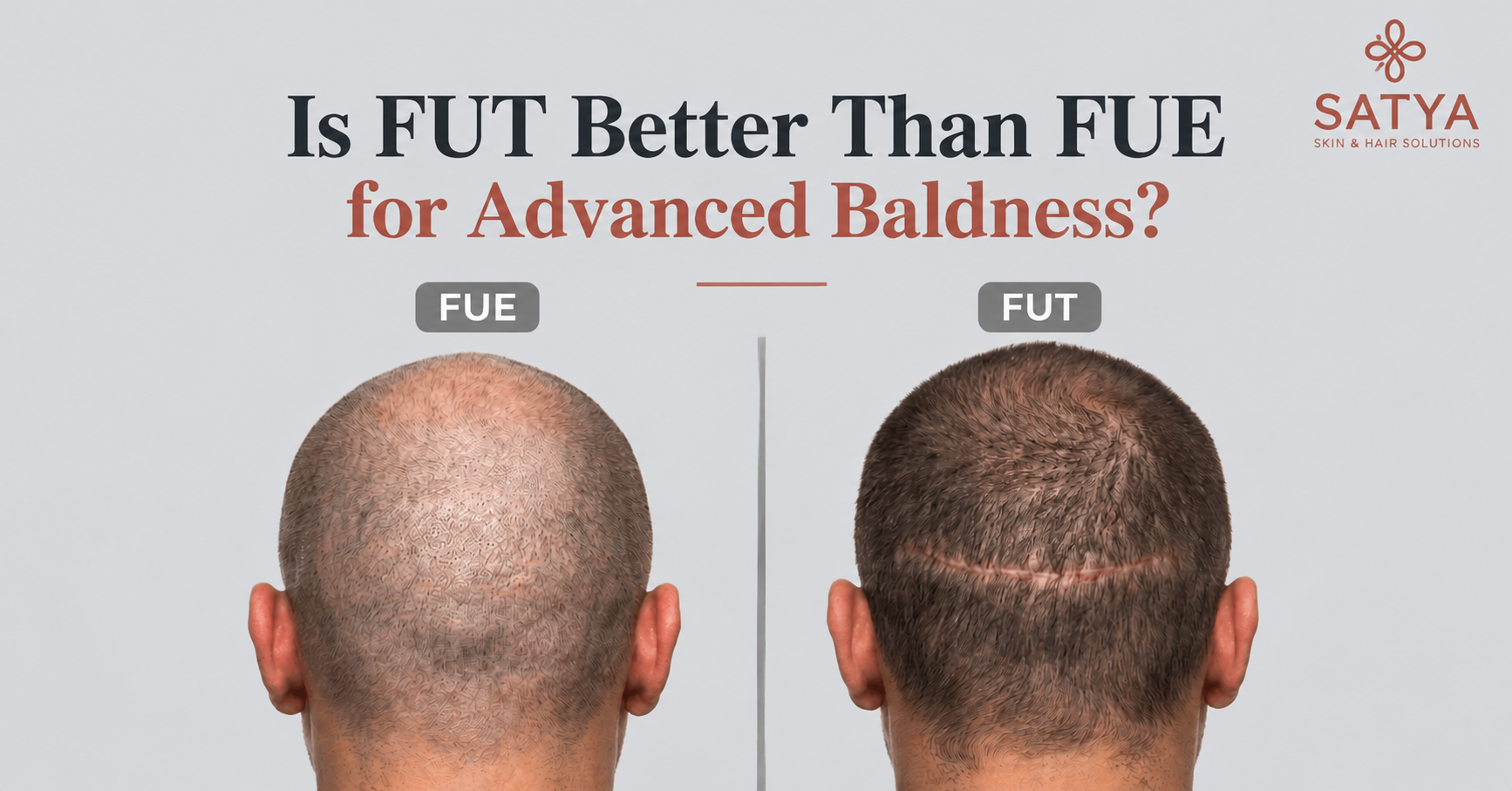
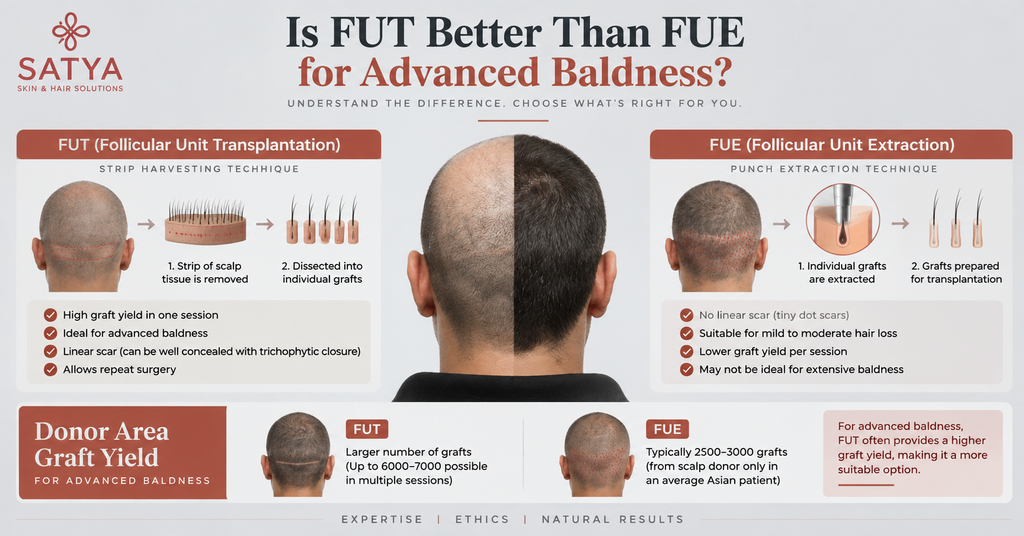
Follicular Unit Transplantation (FUT), sometimes called the strip method, removes a single strip of donor tissue from the mid portion of the scalp, generally the most genetically permanent zone. This strip is dissected under microscopic magnification into individual follicular unit grafts, and the donor site is closed, leaving one linear scar.
Where FUT Has a Genuine Advantage for High Graft Counts
- Harvests from the donor’s most permanent zone in a single pass, which commonly yields a higher usable graft count per session than FUE from an equivalent donor area.
- Grafts retain surrounding protective tissue during microscopic dissection, which is generally associated with lower transection (graft damage) rates.
- Dissection can run in parallel with strip removal, which typically makes FUT more time efficient for very large sessions.
- Produces one concentrated linear scar rather than scarring spread across the donor area, though how visible this is depends on hair length, styling preference and donor hair characteristics, and should be discussed individually rather than assumed.
DR. SHAIIL GUPTA ON GRAFT INTEGRITY AT SCALE
When a case genuinely needs 4,000 or more grafts, how much tissue survives handling matters as much as how many grafts are extracted. A strip that yields intact, well protected grafts in a single efficient pass is often a more reliable foundation for a large session than maximizing extraction speed alone.
FUE Hair Transplant Techniques: Mechanism and Their Ceiling at Scale
How FUE Works
Follicular Unit Excision (FUE) extracts individual follicular units one at a time using a small circular punch tool, without a linear incision. Each extraction leaves a tiny, dot-like scar, scattered across the donor area rather than concentrated in one line.
Where FUE’s Donor Math Becomes the Limiting Factor
- No linear scar is the technique’s clearest advantage, which matters most to patients who prefer wearing their hair very short.
- To match the graft yield FUT can achieve from the permanent zone, FUE commonly needs to draw from a meaningfully larger donor surface area, sometimes extending beyond the most permanent strip.
- Surgeons commonly limit a single FUE session to a fraction of total donor capacity to avoid visible thinning, which is why very large single sessions (4,000 or more grafts) are less routine with FUE alone.
- Because grafts are extracted individually, FUE is generally associated with a higher transection risk without meticulous technique, and larger sessions extend total procedure time, which increases the time grafts spend outside the body before implantation.
- Repeat FUE sessions add new extraction sites each time, so scarring can compound across multiple procedures in a way a single FUT scar line generally does not.
FUT vs FUE for Advanced Baldness: Head to Head
| Factor | FUT Transplant Surgery | FUE Hair Transplant Techniques |
|---|---|---|
| Typical yield per session | Generally higher, drawn from the donor’s most permanent strip | Generally lower ceiling per session at equivalent graft quality |
| Donor scarring | One linear scar, concentrated in a single zone | Multiple small scars spread across the donor area, which compounds with repeat sessions |
| Graft handling and survival | Grafts retain protective tissue during dissection, generally lower transection rates | Individually extracted, generally higher transection risk without meticulous technique |
| Procedure time for large sessions | Typically more time efficient at high volumes | Typically longer, sometimes staged across more than one day |
| Repeat sessions over time | A new strip generally replaces the prior scar line | Additional extraction sites are added each session |
| Best suited for | Patients prioritizing maximum yield per session who accept a linear donor scar | Patients prioritizing no linear scar, with realistic expectations about per session limits |
Why “Which Is Better” Is the Wrong Question for Advanced Baldness
Neither FUT transplant surgery nor FUE hair transplant techniques is a universal answer for advanced baldness. The right approach depends on donor density, scalp laxity, hair caliber, how many total grafts the case realistically requires, and how the patient weighs a linear scar against a longer procedure with a lower per session ceiling.
Treated as a donor planning decision rather than a brand preference, the more useful question becomes how to combine what each technique does well, which is the reasoning behind planning a combination approach for many advanced cases rather than defaulting to a single method for the entire plan.
Satya’s Balanced Hair Transplant™ Approach for Advanced Cases
DR. SHAIIL GUPTA ON BALANCED HAIR TRANSPLANT™
alanced Hair Transplant™ is our planning approach for cases where a single technique is unlikely to serve the patient well on its own. Rather than defaulting to FUT or FUE for an entire advanced case, we assess which donor zones and techniques best serve each part of the plan, and combine them deliberately. This is not offered to every patient. It is considered specifically when the donor assessment shows it would genuinely improve the outcome or protect future donor capacity.
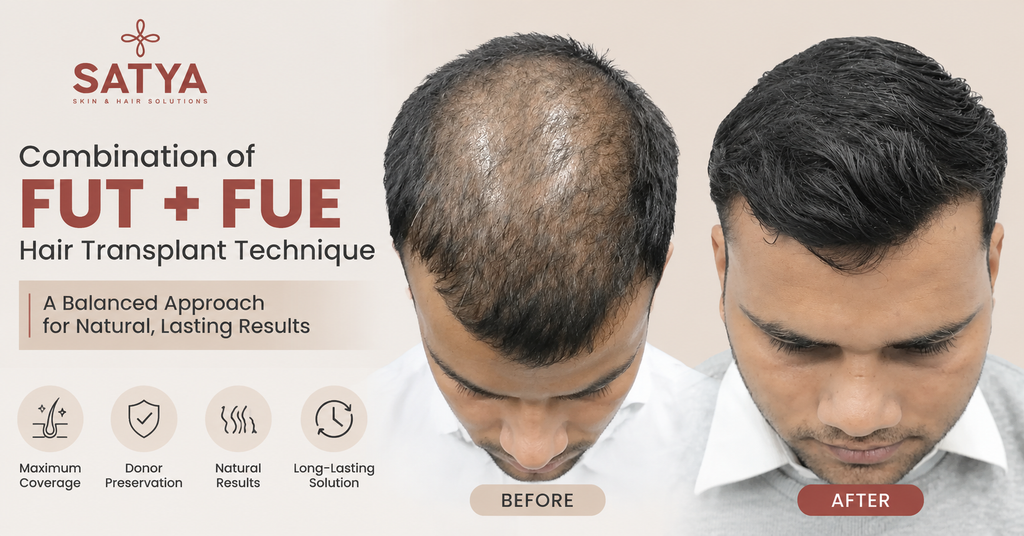
In practice, this can mean using FUT to harvest grafts efficiently from the permanent mid strip, then using FUE selectively to draw supplemental grafts from surrounding areas without placing additional tension on a single strip closure, preserving flexibility for a future touch up if the underlying pattern continues to progress. This planning principle is consistent with our MHT™ (Maximum Harvesting Technique) approach: the objective is maximizing usable graft yield while protecting long term donor capacity, not maximizing the number of grafts extracted in one session.
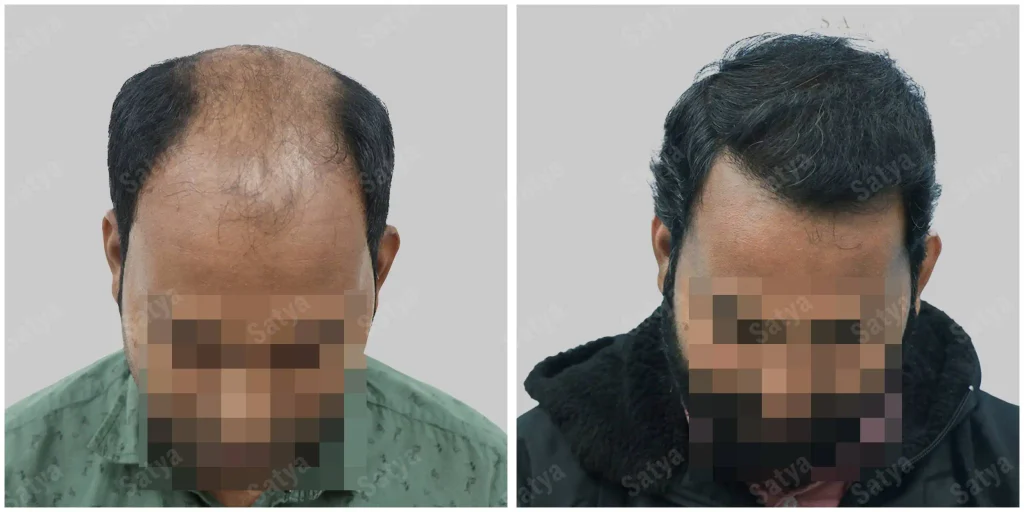
Not every advanced case needs a combination. Whether a Balanced Hair Transplant™ plan, FUT alone, or FUE alone is appropriate is determined individually after a donor assessment, not applied as a default recommendation.
DSFT™ and Why Graft Handling Matters More at High Volumes
Larger sessions mean more grafts collectively spend more time outside the body before implantation. Published data commonly cite graft survival in the range of 95 to 98 percent within roughly 2 hours of extraction, with survival declining as handling time extends, which is one reason graft handling protocol becomes more consequential, not less, as session size grows.
DR. SHAIIL GUPTA ON DSFT™
DSFT™ (Direct Storage Follicular Technology) is our protocol for minimizing how long grafts spend outside the body and reducing repeated tissue handling. It does not eliminate the underlying biology of ischemia. What it does is remove avoidable sources of handling time, which we consider particularly relevant in higher volume advanced cases where total handling time otherwise increases simply because there is more tissue to manage.
Who Is, and Is Not, a Suitable Candidate for a High Graft Count Plan
Generally Reasonable Candidates
- Confirmed advanced pattern hair loss with donor density and laxity sufficient to support a high graft count plan, verified through a donor assessment.
- Realistic expectations about staged sessions, since advanced baldness commonly requires more than one procedure regardless of technique.
- Willingness to discuss combination planning rather than requesting one technique by name without an assessment.
Cases That Need Further Discussion Before Proceeding
- Donor supply that is insufficient relative to the area of loss, where surgery may need to be scaled back or deferred.
- Active, unconfirmed, or rapidly progressing hair loss that has not been evaluated for non-androgenetic causes.
- Expectations of a single session achieving full, mature density, which is not how either technique behaves biologically.
- Scalp or health conditions that could affect wound healing, which should be reviewed individually.
Risks and Realistic Expectations for Advanced Cases
- Donor depletion risk if a donor area is overharvested early, reducing options for a future touch up as hair loss continues to progress.
- Standard surgical risks apply to both techniques, including infection, temporary numbness, and shock loss of existing native hair, alongside the scarring differences described above.
- Multiple sessions are common for advanced baldness regardless of technique chosen. This reflects donor planning, not a failed first procedure.
- Results mature over 12 to 18 months, with crown coverage typically taking longer than the frontal hairline. No responsible surgeon can guarantee a specific density or timeline.
| 3,000 to 5,000Typical lifetime harvestable graft ceiling for most patients (commonly cited range) | 95 to 98%Graft survival typically cited within about 2 hours outside the body | 12 to 18Months typically cited for results to fully mature, longer for crown coverage |
Frequently Asked Questions
Not universally. FUT transplant surgery generally yields more grafts per session from the donor’s most permanent zone, while FUE hair transplant techniques avoid a linear scar but have a lower safe per session ceiling. For many advanced cases, a combination approach serves the case better than either technique used alone.
Balanced Hair Transplant™ is Satya’s planning approach for cases where a single technique is unlikely to serve the patient well on its own. It combines FUT and FUEdeliberately across different parts of a case, based on an individual donor assessment, rather than defaulting to one method for the entire plan.
Norwood 5 to 7 cases commonly require 3,500 to 6,000 or more grafts to restore frontal, mid scalp and crown coverage, sometimes across more than one session. The exact number depends on donor capacity and desired density, confirmed only through an individual assessment.
FUE avoids the single linear scar associated with FUT, but it leaves multiple small scars spread across the donor area, and these can compound with repeat sessions. FUT concentrates scarring into one line, which a new strip generally replaces in a repeat procedure rather than adding to it.
Yes. Combining both techniques, sometimes within a single case, is a recognized approach for advanced baldness when a single method is unlikely to safely provide the total graft count required. This is assessed individually, not applied by default.
DSFT™ (Direct Storage Follicular Technology) is Satya’s protocol for minimizing how long grafts spend outside the body and reducing repeated handling. Since graft survival is linked to handling time, this becomes more relevant, not less, as the number of grafts in a session increases.
Most patients see meaningful density within 6 to 9 months, with full maturation, especially crown coverage, typically taking 12 to 18 months. Results vary from person to person, and no clinic can responsibly guarantee a specific timeline or density.
NEXT STEP
Don’t decide between FUT transplant surgery and FUE hair transplant techniques based on a general comparison alone. Advanced baldness is a donor planning problem unique to your scalp, and the right approach, including whether a Balanced Hair Transplant™ plan makes sense for you, can only be confirmed through an individual donor assessment.
Book Your Consultation with our hair restoration team at Satya Skin and Hair Solutions, Gurgaon and Delhi. Call +919999570494 or book online. Results vary from person to person, and any recommendation you receive will be based on your donor assessment, not a general comparison.