Search “best hair transplant” and hundreds of clinics claim the top spot, each with its own trademarked technique name and a wall of testimonials. The technique itself rarely decides your outcome. Surgeon skill, honest donor assessment, and a realistic long-term plan decide it. This guide walks through how to evaluate any clinic, including this one, using the same clinical criteria a hair restoration surgeon would use.
Quick Answer: How to Choose the Right Hair Transplant
The “best” technique is the one matched to your donor density, hair loss pattern, and lifestyle, not the one a clinic markets hardest.FUE suits patients who want minimal scarring and shorter hairstyles; FUT yields more grafts per session for larger cases; DHI offers precise hairline placement at a higher per-graft cost.
A trustworthy clinic is defined by surgeon-executed extraction and implantation, verifiable ISHRS or board-level credentials, and transparent donor-density math, not by price alone.
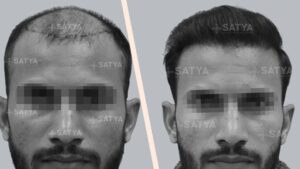
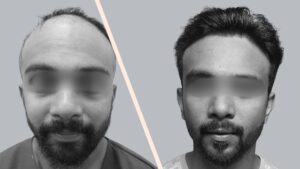
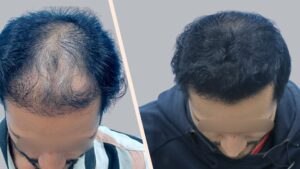
Ask who actually performs the procedure, request unedited before-and-after photos under consistent lighting, and get a written long-term hair loss management plan before you book.
What Actually Makes a Hair Transplant “Best” for You?
There is no universally superior hair transplant technique. The right choice depends on your Norwood stage, donor hair density, scalp laxity, and how much coverage your case genuinely requires. A transplant chosen for these clinical factors, and performed by the surgeon who assessed them, consistently outperforms one chosen for brand marketing.
Clinics that lead with a proprietary technique name before they have examined your scalp are marketing a product, not planning a procedure. Two patients with the same Norwood stage can need different approaches depending on donor supply, hair caliber, and scalp elasticity. That is a clinical assessment, not a menu choice, and it should happen before any technique or package is recommended.
FUE vs. FUT vs. DHI: The Core Techniques Compared
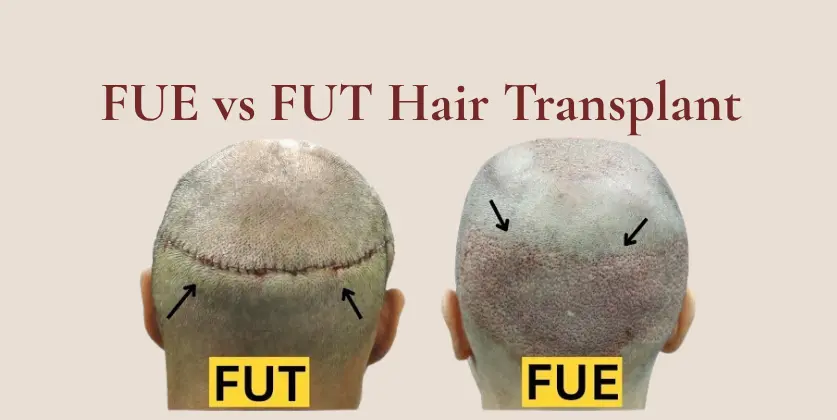
FUE hair transplant(Follicular Unit Extraction) removes individual follicular units directly from the donor area. FUT Hair Transplant (Follicular Unit Transplantation) removes a thin strip of donor scalp that is dissected into grafts. DHI (Direct Hair Implantation) is a variant of extraction where grafts are implanted with a specialized pen immediately after removal, without pre-made recipient incisions.
| Criterion | FUE | FUT (Strip) | DHI |
|---|---|---|---|
| Candidate profile | Wants to wear hair very short; moderate to large donor needs | Needs maximum graft yield in one session; comfortable with a concealed linear scar under longer hair | Prioritizes hairline precision and density control in smaller sessions |
| Recovery time | Roughly 7–10 days for visible healing and scab resolution | Roughly 10–14 days; sutures or staples typically removed around day 10 | Roughly 7–10 days; often slightly more comfortable with no strip removal |
| Scarring | Tiny punctate dot scars scattered across the donor area | A single linear scar across the back of the scalp, concealed by surrounding hair | Punctate scarring similar to FUE, since donor extraction uses the same method |
| Typical graft yield per session | Commonly up to roughly 3,000–3,500 grafts, donor-dependent | Can exceed 4,000–4,500 grafts in a single session due to harvesting efficiency | Generally lower per-session volume, often 1,500–2,500 grafts, given slower implantation pace |
| Typical cost per graft | Mid-range | Generally the lowest per graft, due to harvesting efficiency | Generally the highest per graft, due to specialized tools and implantation time |
| Dr. Shail Gupta, Lead Hair Transplant Surgeon Graft-yield numbers are session estimates, not guarantees. Donor density, scalp elasticity, and hair caliber move the real number more than the technique label does. Before you finalize a plan, ask your surgeon for your actual donor capacity, calculated per square centimeter of scalp, rather than a generic packaged figure. |
Red Flags and “Hair Mills”: Why Surgeon Execution Matters
A “hair mill” markets a named surgeon while a rotating team of technicians performs the actual extraction and implantation. Ask directly whether the surgeon personally extracts and implants your grafts or only supervises the room; that single answer separates outcome-focused clinics from volume-focused ones.
- The consultation is run entirely by a sales counselor, with no direct time from the operating surgeon.
- Per-graft package pricing is quoted before any in-person or video donor assessment has taken place.
- Before-and-after photos use inconsistent lighting, angles, or styling that make results hard to verify.
- A specific graft count is promised before your scalp has been examined at all.
- Shock loss, a temporary shedding of existing hair that can follow any transplant, is never mentioned during informed consent.
- Several procedures are scheduled back-to-back on the same day, across different patients, under one “lead surgeon.”
- The clinic cannot name a recognized professional affiliation, such as the ISHRS (International Society of Hair Restoration Surgery) or an equivalent national board, for the operating surgeon.
The 5-Point Surgeon Evaluation Checklist
Before booking any procedure, verify these five things directly with the clinic. If a clinic cannot answer one of them clearly, treat that as the answer.
| Criterion | What to Verify | Red Flag If Missing |
|---|---|---|
| 1. Credentials & affiliation | Board or society credentials specific to hair restoration (e.g., ISHRS membership), and years the surgeon has personally performed procedures | No verifiable credential, or experience limited to general medicine with no hair-restoration-specific training |
| 2. Before/after transparency | Consistent lighting, angle, and hairstyle across photos, ideally shown at 12+ months, with donor-area photos included | Retouched or cropped photos, inconsistent angles, or no donor-area photos offered |
| 3. Donor density math | A documented calculation of available donor grafts versus projected need across future hair loss stages | A flat graft number quoted without measuring donor density or scalp laxity |
| 4. Post-operative care protocol | A written plan covering wash schedule, activity restrictions, medication, and follow-up appointments | Vague verbal instructions with no written protocol or scheduled follow-up |
| 5. Long-term hair loss plan | A plan that addresses future hair loss in areas not being transplanted now, since pattern hair loss is progressive | No discussion of hair loss beyond the area treated today |
Donor Capacity and Graft Survival: The Math Clinics Do Not Always Explain
Your donor area is a finite, non-renewing resource. Published clinical literature on follicular unit transplantation commonly cites graft survival in the range of 90 percent or higher under optimal harvesting, handling, and post-operative conditions, though the actual figure depends heavily on surgeon technique and how long grafts spend outside the body.
This is why donor planning matters more than the technique name on the brochure. A surgeon who calculates how much donor hair a case will realistically need, including a buffer for future progression, is protecting a resource you cannot regenerate. A surgeon who quotes a large graft number before assessing density is spending that resource without a plan.
Dr. Shail Gupta, Lead Hair Transplant Surgeon
Because donor supply cannot be regenerated, planning allocation across a patient’s projected hair loss progression, sometimes described as maximum harvesting or future-ready planning, tends to preserve more usable donor hair in case a second procedure is ever needed years later.

Frequently Asked Questions
Transplanted grafts are typically resistant to the hormone (DHT) that drives pattern hair loss, so transplanted hair generally continues growing long-term. Hair in areas that were not transplanted can still continue thinning, which is why a long-term management plan matters as much as the procedure itself.
This depends on your Norwood stage, the area to be covered, and your density goals, not a fixed number that applies to everyone. A credible surgeon calculates this from your measured donor density and area of loss rather than quoting a package figure before assessment.
Neither is universally better; each suits different needs. FUE suits patients who want to keep hair short and avoid a linear scar, while FUT can yield more grafts in a single session for patients needing extensive coverage who are comfortable with a concealed linear scar.
Ask how many years the surgeon has personally performed the procedure, not the clinic’s total years in operation. Request unedited before-and-after cases at 12+ months, and ask about affiliation with a recognized body such as the ISHRS.
Reviewed By
Dr. Shail Gupta, Lead Hair Transplant Surgeon, Satya Skin & Hair Solutions. 23+ years in hair restoration surgery, 15,000+ transplants performed, 2,000+ corrective and repair cases, and patients treated from 80+ countries.
A Clinical Next Step, Not a Sales One
If you are weighing your options, the next reasonable step is a clinical evaluation, not a sales pitch. Satya Skin & Hair Solutions offers evidence-based consultations with Dr. Shail Gupta covering donor density, technique fit, and a realistic long-term plan, in Gurgaon (DLF Phase 4, Galleria Market) and Delhi (Pitampura).
Book a consultation| Call the clinic: +919910094945