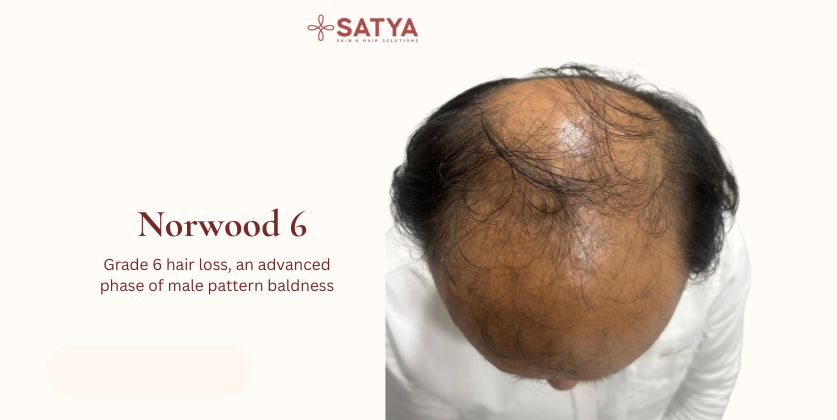
If you have reached the stage where the top of your scalp is almost completely bare and only a band of hair remains on the sides and back, you are probably searching for answers about a Norwood 6 Hair Transplant. This is one of the most advanced stages of male pattern baldness, and it raises a fair question that most men ask quietly: is a transplant even possible at this point?
The honest answer is that a Norwood 6 Hair Transplant can give natural, lasting results for many men, but only when the planning is realistic and the donor area is respected as a limited resource.
At Satya Skin & Hair Solutions, our doctors believe that the most important part of treating advanced hair loss is not the surgery itself. It is the planning that happens before it. This guide explains what Grade 6 hair loss really means, what a transplant can and cannot achieve, and how an experienced team approaches it responsibly.
What Is Grade 6 Hair Loss?
The Norwood scale is the standard system doctors use to describe male pattern baldness, from early thinning at Norwood 1 to advanced baldness at Norwood 7. Grade 6 hair loss sits near the top of that scale.
At this stage, the receding hairline at the front and the thinning crown have joined together. The bridge of hair that once separated them has disappeared, leaving a large connected bald area across the top of the head. What remains is the donor zone: a horseshoe shaped band of permanent hair around the sides and back of the scalp.
Understanding this picture matters, because Grade 6 hair loss is not simply a bigger version of early balding. It is a different planning problem altogether, and it needs to be treated as one.
Why a Norwood 6 Hair Transplant Is More Complex Than Earlier Stages
In early stages of hair loss, the bald area is small and the donor supply is plentiful. The math is easy. At Grade 6, the situation reverses. The area that needs coverage is at its largest, while the donor area, which is the only source of permanent grafts, stays the same size for everyone.
This creates a real challenge. A Norwood 6 Hair Transplant is not about filling every bald spot to look the way the scalp did at age twenty. It is about distributing a finite number of healthy grafts in a way that looks natural, frames the face well, and still leaves a safe reserve for the future.
This is why two men at the same Norwood grade can be told very different things by an honest clinic. The difference is rarely the baldness. It is almost always the donor.
Is a Norwood 6 Hair Transplant Actually Possible?
Yes, a Norwood 6 Hair Transplant is possible for many patients, and the results can be very satisfying when expectations are set correctly. But it is not suitable for everyone, and a responsible doctor will tell you so during the consultation rather than after.
Suitability depends on a few honest factors:
- The density and quality of your donor area
- How much total bald area needs coverage
- Your age and how much further hair loss is likely
- Your personal goals and how natural you want the result to look
When the donor area is strong, a single well planned procedure can restore a natural looking front and mid scalp. When the donor area is limited, the plan may focus on the most visible zones first, or combine surgical and non surgical methods. The goal is never to chase maximum coverage at any cost. It is to create a result that still looks right in ten and twenty years.
The Donor Area: The True Deciding Factor in Norwood 6 Hair Treatment
If there is one principle that guides every Norwood 6 Hair Treatment at Satya, it is this: donor hair is a non renewable resource. Once a follicle is taken from the back or sides, it does not grow back there. It can only be used once.
This is why our doctors assess the donor area carefully before discussing graft numbers. We look at donor density, the safe extraction zone, and how the donor itself may thin over time. Protecting the donor is more important than maximizing graft count in a single session, because overharvesting can leave the back of the scalp visibly thin and limit any future correction.
To make the most of a limited donor responsibly, our team uses MHT (Maximum Harvesting Technique). The purpose of MHT is to improve usable graft yield while keeping the donor safe and natural looking. It is not about extracting the highest possible number of grafts. It is about extracting the right number, in the right way, without compromising the donor for the future.
How Many Grafts Does a Norwood 6 Hair Transplant Need?
This is the most common question men ask, and the honest answer is that there is no single number that fits everyone. As a general guide, a Norwood 6 Hair Transplant often involves a large number of grafts to cover the front and mid scalp, because the bald area is extensive.
What matters more than the headline number is how those grafts are placed. Grafts are not spread evenly like paint. A skilled plan concentrates density where it is most visible, such as the front and the parting line, and uses lighter, natural coverage further back where the eye notices it less. This is how a finite donor supply is made to look full and balanced.
In some cases the donor area alone cannot supply enough grafts for full coverage. When that happens, our doctors may discuss using beard or body hair as additional sources, always after explaining the trade offs clearly. The plan is built around what your body can safely provide, not around a number promised in an advertisement.
The Satya Approach to Norwood 6 Hair Treatment
Advanced hair loss deserves more than a quick quote and a surgery date. Our Norwood 6 Hair Treatment philosophy is led by our doctors, Dr. Shail Gupta and Dr. Ruchi Agarwal, and is built on a few clear ideas.
Think twenty years, not twenty months. A Grade 6 patient is still likely to lose more native hair over time. We plan for that future so your result does not look thin or patchy as the surrounding hair changes.
Balanced Hair Transplant. Rather than emptying the donor for one dramatic session, we plan coverage in a balanced way that protects the donor and keeps options open for the years ahead.
Better graft survival with DSFT. Our use of DSFT (Direct Storage Follicular Technology) is aimed at reducing graft handling and trauma, which supports healthier graft survival. This matters even more in advanced cases where every single graft counts.
Natural design first. A Mimic Nature Hairline is designed for facial harmony and age appropriateness. A hairline that looks right for a man in his forties is very different from one drawn for a teenager, and we plan accordingly.
Health bhi, hair bhi. Hair restoration should never come at the cost of your overall health. We also review the medical and lifestyle factors behind your hair loss, and follow a MIN-MED approach that favours the lowest effective medication where it is clinically appropriate.
What Realistic Results Look Like at Grade 6 Hair Loss
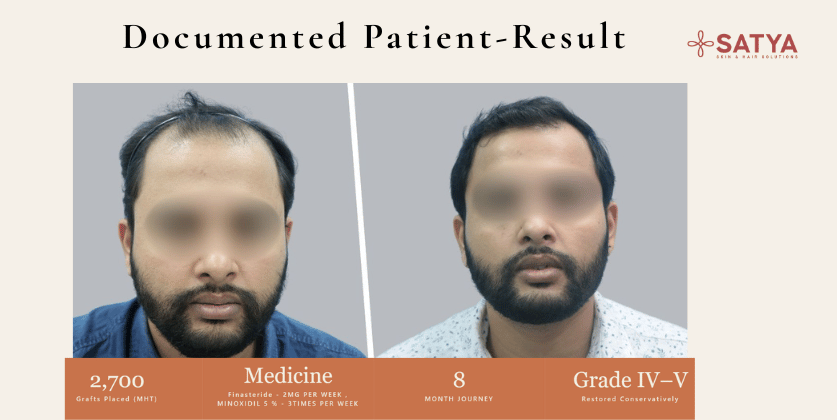
It is important to be clear about what a transplant can and cannot do for Grade 6 hair loss. A good result restores a natural looking frame to the face, gives you a defined hairline, and adds meaningful density to the areas that matter most when people look at you.
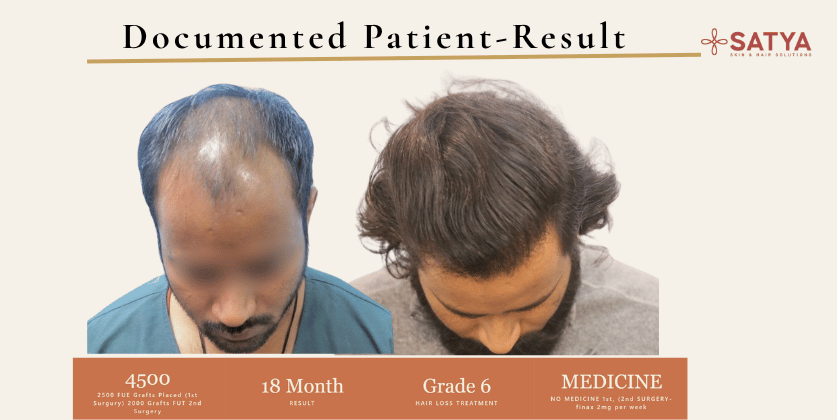
What it usually does not do is recreate the dense, all over coverage of a much younger scalp. The donor simply cannot supply that much hair across such a large area. Anyone who promises you that should be questioned, not trusted.
Honest results at this stage are about proportion and natural appearance, not about pretending hair loss never happened. Most patients who understand this from the start are very happy, because the outcome matches what they were told to expect.
When a Combination Plan Makes Sense
For some men with Grade 6 hair loss, the best path is not surgery alone. A combination plan may include medical therapy to protect existing hair, scalp and nutritional support, and in selected cases additional donor sources or staged procedures.
When the donor supply is genuinely exhausted and a patient still wants more density, we will discuss every available option transparently, including its limitations and maintenance needs. We will also tell you honestly when doing less is the wiser choice. A plan built on transparency tends to age far better than one built on promises.
Talk to a Doctor Before You Decide
Grade 6 hair loss is a stage where good planning makes all the difference between a natural result and a disappointing one. If you are considering a Norwood 6 Hair Transplant, the best first step is an honest assessment of your donor area and your goals.
At Satya Skin & Hair Solutions, our consultations are educational, not pushy. Dr. Shail Gupta and Dr. Ruchi Agarwal will explain what is realistically possible for your case, what it would involve, and whether surgery is even the right choice for you.
To book a consultation or ask a question, call +91 99100 94945
Frequently Asked Questions
For many men it is, provided the donor area is adequate and expectations are realistic. The value comes from a natural, lasting result that fits your face and age, not from chasing complete coverage. A consultation is the only way to know if it suits you.
Not always. The bald area at Grade 6 is large and the donor is limited, so coverage is prioritised across the most visible zones. Some patients achieve their goals in one session, while others benefit from a staged plan that protects the donor.
There is no fixed number that fits everyone. It depends on your donor density, the size of the bald area, and your goals. What matters most is smart placement, not just the total count.
The procedure is carried out under local anaesthesia and most patients tolerate it well. As with any medical procedure there are risks, which your doctor will explain fully during the consultation so you can decide with complete information.
If the donor cannot safely supply enough grafts, our doctors will tell you honestly. In such cases we discuss alternatives such as medical management, beard or body hair use where suitable, or other supportive options, always with their limitations explained.
Your transplanted hair is permanent, but your native hair can continue to thin over time. This is exactly why long term planning and donor preservation are central to how we approach every advanced case.