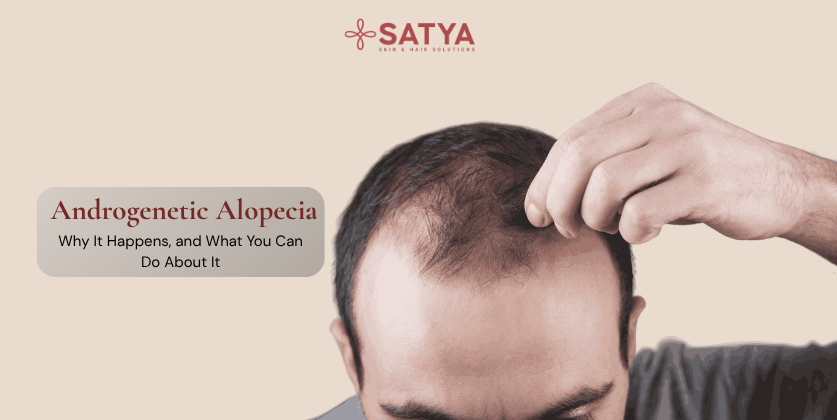
You look in the mirror and notice your hairline has shifted. Or your parting looks wider than it did a year ago. Or you are seeing more hair on the pillow every morning. If this sounds familiar, there is a good chance you are dealing with androgenetic alopecia the most common form of hair loss in both men and women worldwide.
Androgenetic alopecia is not just a cosmetic concern. It is a medical condition with a clear biological basis, and for most people, it progresses slowly but steadily without treatment. The good news is that today we understand it better than ever before and there are evidence-based ways to manage it.
What Is Androgenetic Alopecia?
Androgenetic alopecia also called pattern hair loss is a genetically driven, hormone-influenced condition that causes the gradual miniaturization of hair follicles. Over time, the affected follicles produce thinner, shorter, lighter strands until they eventually stop producing hair altogether.
The name itself tells the story: “Andro” refers to androgens (male hormones like DHT), and “genetic” refers to the inherited predisposition. Both factors must be present for the condition to develop.
Androgenetic Alopecia Causes: What Is Really Happening in Your Scalp
The primary driver behind androgenetic alopecia causes is a hormone called dihydrotestosterone, or DHT. DHT is derived from testosterone through the action of an enzyme called 5-alpha reductase. In people who are genetically susceptible, the hair follicles on certain areas of the scalp have receptors that are highly sensitive to DHT.
When DHT binds to these receptors, it shortens the growth phase (anagen) of the hair cycle. With each cycle, the follicle shrinks a little more a process called miniaturization. Eventually, the follicle produces only fine, almost invisible vellus hair, or nothing at all.
Key Contributing Factors
- Genetic inheritance (from either parent’s side)
- Elevated DHT sensitivity in scalp follicles
- Hormonal fluctuations particularly in women post-pregnancy or menopause
- Aging, which amplifies DHT’s effect on susceptible follicles
- Stress and nutritional deficiencies can accelerate an existing predisposition
Androgenetic Alopecia in Males: The Classic Pattern
Androgenetic alopecia in males typically presents as a receding hairline at the temples, followed by thinning at the crown. Over time, these two areas may merge, leaving only a horseshoe-shaped band of hair around the sides and back of the head. This progression is graded using the Norwood-Hamilton scale from Stage I through Stage VII.
Hair loss often begins in a man’s twenties or thirties, though it can start earlier. The earlier it begins, the more significant the eventual loss tends to be without intervention.
Androgenetic Alopecia in Females: Different Pattern, Same Root Cause
Androgenetic alopecia in females is frequently underdiagnosed because the presentation looks different from men. Women rarely develop a fully receding hairline. Instead, the hair thins diffusely across the crown and top of the scalp while the frontal hairline is usually preserved. This is graded using the Ludwig scale.
Female androgenetic alopecia often intensifies at specific hormonal transition points: after pregnancy, during perimenopause, or following discontinuation of oral contraceptives. It is important to note that women with this condition almost always have normal androgen levels the issue lies in the sensitivity of their follicles, not the hormone level itself.
When Should Women Seek Evaluation?
- Visible widening of the central parting
- Increased hair shedding over several months
- Reduced hair volume or ponytail thickness
- Scalp becoming more visible under bright light
Androgenetic Alopecia Symptoms: How to Recognize It
The symptoms of androgenetic alopecia develop gradually, which is why many people dismiss the early signs. Knowing what to look for helps you act sooner, which almost always leads to better outcomes.
- Gradual thinning at the hairline or crown (not sudden or patchy)
- Hairs that regrow increasingly finer and shorter after each cycle
- More hair visible on the pillow, comb, or shower drain
- beyond the normal 50–100 strands per day
- Scalp becoming more visible at the parting or temples
- No associated itching, pain, or inflammation (unlike other hair conditions)
Importantly, androgenetic alopecia does not cause complete scalp baldness in women and only causes full baldness in a subset of men. The donor area at the back and sides of the scalp typically remains unaffected which is why hair transplantation works for this condition.
Androgenetic Alopecia Treatment: What the Evidence Actually Supports
There is no one-size-fits-all androgenetic alopecia treatment. The right approach depends on the stage of loss, gender, age, and whether the goal is to slow progression, stimulate regrowth, or restore density surgically.
Medical Treatments
- Minoxidil (topical or oral): Prolongs the anagen phase and increases follicle size. Effective in both men and women. Best for early-to-moderate stages.
- Finasteride (oral, for men): Blocks 5-alpha reductase, reducing DHT levels. Clinically proven to slow loss and promote regrowth in men. Not recommended for women of childbearing age.
- Dutasteride: A more potent DHT blocker, used in select cases under medical supervision.
- Nutritional correction: Deficiencies in iron, ferritin, Vitamin D, zinc, and biotin can worsen androgenetic alopecia and must be addressed alongside hormonal treatment.
Procedural and Advanced Treatments
- PRP (Platelet-Rich Plasma): Concentrated growth factors from your own blood, injected into the scalp to stimulate dormant follicles. Works best in the early stages.
- Low-Level Laser Therapy (LLLT): Stimulates follicular activity through photobiomodulation. Useful as an adjunct to other therapies.
- Hair Transplant Surgery: The only permanent solution for restoring density in areas where follicles are no longer active. Only appropriate once hair loss has stabilized.
The Satya Approach: Diagnosis First, Treatment Second
At Satya Skin & Hair Solutions, we approach androgenetic alopecia the way any complex medical condition should be approached with a thorough diagnosis before any treatment is recommended.
Dr. Ruchi Agarwal, Dermatologist and Co-founder with over 20 years in clinical practice, evaluates each patient with detailed scalp analysis, hormonal screening where indicated, and a review of the full medical history. Hair loss in women, in particular, requires careful investigation to rule out thyroid dysfunction, PCOS, iron deficiency anaemia, and other systemic causes that can mimic or worsen androgenetic alopecia.
Dr. Shail Gupta, Hair Transplant Specialist and Co-founder, leads the surgical arm for patients who are candidates for hair restoration. Satya’s proprietary techniques including the Mimic Nature™ Hairline Design and Balanced Hair Transplant™ are developed around one principle: results that look natural because they are natural.
Our philosophy is Minimal Medicine we do not prescribe what is not needed, and we do not operate on patients who are not ready. If medical management can stabilize your hair loss and produce meaningful regrowth, that is always where we start.
When Should You See a Dermatologist?
The most common reason patients delay consultation is the belief that shedding is normal or temporary. Sometimes it is. But androgenetic alopecia is progressive every month without intervention means follicles moving further into miniaturization.
You should consult a dermatologist if:
- You notice consistent thinning at the crown, temples, or parting for more than 3 months
- A parent or sibling has significant hair loss
- You are a woman experiencing diffuse thinning after a hormonal change
- You have tried over-the-counter products without improvement
Earlier evaluation almost always means more options. Follicles that are still producing even fine hair can often be saved with the right treatment.
Ready to understand your hair loss not just treat it?
If you have been noticing gradual thinning or a changing hairline, a proper diagnosis is the most valuable thing you can do right now. At Satya Skin & Hair Solutions, our team will help you understand whether you are dealing with androgenetic alopecia, what stage you are at, and what treatment approach makes the most sense for you medically and practically.
Book a consultation with Dr. Ruchi Agarwal or Dr. Shail Gupta at our Delhi (Pitampura) or Gurgaon (DLF Phase 4) clinics.
No pressure. No hype. Just an honest conversation about your hair.
About the Experts
Dr. Ruchi Agarwal is a Dermatologist with 20+ years in clinical practice and Co-founder of Satya Skin & Hair Solutions. She specializes in diagnosing hair and scalp conditions, medical management of hair loss, and non-surgical hair treatments for women.
Dr. Shail Gupta is a Hair Transplant Specialist and Co-founder of Satya, known for proprietary surgical techniques including DSFT™, MHT™, Mimic Nature™ Hairline, and Balanced Hair Transplant™. The clinic has performed 50,000+ procedures over 20 years.
Frequently Asked Questions
The hair loss itself is permanent if left untreated follicles that have fully miniaturized cannot regrow hair. However, with timely medical treatment, progression can be significantly slowed and in many cases partially reversed. Surgical restoration is an option for areas where follicles are no longer active.
The two primary androgenetic alopecia causes are genetics (inherited sensitivity of hair follicles) and DHT a hormone that binds to these sensitive follicles and shortens their growth cycle. Both factors must be present. You can have elevated DHT without hair loss if you do not have the genetic predisposition, and vice versa.
Androgenetic alopecia in females follows a different pattern diffuse thinning over the top of the scalp rather than a receding hairline. Women usually retain their frontal hairline. The underlying mechanism is the same (DHT-induced follicle miniaturization), but women are more likely to have normal androgen levels with follicle-level hypersensitivity.
No. Hair transplantation is appropriate only when hair loss has stabilized and medical treatments have been tried or are insufficient. For active or early-stage androgenetic alopecia, the first-line approach is medical minoxidil, finasteride (in men), PRP, and nutritional correction. Surgery is a permanent solution, not an emergency measure.
Androgenetic alopecia can technically begin at any age after puberty. It is most commonly noticed in men in their twenties and thirties, while women more often observe it in their forties and fifties though post-pregnancy hair loss can bring it to attention earlier. Earlier onset often means more progressive loss over time.
Stress does not cause androgenetic alopecia but can trigger or accelerate a separate condition called telogen effluvium sudden diffuse shedding. In someone with an underlying genetic predisposition, telogen effluvium can unmask or worsen androgenetic alopecia. Managing stress is an important part of any comprehensive hair health plan.