
At a glance, it looks like a textbook success: a clean FUE transplant, full coverage from the hairline to the crown, and a delighted patient. But here’s what most people scrolling past that photo miss, you cannot actually tell, from the result alone, how much of it was the surgeon and how much was a daily tablet. Reading it correctly takes a knowledgeable eye.
The Case
2,600 Grafts, FUE, Front, Middle & Crown
The patient’s result was achieved via FUE (Follicular Unit Extraction), using 2,600 grafts to cover the frontal, middle and crown regions. The coverage looks successful, but crucially, it’s unclear whether the patient also used medicinal support like finasteride or minoxidil to get there.
Medication use: unstated
That “unclear” is the whole story. Notice the math, too: 2,600 grafts spread across three separate zones, front, mid-scalp, and crown, isn’t a large number per area. When modest graft coverage still looks full across the entire scalp, an experienced eye immediately wonders what else might be contributing.
The Comparison That Raises the Question
To show why that suspicion is fair, Dr. Shail puts up a very different case: a person who achieved substantial hair growth using medication only, finasteride at 1.25 mg daily plus 5% minoxidil, with no transplant surgery at all.
If medicine alone can produce that kind of density, then it’s entirely possible the transplant patient could have reached similar improvements through medication too. The grafts may have helped, but the medicine may be doing a large share of the visible work, and there’s no way to separate the two just by admiring the photo.
“You can’t credit the scalpel for what the tablet is doing. Telling them apart is a skill, not a glance.”
The Part Everyone Forgets: It Can Vanish
This isn’t just an academic distinction. The contribution of medication must be acknowledged, because stopping these treatments often leads to the observed hair growth simply vanishing. Density that depends on a daily drug is only as permanent as the habit of taking it.
So a patient who credits the surgery for everything, and then stops their medicine, can watch a chunk of that “surgical” result fade, never realizing the medication was holding it up all along.

How Long Do the Results of Hair Transplant Surgery Last?
Quick Answer Hair transplant results are considered long-lasting because transplanted follicles are taken from a…
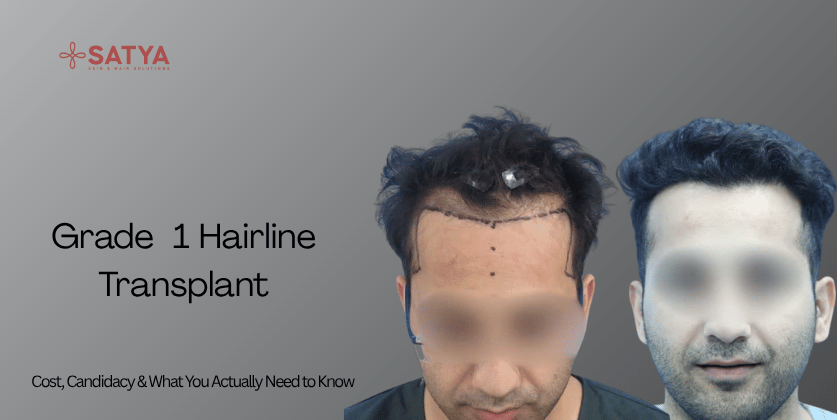
Grade 1 Hairline Transplant: Cost, Candidacy & What You Actually Need to Know (2026)
Before you read further: Clinically, “Grade 1” on the Norwood-Hamilton scale, the classification hair restoration…
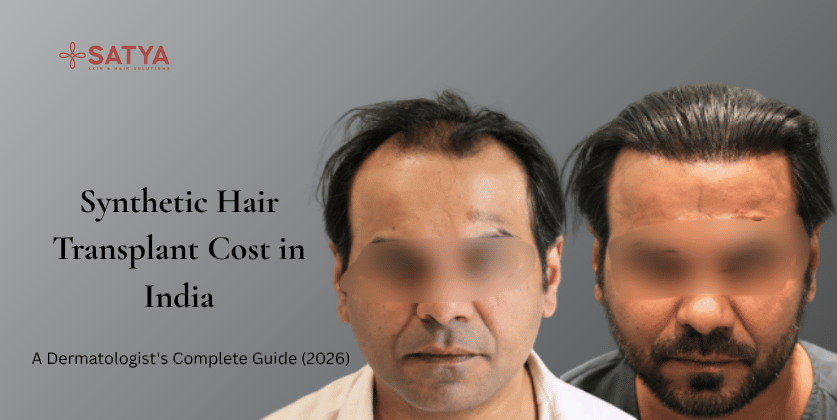
Synthetic Hair Transplant Cost in India: A Dermatologist’s Complete Guide (2026)
Before you read further: A synthetic hair transplant is not the same procedure as a…

What the Knowledgeable Eye Actually Looks For
Accurately analyzing a hair restoration result means separating the effect of surgery from the effect of medication. Here’s the kind of reasoning an experienced clinician applies to a before-and-after that an untrained eye skips right over.
Five things a clinician checks before believing a result
Why This Matters for Your Decision
Failing to account for medication leads to a fundamental misunderstanding of how a result is maintained over time. If you believe surgery did everything, you’ll assume the result is set in stone, and you may be caught off guard when it isn’t. If you understand medication’s role, you can make an informed choice about staying on treatment, and you’ll judge every clinic’s portfolio with far clearer eyes.
That’s the real value of a knowledgeable eye: not cynicism about transplants, but clarity about what you’re actually buying and what it takes to keep it.
Frequently Asked Questions
Not from the photo alone. It takes a knowledgeable eye to weigh graft count against coverage, check whether untreated areas improved, and factor in the medication regimen. Without that, it’s easy to credit surgery for density the medicine created.
For the right person, it can come surprisingly close. In the comparison case, finasteride at 1.25 mg daily plus 5% minoxidil produced substantial growth with no surgery, enough that a transplant patient might have reached similar density on medication alone.
Spread across all three zones, 2,600 grafts is a modest number per area. When such coverage still looks full, it’s a clue that medication may be contributing to the density, which is exactly what a trained eye investigates.
Growth that was driven by the medication often vanishes after stopping. That’s why the medication’s contribution must be acknowledged up front; it directly determines how the result is maintained over time.