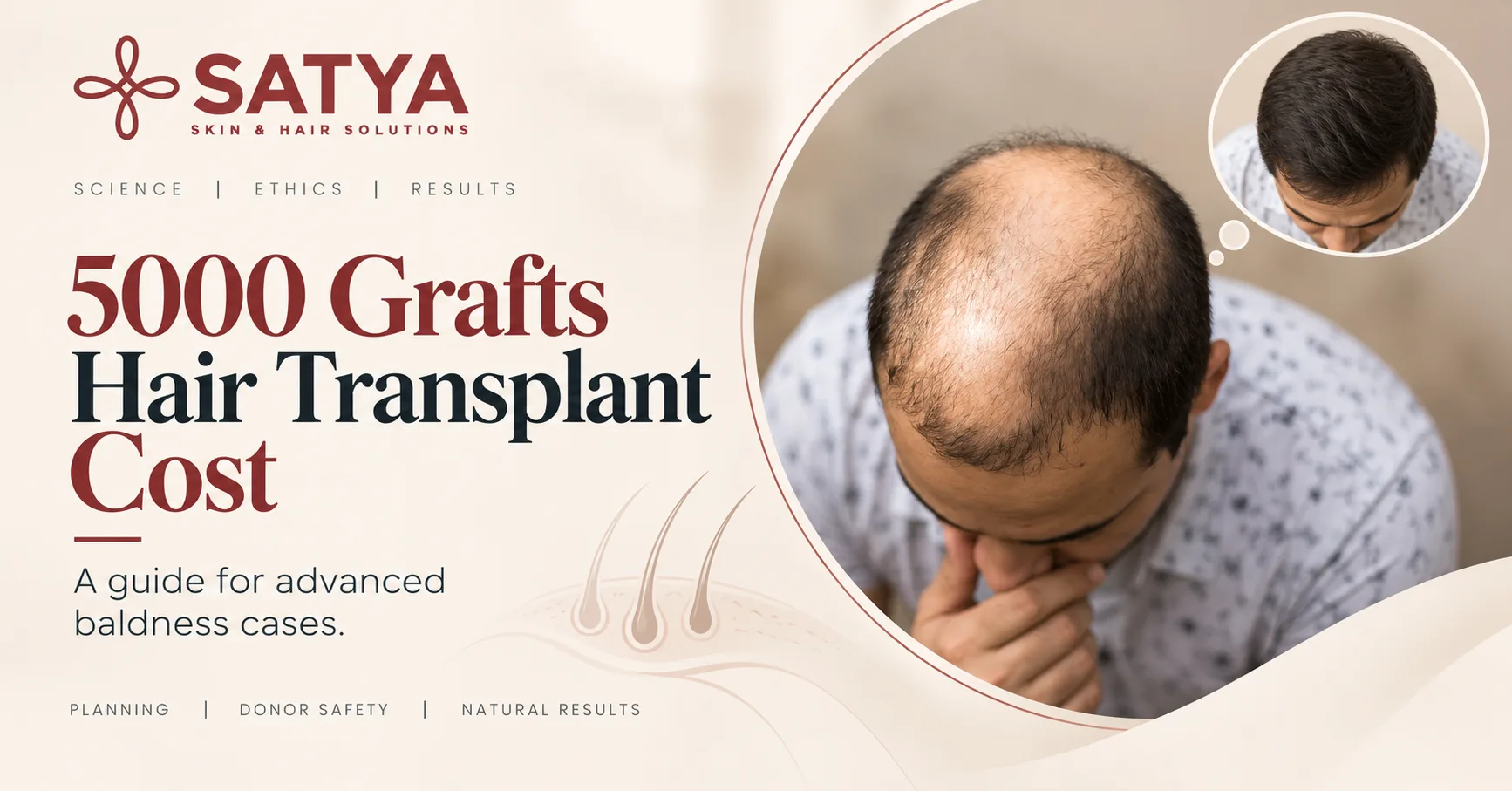
A 5000 grafts hair transplant cost in India typically falls between ₹1,50,000 and ₹4,50,000 at indicative Delhi NCR market rates, depending on the technique (FUT, FUE, or a combination), the surgeon’s direct involvement, and what the quote includes. Five thousand grafts carry roughly 9,000 to 11,000 hairs and are usually considered for advanced hair loss (Norwood 5 to 7). The bigger question is not the price but the donor: 5,000 grafts can be most of a person’s lifetime supply, so the plan should come from a donor assessment, not a package.
Five thousand grafts is a large number in two ways. It is a significant financial decision, and it is a significant biological one, because grafts taken from the back of the scalp do not grow back. This guide explains what 5,000 grafts means, the realistic 5000 grafts hair transplant cost in India, whether your donor area can supply it, and what recovery and results realistically look like.
What Does 5,000 Grafts Actually Mean?
A graft is a follicular unit, a natural group of one to four hairs. Dr. Robert Bernstein’s measurements found most patients average about 2 hairs per unit, within a range of roughly 1.5 to 3. So 5,000 grafts usually means about 9,000 to 11,000 hairs, though the exact figure varies from person to person.
Hair thickness matters as much as the count. A coarse hair covers far more scalp than a fine one, so two patients with the same graft number can get very different visual results. A clinic that quotes only a graft count, without telling you your average hairs per graft and hair calibre, is leaving out half the picture.
Is 5,000 Grafts a Megasession?
Yes. A 2013 review by Dr. Steven Gabel in Facial Plastic Surgery Clinics of North America defines a megasession as more than 3,000 follicular unit grafts in one procedure, and notes that it requires careful patient selection and an experienced, well-organised team.
Who Needs 5,000 Grafts?
Graft needs depend on how much area is bald, the density you want, and how your hair loss is likely to progress. These are approximate ranges:
| Hair Loss Grade (Norwood) | Approximate Grafts | Typical Coverage Goal |
|---|---|---|
| Grade 2 to 3 | 1,000 to 1,800 | Hairline and temples |
| Grade 4 | 2,000 to 3,000 | Front and mid-scalp |
| Grade 5 to 6 | 3,500 to 5,000 | Front, mid-scalp, and some crown |
| Grade 7 | 5,000 or more, often over two sessions | Front-weighted coverage; crown lighter |
A 5,000-graft plan suits someone with advanced, stable, patterned loss and a strong donor area. It is usually not appropriate for a young patient whose loss is still progressing fast, someone with diffuse thinning that includes the donor zone, or someone expecting the density they had at 20. Read more about Norwood 5 and Norwood 6 hair transplants.
5000 Grafts Hair Transplant Cost in India
Most Indian clinics price per graft, so total cost scales with the number of grafts and the technique. Applying indicative Delhi NCR market rates to 5,000 grafts:
| Technique | Indicative Rate per Graft | Estimated Cost for 5,000 Grafts |
|---|---|---|
| FUT (strip method) | ₹30 to ₹50 | ₹1,50,000 to ₹2,50,000 |
| FUE | ₹40 to ₹90 | ₹2,00,000 to ₹4,50,000 |
| Combined FUT + FUE (for example 3,000 + 2,000) | Blended | ₹1,70,000 to ₹3,30,000 |
| DHI or implanter-pen FUE | ₹80 to ₹150 | ₹4,00,000 to ₹7,50,000 |
These are market ranges for illustration, not a Satya price list or a quote. Some clinics charge a lower per-graft rate for larger sessions, so compare the total and what it includes rather than the headline rate. Our hair transplant cost in India guide explains graft-based pricing in more detail, and our 4,000-graft cost guide covers the next size down.
What a 5000 Grafts Hair Transplant Cost Should Include
- Blood tests and the pre-operative donor assessment
- Anaesthesia and medicines during the procedure
- Post-operative medicines for the full recovery period
- Whether a two-day procedure is charged as one session
- Follow-up visits, and any PRP sessions if recommended
- Travel and stay, if you are coming from outside Delhi NCR
Very low quotes for 5,000 grafts often mean technician-led surgery or aggressive harvesting. Our article on why a low-cost hair transplant can prove costly explains why. If you are comparing India with Turkey, see our India vs Turkey comparison.
Can Your Donor Area Supply 5,000 Grafts?
This is the most important question, and it should be answered before cost is discussed. In a physician answer for the International Alliance of Hair Restoration Surgeons, Dr. Bernard Nusbaum puts the lifetime donor supply for someone with extensive pattern baldness at roughly 5,000 to 7,000 follicular units. For many people, then, 5,000 grafts is most of what they will ever have.
How the grafts are taken also matters. A 2018 study in the World Journal of Plastic Surgery advised removing less than 35% of donor density by FUE in a first session and only 10 to 20% in a second, because thinning becomes visible as cumulative extraction approaches half. Over-harvesting cannot be undone, so the donor area must still look natural after surgery.
Ways to Reach 5,000 Grafts Responsibly
- Combining FUT and FUE: a strip from the densest central zone plus FUE from around it can yield more grafts while spreading the extraction. See our FUT and FUE pages.
- Body or beard hair: suitable for some patients to add coverage behind the hairline or in the crown. See body hair transplant.
- Staging: doing part of the plan now and the rest after the first result has matured.
DR. SHAIL GUPTA ON DONOR PLANNING
Most conversations about 5,000 grafts start with how many grafts can be taken. I start with how many should be taken. Our MHT™ (Maximum Harvesting Technique) is about getting the most usable grafts from your donor while keeping it looking natural and leaving a reserve for the future. A patient can recover from a weak hairline. A patient cannot recover from a destroyed donor.
One Session or Two?
Large single sessions can treat a wide area at once, and some experienced teams do them well. The concerns are practical.
The longer grafts stay outside the body, the more survival falls: a 1992 study by Dr. Bobby Limmer, cited by the IAHRS, found survival of about 95% at two hours, 90% at four hours, and 88% at six hours. Dr. Nusbaum also notes there are no scientific studies on graft survival in sessions of 5,000 or more.
| Factor | One Large Session | Two Staged Sessions |
|---|---|---|
| Time to full coverage | Shorter | Longer, usually 12 or more months apart |
| Out-of-body time per graft | Longer on average | Shorter |
| Plan adjustment | Committed at once | Second session refined after the first result |
| Donor protection | Higher risk of over-harvesting | Easier to protect donor appearance |
| Downtime | One longer recovery | Two shorter recoveries |
Many surgeons perform 5,000 FUE grafts over two consecutive days to keep each day manageable. Whichever route is chosen, graft handling matters: our DSFT™ protocol is designed to keep out-of-body time and handling to a minimum. If you already had one procedure, read should you undergo a second FUE transplant.
What to Expect: From Procedure Day to Final Result
The procedure is done under local anaesthesia while you are awake, over one or two long days. FUE needs the donor area shaved; FUT leaves a fine linear scar hidden under longer hair (see should you fear the FUT scar).
| Timeframe | What Usually Happens |
|---|---|
| Days 1 to 5 | Swelling of the forehead is common after large sessions and settles within days |
| Days 7 to 10 | Crusts clear; many patients return to desk work after about a week |
| Weeks 2 to 8 | Transplanted hairs shed, which is expected; native hair may also shed temporarily |
| Months 3 to 4 | New growth begins, fine at first |
| Month 12 | The front is largely mature |
| Months 12 to 18 | The crown matures; final assessment and any second-stage planning |
What 5,000 Grafts Can Realistically Cover
In advanced loss, 5,000 grafts are usually weighted to the front and mid-scalp, because that frames the face. The crown receives lighter coverage or is left for a later session. The aim is natural coverage, not your original density, which no transplant can recreate. Side effects such as swelling, numbness and folliculitis are covered in our guide to hair transplant side effects.
Protecting a 5,000-Graft Investment
The 5000 grafts hair transplant cost is only part of the investment. Transplanted hair from a stable donor tends to keep growing, but the native hair around it can keep thinning. Without a plan for that, a large transplant can look isolated years later. Our comparison of minoxidil, finasteride and hair transplant explains how medicine and surgery work together.
DR. RUCHI AGARWAL ON HEALTH AND MEDICATION
A procedure lasting one or two long days needs a proper health check first: blood counts, blood sugar, blood pressure, and the medicines you already take. Afterwards, we use our MIN-MED™ approach, the lowest effective dose reviewed over time, to protect the native hair around the grafts. Health bhi, hair bhi.
How We Plan Large Sessions at Satya
Every large-session plan at Satya starts with a donor assessment and a forecast of how your hair loss is likely to progress over the next ten to twenty years. We design a Mimic Nature Hairline™ that will still suit you as you age, and set the graft number from that plan. Sometimes the honest answer is fewer grafts than you expected, or two stages instead of one.
Frequently Asked Questions
At indicative Delhi NCR market rates, about ₹1,50,000 to ₹2,50,000 by FUT, ₹2,00,000 to ₹4,50,000 by FUE, and more for implanter-pen techniques. The final figure depends on the technique, surgeon involvement, and what the quote includes.
Usually about 9,000 to 11,000 hairs, because most people average around 2 hairs per follicular unit. Your own count depends on your donor characteristics, which are measured during assessment.
Some teams do, but many surgeons split 5,000 FUE grafts over two consecutive days to limit how long grafts stay outside the body. FUT, or FUT combined with FUE, can yield a large number of grafts in a single day.
It can give good front and mid-scalp coverage in many Norwood 6 cases, with lighter crown coverage. Norwood 7 often needs a second session or additional donor sources, and full original density is not achievable.
Rarely from the scalp alone. Lifetime donor supply in extensive baldness is often estimated at about 5,000 to 7,000 follicular units, so plans beyond that usually rely on beard or body hair, spread over more than one session.
Expect swelling for a few days and crusts for about 7 to 10 days. Many patients return to desk work after about a week. New growth starts at 3 to 4 months, and the full result takes 12 to 18 months.
In a well-selected patient with an experienced team, it is a routine large procedure under local anaesthesia. The main risks are over-harvesting the donor, lower graft survival if grafts stay out too long, and the usual surgical side effects. A health check and a donor-first plan reduce these risks.
Not Sure What Suits You?
Before you compare 5000 grafts hair transplant cost quotes, find out what your donor area can safely provide. Schedule an evidence-based consultation with our hair restoration team at Satya Skin & Hair Solutions in DLF Phase 4, Gurgaon, or Pitampura, Delhi. Results vary from person to person, and any graft number we recommend will follow your donor and scalp assessment.