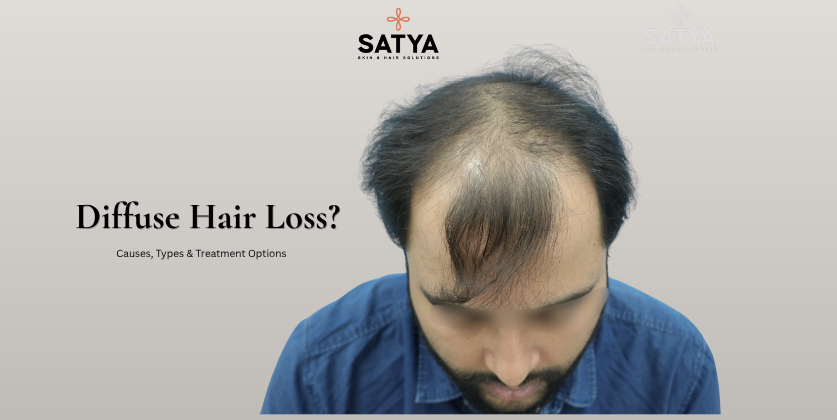
| Diffuse hair loss is thinning that spreads evenly across the whole scalp rather than appearing as a bald patch or a receding hairline. Because the density drops all over, people often notice more hair in the shower or on the pillow, and a wider parting, before any single bald spot forms. It is a symptom, not a single disease. Common causes include telogen effluvium (often reversible), diffuse androgenetic alopecia, thyroid or nutritional problems, and, less commonly, diffuse unpatterned alopecia (DUPA). Correct diagnosis decides whether medical treatment, non-surgical therapy, or, in select cases, a transplant is the right route. |
You run your fingers through your hair, and more strands come away than you remember. Your parting looks wider in photos, your ponytail feels thinner, yet there is no obvious bald patch. This pattern, thinning everywhere at once, is what doctors call diffuse hair loss, and it is one of the most misunderstood hair complaints we see at Satya Skin & Hair Solutions.
Diffuse hair loss can be unsettling precisely because it is hard to point to. The aim of this guide is simple: to explain what diffuse hair loss is, what causes it, when it can recover on its own, and what a responsible treatment plan actually looks like, without the hype, the false promises, or the pressure to rush into surgery.
What Is Diffuse Hair Loss, Exactly?
In a healthy scalp, hair grows in cycles. At any time, most follicles are in the growing (anagen) phase, while a small share are resting and shedding. Diffuse hair loss occurs when an unusually large number of follicles across the entire scalp shift out of the growth phase together. The result is a uniform drop in density rather than the localised pattern seen in classic male or female pattern baldness.
Two features set diffuse hair loss apart. First, it is widespread, the crown, mid-scalp, sides and sometimes the back all thin to a similar degree. Second, it is often a signal of something happening elsewhere in the body, such as a recent illness, a hormonal shift, or a nutritional gap. That is why we treat diffuse thinning as a clue to investigate, not just a cosmetic issue to cover up.
Diffuse Thinning vs. Patterned Baldness: Why the Difference Matters
Patterned hair loss has a recognisable map. In men, it usually starts at the temples and crown; in women, it widens the central parting while the frontal hairline holds. Diffuse thinning ignores that map and reduces density across the whole head, which makes it easy to confuse with simply “losing volume” as you age.
This distinction is not academic. The cause, the reversibility, and the suitability for a hair transplant are all different depending on which type you have, which is exactly why self-diagnosis from online photos is unreliable.
What Causes Diffuse Hair Loss?
Diffuse hair loss is best thought of as a final common pathway that several different triggers can lead to. The main categories we assess for are below.
1. Telogen Effluvium (Often Reversible)
This is the most common cause of sudden, all-over shedding. A physical or emotional “shock” pushes many follicles into the resting phase at once; the shedding becomes visible roughly two to three months later. Triggers include high fever or infection, surgery, childbirth, rapid weight loss, crash dieting, severe stress, and certain medications. Acute telogen effluvium frequently recovers on its own once the trigger is resolved, though it can persist if the underlying cause continues.
2. Diffuse Androgenetic Alopecia
Sometimes, genetic, hormone-driven hair loss presents in a diffuse form rather than a sharply patterned one. Diffuse androgenetic alopecia is especially common in women, where it typically thins the crown and mid-scalp while preserving the frontal hairline. It is progressive and is managed and stabilised over time rather than cured, a distinction we are always upfront about.
3. Diffuse Unpatterned Alopecia (DUPA)
DUPA is less common but clinically very important. Here, the thinning involves the entire scalp, including the back and sides that are normally a stable “donor” zone. Because no area is reliably resistant to loss, DUPA usually makes someone a poor candidate for a hair transplant. Identifying it early prevents a great deal of disappointment and wasted expense.
4. Medical & Nutritional Triggers
Thyroid disorders, iron deficiency (low ferritin), vitamin D or B12 deficiency, PCOS, and some chronic conditions can all drive diffuse thinning. These are exactly the factors that blood tests reveal, and exactly why correcting the root cause often matters more than any topical product.
Quick Comparison of the Main Causes
| Type | Typical Trigger | Reversible? | Transplant Suitable? |
|---|---|---|---|
| Telogen Effluvium | Illness, stress, childbirth, deficiency | Often, once cause is treated | Not needed in most cases |
| Diffuse Androgenetic Alopecia | Genetics & hormones (DHT) | Managed / stabilised, not cured | Sometimes, if donor is stable |
| DUPA | Genetic, donor area involved | Stabilised with medical care | Usually not advised |
| Nutritional / Thyroid | Iron, vitamin D, thyroid imbalance | Often, with correction | Rarely the right first step |
| “With diffuse hair loss, the strands you see falling are the symptom, not the diagnosis. My first job is never to reach for a product; it is to find out why the scalp is shedding. Treat the cause correctly, and a surprising amount of hair returns on its own.” |
Signs & Symptoms: How to Recognise Diffuse Thinning
Diffuse hair loss rarely announces itself with a bald spot. Instead, look for a gradual cluster of changes:
- Increased shedding: Noticeably more hair on your pillow, in the shower drain, or on your brush
- Widening part: A parting that looks wider than it did a year ago
- Reduced volume: A ponytail or bun that feels thinner to tie
- See-through look: The scalp becomes faintly visible under bright light, across the whole head rather than one area
If these have appeared over weeks to months, a professional evaluation is worthwhile, partly to confirm the type, and partly to rule out treatable medical causes.
Is Diffuse Hair Loss Reversible?
This is the question most patients ask first, and the honest answer is: it depends on the cause. Telogen effluvium and deficiency-driven thinning often recover well once the trigger is addressed, which is why so many people regrow hair without a transplant. Diffuse androgenetic alopecia behaves differently: it can be slowed, stabilised, and partially improved with consistent medical therapy, but it is a long-term condition to manage, not a one-time fix.
We deliberately avoid words like “cure,” “miracle,” or “permanent fix.” Realistic, stage-appropriate expectations are part of good medicine, and they protect you from treatments that overpromise.
How Diffuse Hair Loss Is Diagnosed
Because diffuse thinning has so many possible causes, diagnosis is methodical rather than guesswork. A typical Satya evaluation includes:
- History: A detailed history, recent illness, stress, diet, medication, family history, and (for women) hormonal and menstrual patterns.
- Scalp examination: Trichoscopy, magnified examination of the scalp to assess follicle calibre, miniaturisation and density, including the donor area.
- Pull test: A gentle hair pull test to gauge how actively hair is shedding.
- Lab work: Blood tests where indicated, ferritin, thyroid function, vitamin D and B12, and hormonal markers.
Crucially, examining the donor zone tells us whether it is stable or itself thinning, the single most important factor in deciding whether a transplant could ever be appropriate.
Diffuse Hair Loss Treatment Options
Effective diffuse hair loss treatment is layered and almost always begins with non-surgical measures. Surgery, where considered at all, comes last and only for the right candidate.
| Approach | What It Does | Best Suited For |
|---|---|---|
| Correcting the root cause | Treats thyroid, iron, vitamin D, stress or dietary triggers | Telogen effluvium & deficiency-related loss |
| Topical minoxidil (microdosed) | Prolongs the growth phase and supports density | Most diffuse thinning, as a foundation |
| Medical therapy (oral, supervised) | Targets the hormonal driver of androgenetic loss | Diffuse androgenetic alopecia |
| PRP / GFC therapy | Uses growth factors to stimulate weak follicles | Early to moderate diffuse thinning |
| Microneedling & scalp care | Improves absorption and follicular environment | Adjunct to medical therapy |
At Satya, foundational topical therapy is delivered through our Min-Made Microdosing protocol, the lowest effective dose that supports the follicle while keeping side effects and dependence to a minimum, in keeping with our principle of “Less Medicine. Less Donor. Maximum Skill.”
Can You Get a Hair Transplant for Diffuse Thinning?
It is one of the most searched questions: Can you have a hair transplant for diffuse thinning?, and the responsible answer is: only sometimes, and never as a first step. A transplant moves hair from a stable donor zone to a thinning one. If the donor area is itself diffusely thinning (as in DUPA), there is no truly stable hair to move, and results can be unpredictable.
There is a second risk. Placing grafts into an actively shedding scalp can stress the surrounding native hair, and transplanting before the loss is stabilised may simply mean chasing a moving target. For these reasons, we stabilise diffuse hair loss medically first, confirm donor stability through trichoscopy, and only then discuss whether surgery adds value.
| “The most skilled thing a surgeon can do for diffuse thinning is sometimes to say ‘not yet, and maybe not at all.’ If the donor isn’t stable, no surgical technique can fix that. We plan for the long term, protect the donor, and operate only when it genuinely serves the patient.” Dr. Shail Gupta, Lead Hair Transplant Surgeon, Satya |
The Satya Approach to Diffuse Hair Loss
Our philosophy “health bhi, hair bhi” puts your overall health alongside your hair. For diffuse hair loss specifically, that means:
- Diagnose before we treat. Identify the true cause through history, trichoscopy, and labs rather than reaching for a default product.
- Medical and non-surgical care first. Correct the root cause and stabilise the follicle before considering anything surgical.
- Protect the donor. Future-Ready Transplant Planning means we never compromise a limited donor zone for a short-term gain.
- No guarantees, no hype. We share realistic timelines and explain what each treatment can and cannot do.
Concerned about all-over thinning?
Our specialists will examine your scalp, identify the cause of your diffuse hair loss, and explain a treatment plan suited to your stage, with no pressure and no exaggerated promises.
Frequently Asked Questions About Diffuse Hair Loss
Often, yes, it depends on the cause. When diffuse thinning is due to telogen effluvium or a nutritional deficiency, hair frequently regrows once the trigger is corrected, with no surgery needed. Androgenetic forms are managed and stabilised with ongoing medical therapy rather than fully reversed.
Not always. Diffuse thinning is a pattern of loss, while diffuse androgenetic alopecia is one specific cause of it. Telogen effluvium, thyroid problems, and deficiencies can produce the same all-over thinning, which is why an accurate diagnosis matters before starting treatment.
Only in selected cases, and never as a first step. A transplant relies on a stable donor zone; if the thinning involves the donor area (as in DUPA), surgery is usually not advised. We stabilise the loss medically and assess donor stability through trichoscopy before discussing whether a transplant is appropriate.
Women can be candidates, but diffuse androgenetic alopecia in women often responds well to medical and non-surgical treatment, and the donor area must be confirmed as stable. Surgery is considered case by case, after a full evaluation, rather than offered by default.
Because hair grows slowly, most people see stabilised shedding within a few months and gradual density improvement over six months or more. We deliberately set realistic timelines, anyone promising overnight regrowth is not being clinically honest.
Yes. Severe stress, illness, rapid weight loss, and deficiencies such as low iron (ferritin), vitamin D or B12 are well-recognised triggers of telogen effluvium. This is exactly why blood tests form part of a thorough diffuse hair loss assessment.
Not necessarily. Many causes of diffuse thinning are temporary and recover with the right care. Even progressive forms can usually be stabilised when addressed early, which is why a timely, accurate diagnosis is so valuable.