Every week, Reddit fills up with dramatic hair transplant before-and-afters. Thousands of upvotes. Dozens of comments saying ‘incredible result.’ But what if the surgeon had very little to do with it?
In his ongoing Reddit Hair Transplant Series, Dr. Shail founder of Satya Skin & Hair Transplant Clinic goes beyond the surface of viral posts to examine the full medical picture. In this episode, he dissects a widely shared result post where the patient underwent two hair transplant sessions while simultaneously taking unusually high doses of finasteride and dutasteride. What looks like a surgical success story may, in fact, be almost entirely medicine-driven.
The Reddit Post: What Was Actually Claimed
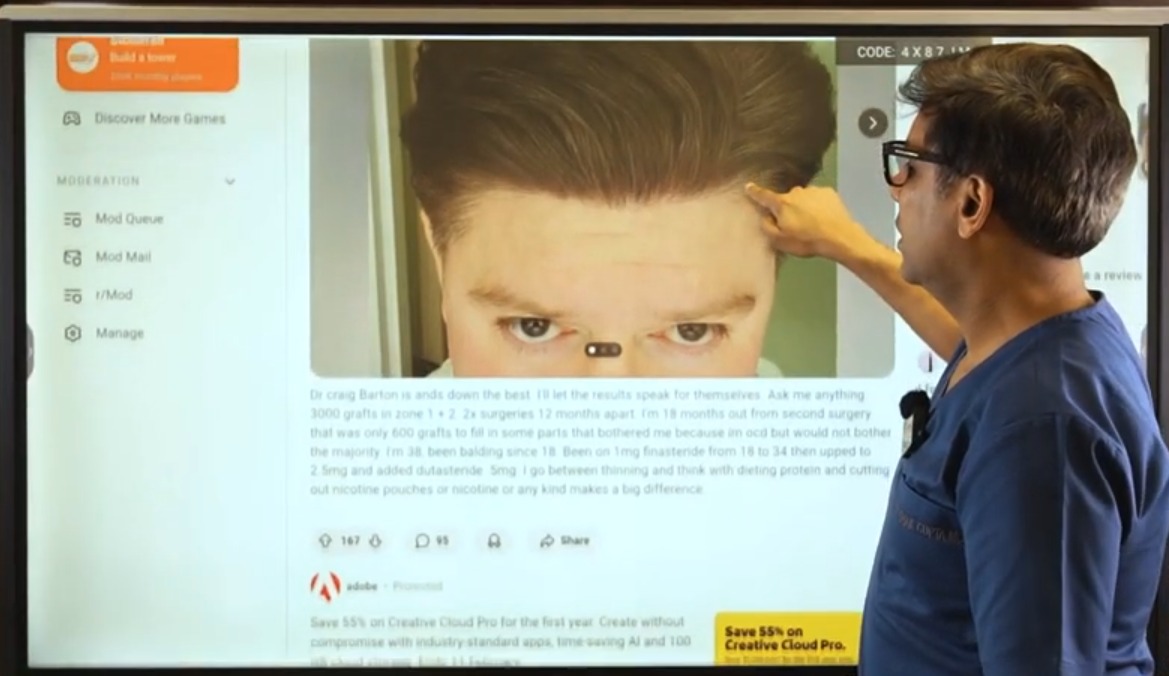
The post in question comes from a Reddit user who shares what appears to be an impressive hair restoration result a well-defined hairline with good density. Dr. Shail opens the video by pointing directly to the after-photo on screen. But what catches his eye immediately is not the hairline it is everything surrounding it.
The patient’s own caption reveals a detailed medication history, two separate surgical sessions, and a combination of hair-loss drugs that Dr. Shail describes as extraordinary. Here is exactly what the post discloses:
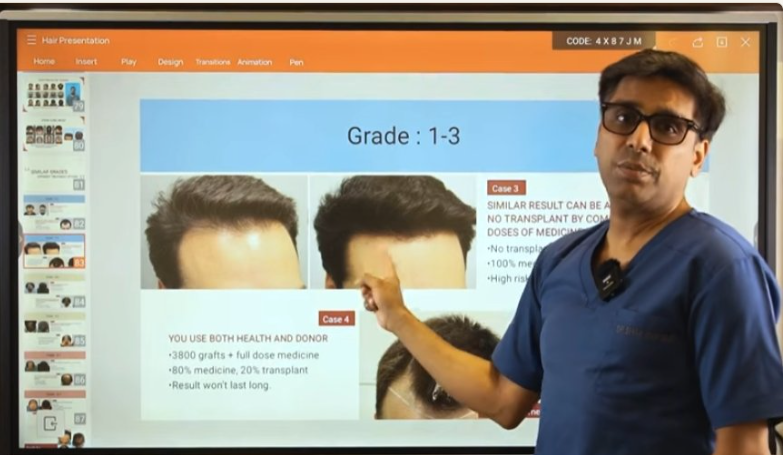
| 3,000 Grafts Session 1 (Zone 1) | 600 Grafts Session 2 (Gap Fill) | 2.5mg Finasteride Daily (raised) | 0.5mg Dutasteride Daily |
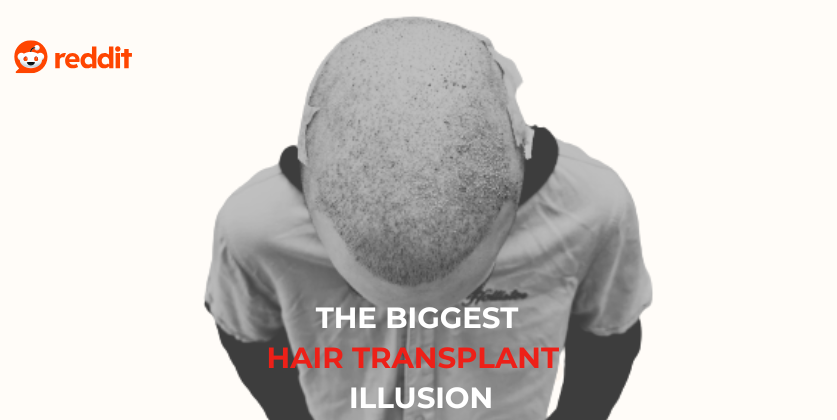
The first issue Dr. Shail flags is the pre-operative photo itself: the patient’s head is completely shaved. This is a critical detail. Without knowing what the existing hair density looked like before the transplant, it is impossible to attribute any post-transplant fullness purely to surgical intervention.
The second issue: 3,000 grafts in Zone 1 alone. Dr. Shail notes this is an extraordinarily high number and ‘seems really, really unlikely’ unless there was an unusual degree of loss which the shaved photo makes impossible to confirm.
The Medication Nobody Is Talking About
While dozens of Reddit commenters praised the hairline and asked for the surgeon’s name, the medications disclosed in the post went almost entirely uncommented upon. Only a single comment in the entire thread raised a concern and it was a simple one: ‘Let’s hope you are not permanently harmed by finasteride and dutasteride.’
The patient disclosed they started on 1mg finasteride daily from age 18 to 34, then escalated to 2.5mg per day, while simultaneously adding 0.5mg dutasteride daily. Both drugs at the same time, at doses above standard clinical guidelines.
| Medication | Standard Dose | Patient’s Dose | Risk Level |
| Finasteride | 1 mg/day | 2.5 mg/day | Elevated |
| Dutasteride | 0.5 mg every other day | 0.5 mg/day (daily) | Elevated |
| Both combined | Not standard protocol | Both taken daily | High Risk |
Dr. Shail’s reaction is direct: ‘That’s huge and insane.’ His concern is twofold the medical risk of combining two DHT blockers at elevated doses, and the diagnostic problem it creates. When you cannot separate the medication contribution from the surgical contribution, the result tells you almost nothing about the surgeon’s actual skill.
Medicine-Boosted Results: What Finasteride Can Do Alone
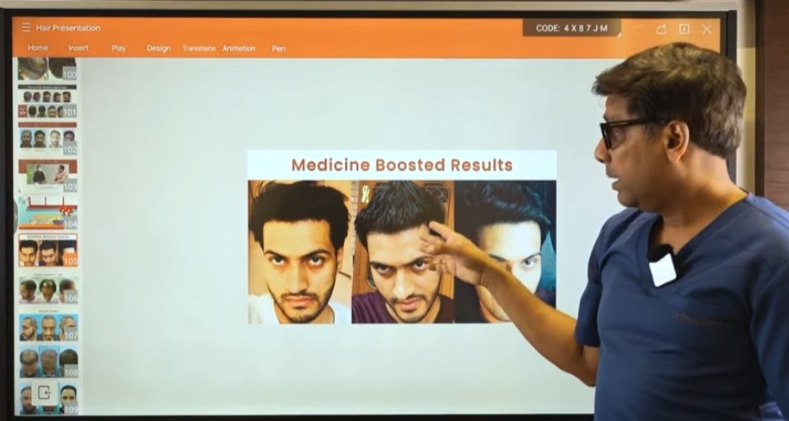
To illustrate exactly how powerful medication is as a standalone hair restoration tool, Dr. Shail presents clinical evidence from his own presentations cases where medication alone produced results that, without context, could easily be mistaken for post-transplant outcomes.
The patient shown in this slide had visible hairline recession and thinning. After a course of finasteride at 1mg per day with no surgical intervention whatsoever the hair growth produced is dramatic. Dr. Shail makes the point directly: ‘This growth which you are seeing here is just because of finasteride. No transplant done.’
Now consider that the Reddit poster was taking 2.5x that dose and simultaneously taking dutasteride on top. The medicine-only baseline these cases establish makes the implications for the Reddit result unmissable.
Clinical Insight
Finasteride works by blocking DHT the hormone responsible for follicle miniaturisation in androgenetic alopecia. At higher doses, more DHT is suppressed, and more follicles are preserved or reactivated. The hair you see growing on medication is real hair — but it belongs to the medicine, not the surgeon.
Dose Dependency: Less Medicine, Less Hair
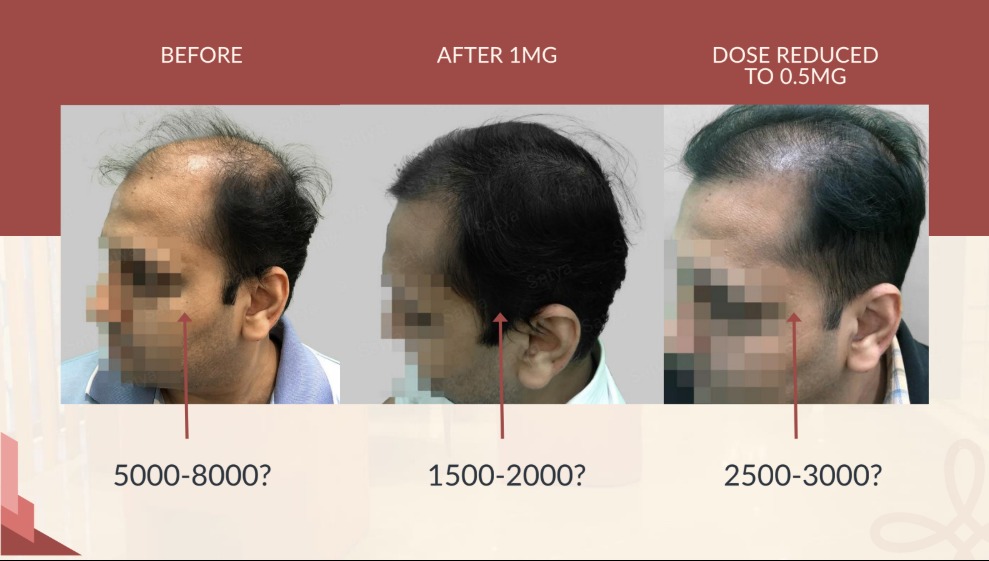
Dr. Shail takes the analysis one step further with a case that demonstrates something even more important the relationship between medication dose and visible hair density is directly proportional and measurable.

This three-panel comparison is one of the most instructive images in Dr. Shail’s entire analysis. A patient with Grade 6–7 hair loss begins finasteride at 1mg/day and sees substantial regrowth. When side effects prompted a dose reduction to 0.5mg, the thickness and density of that regrowth dropped visibly and measurably without any change to the transplant.
Less the dose, less would be the free hair and free credit to the surgeon. Remember this. This is a very important point.
Dr. Shail, Satya Skin & Hair Transplant Clinic
What Happens When the Medicine Stops
The implication for the Reddit post is stark. At 2.5mg finasteride daily two and a half times the dose shown in this comparison the medicine’s contribution to any visible hair density is amplified accordingly. And none of that contribution was credited to the medicine in the post.
What Happens When the Medicine Stops
The most sobering part of Dr. Shail’s analysis centres on a pattern he sees repeatedly both in his clinic and across Reddit result threads. A patient gets a transplant, takes their medication faithfully during recovery, sees an excellent result, and celebrates. Then at some point, they stop.
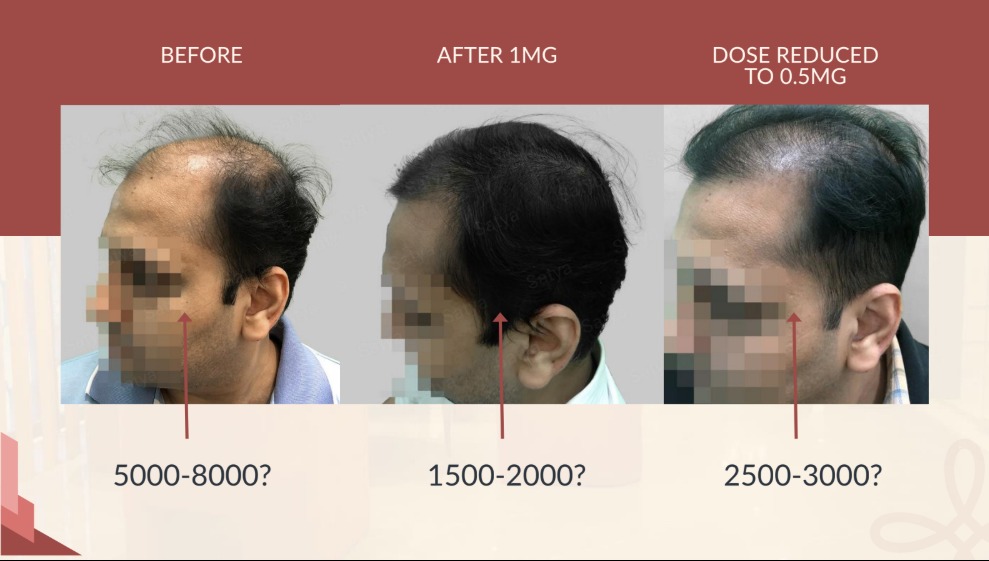
The result does not simply ‘fade.’ In many cases, it disappears entirely. The patient returns to Reddit asking where their result went. They are confused, upset, and often blame the surgeon. But the answer, Dr. Shail explains, is that the result they saw was always a combination outcome with medicine likely contributing 80%, 90%, or in some cases 100% of the visible improvement.
Critical Understanding
Transplanted hair is permanent DHT cannot miniaturise it. But the surrounding native hair that medication was keeping alive will shed when the drug is stopped. If most of the ‘result’ was native hair preserved by high-dose finasteride and dutasteride, stopping those drugs can make it appear as if the entire transplant failed when in fact the transplanted grafts are still there, now surrounded by shed native hair.
Dr. Shail poses the question directly to viewers imagining the Reddit poster’s future: ‘He is taking 0.5mg dutasteride daily and 2.5mg finasteride daily. Imagine what will happen if he stops taking the medicine. Imagine, just imagine.’
Why Reddit Is Particularly Dangerous for Hair Transplant Research
Reddit is a powerful peer-to-peer information platform but in hair transplant research, its structural dynamics actively mislead patients.
No Medical Context Is Required
Anyone can post a result. There is no requirement to disclose medications, dosages, graft counts with zone breakdowns, or pre-operative assessments. The post in this video disclosed medications but only in passing, buried in a text caption beneath a striking after-photo. Most posts disclose nothing at all.
Upvotes Reward Visual Drama, Not Medical Accuracy
A dramatic transformation earns upvotes. Cautionary comments are buried. In the post Dr. Shail analyses, the single useful comment the one questioning the medication was largely ignored while the thread celebrated the hairline. The community’s voting mechanism is optimised for visual impact, not medical truth.
Cost Is Not a Proxy for Transparency
This was a high-cost US procedure estimated by commenters at $15,000 to $20,000. Yet the result narrative follows exactly the same misleading pattern seen in budget procedures. Expensive does not mean honest, and spending more money does not make a medication-driven result any more attributable to surgery.
The Shaved Before Photo Problem
Dr. Shail returns repeatedly to this point. A shaved baseline photo hides the patient’s true pre-operative density. It makes it impossible to determine how much of the visible hair existed before any intervention making the entire before-and-after comparison meaningless from a clinical standpoint.
How to Evaluate Any Hair Transplant Result Properly
Demand an Unshaved Before Photo
The baseline must show actual pre-existing hair density. No valid comparison can be made from a shaved photo. If a clinic or patient cannot provide this, the result should be treated as unverifiable.
Ask for Full Medication Disclosure with Dosages
Finasteride, dutasteride, minoxidil all must be listed with exact doses and the duration they were taken before and after the procedure. A result on 2.5mg finasteride + 0.5mg dutasteride daily is not comparable to a result on 1mg finasteride or no medication at all.
Look for Long-Term Follow-Ups
Short-term photos taken at peak medication effect are not reliable indicators of a permanent result. Look for follow-ups at two, three, and five years ideally with standardised lighting, angles, and documented medication status at each stage.
Question High Graft Counts
3,000 grafts in a single zone is at the upper boundary of what is anatomically realistic. Inflated counts inflate fees and inflate perceived surgical achievement. Always request a documented breakdown of graft placement by zone.
Key Takeaways from Dr. Shail’s Analysis
- A shaved pre-op photo conceals the patient’s true baseline and makes any before-and-after comparison impossible to evaluate honestly.
- Finasteride at 2.5mg/day combined with dutasteride at 0.5mg/day daily is well above standard dosing the hair these drugs produce alone can be dramatic enough to appear surgical.
- Hair regrowth from medication is directly dose-dependent: higher dose equals more visible hair growth, independent of any transplant.
- When medication is stopped, medicine-dependent hair sheds causing results that appeared surgical to partially or completely disappear.
- Reddit result posts lack medical oversight and are structurally biased toward visual drama over clinical accuracy.
- The only thing that can truly protect your donor area, your health, and your money is complete information Satya.
The Satya Principle: Truth as the Only Safe Foundation
Dr. Shail closes the video with a statement that is both a warning and an invitation. ‘Spending money sitting on Reddit is not going to solve your problem. The only thing which can actually save you is truth. Satya.’
The word Satya means truth in Sanskrit and it is not incidental to the clinic’s name. It is the governing principle of every consultation, every case analysis, and every piece of content the clinic produces. The Reddit Hair Transplant Series exists precisely because the information patients need most is the information that gets the fewest upvotes.
Hair transplant is not a decision to be made based on a viral post. It involves your donor area a finite, non-renewable resource. It involves your health and your hormonal biology over years or decades. It involves medications you may need to take indefinitely to maintain any result. And it involves a surgical outcome that, when done poorly or based on wrong assumptions, may be difficult or impossible to correct.
The mission at Satya Skin & Hair is to make hair transplant decisions safe for everyone not by discouraging the procedure, but by ensuring every patient walks in with a complete, unvarnished picture of what they are committing to.
Questions About Hair Transplants & Medication
Yes significantly. At standard doses of 1mg/day, finasteride can produce visible regrowth by blocking DHT-driven follicle miniaturisation. At higher doses like 2.5mg/day, the effect is proportionally stronger. Dr. Shail’s clinical cases show regrowth in Grade 6–7 loss with no surgical intervention at all.
Both block DHT through the same pathway dutasteride more completely. Taking both simultaneously at elevated doses compounds hormonal effects and side effect risks significantly. This is not a standard protocol and should only occur under close medical supervision. Dr. Shail describes this combination in the video as ‘huge and insane.’
Selection bias, photography, and medication contribution all play a role. People post positive outcomes. Photos taken at peak medicine-dependent regrowth look dramatically different from photos taken years later off medication. Without baseline photos and medication disclosures, viewers have no way to contextualise what they are seeing.
A credible result includes an unshaved clear baseline photo, documented graft count with zone breakdown, full disclosure of all medications and dosages, and long-term follow-up photos at standardised conditions. Ideally, the result is independently reviewed by a specialist not involved in the procedure.
It depends entirely on your degree of loss, cause, age, and medication response. Some patients achieve cosmetically sufficient results from medication alone. Others require both. A consultation with a specialist who can assess donor density, loss pattern, and medication response is the only way to determine the right approach for your specific case.
Medical Disclaimer: This article is for educational purposes only and is based on Dr. Shail’s clinical video analysis. It does not constitute medical advice. Finasteride and dutasteride are prescription medications their use, dosage, and combination should only be determined by a qualified medical professional. Individual results from hair transplant procedures vary based on genetics, donor density, age, and adherence to post-operative protocols.