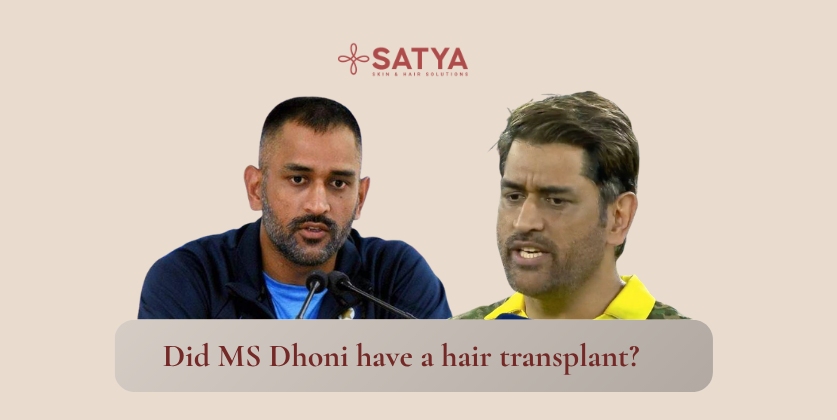
MS Dhoni is one of the greatest captains Indian cricket has ever produced. His ability to read a match, stay calm when everything is on the line, and make precise decisions under enormous pressure put him in a category of his own.
But when it comes to his hair transplant and the visible changes in his hairline strongly suggest a procedure was done, even if it has never been officially confirmed the execution tells a very different story from his cricketing legacy.
This is not a personal critique of the man. It is a clinical critique of the procedure. And it is one we are uniquely placed to make because at Satya Skin & Hair Solutions in Gurgaon, we regularly receive patients who come to us after exactly this type of result: a transplant that was done, cost real money, and still looks unnatural.
Important disclaimer: MS Dhoni has never publicly confirmed undergoing a hair transplant procedure. This blog uses the publicly visible changes in his hairline as an educational lens to explain how modern hair restoration works, not as a clinical claim about his personal medical choices.
MS Dhoni’s Hair Journey: A Timeline That Fans Have Been Watching
To understand the current conversation around the “MS Dhoni hair transplant“, it helps to look at his hair history in phases.
2004–2010: The Long-Haired Debut Era
Dhoni made his international debut around 2004 with his signature long, flowing hair. At that time, there was no visible thinning or hairline recession. The long locks became part of his identity, the ‘Mahi’ look that defined a generation of fans.
2011–2016: The Thinning Phase
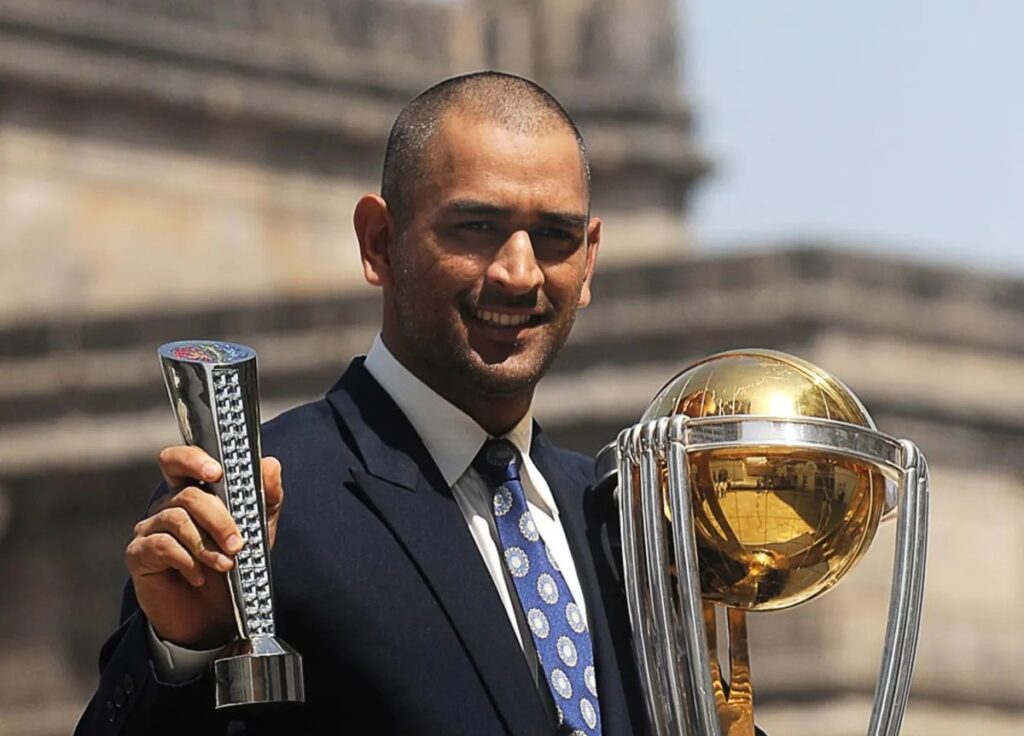
Following the 2011 World Cup victory, Dhoni transitioned to shorter hairstyles. As high-definition broadcast cameras became standard in cricket coverage, viewers began noticing a receding temporal hairline and reduced density at the crown.
The pressures of captaincy, physical demands of professional sport, and likely genetic predisposition all contributed. By 2015–2016, the hairline recession was more pronounced in photographs taken from certain angles.
2020 Onward: The Visible Transformation
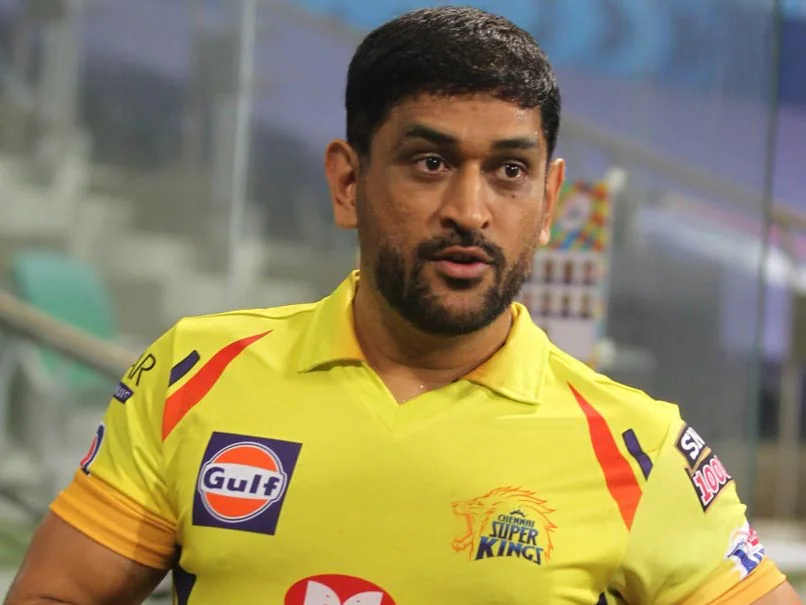
During the COVID-19 period, Dhoni stepped back significantly from public appearances. When he re-emerged in 2020 and 2021, and even more strikingly in the 2023 and 2025 IPL seasons, observers noted restored frontal density, a more defined temporal hairline, and the ability to style his hair long again. The hair moves naturally during physical activity, responds normally to sweat, and can be pulled into tight knots, which rules out non-surgical hairpieces.
As hair restoration specialists, we can say this: growing a thick, long mane from a previously receding frontal scalp is biologically impossible without first restoring the follicles. Whether that restoration involved a surgical hair transplant, an exceptionally skilled non-surgical approach, or a combination of treatments, only Dhoni’s medical team can confirm.
What the Photographs Actually Show: A Clinical Breakdown
Most commentary on celebrity hair transplants stays vague. “His hair looks great” or “you can tell it’s a transplant” neither of those observations is useful to someone trying to understand what quality actually looks like.
As hair restoration specialists who examine hairlines in clinical settings every day, here is what draws our attention when we look closely at Dhoni’s post-transformation hairline in high-resolution broadcast footage and public photographs.
Observation 1: Thick, Coarse Grafts at the Frontal Hairline Edge
A natural hairline never begins with your thickest, most mature hair. Nature creates a soft transition zone at the very front extremely fine, single-strand follicles with low profile and shallow exit angles. These single-hair units form a feathered edge that gradually gives way to denser hair further back.
What is visible in Dhoni’s frontal zone is the opposite. Coarse, multi-follicular grafts units containing two or three hairs each appear to have been placed directly at the leading edge of the hairline. The result is a front row that reads as planted rather than grown. Even from a television camera distance, the edge is too definite, too thick, and too abrupt to look natural.
| Clinical Observation: Front Row Graft Selection Error Natural hairline front row: Single follicular units (1 hair per graft), fine texture, shallow exit angleObserved here: Multi-follicular grafts (2 to 3 hairs per unit) positioned at the very leading edgeWhy this matters: The front row sets the entire visual impression of the hairline. Get it wrong and the whole result reads as artificial regardless of how good the density zone behind it isThis is one of the most common errors we see in repair cases at Satya, and it is fully correctable |
Observation 2: Geometric Hairline Shape Instead of Organic Design
Look carefully at the shape of the hairline itself. A natural male hairline even in a young man in his twenties is not a geometric form. It follows organic curves, slight left-to-right asymmetry, soft recession at the temples, and what clinicians call an “irregular edge” that gives the impression of hair that has always been there.
In multiple photographs and broadcast clips, Dhoni’s post-transplant hairline shows sharp, angular peaks that form a triangular or geometric profile. This is not what natural hairlines look like. This is what a hairline drawn with a template looks like a surgical construction rather than an organic form.
“A natural hairline is never geometric. It is soft, irregular, asymmetric, and has a gradual transition. What we see here is a designed shape and that is precisely the problem.”
Observation 3: Graft Direction Errors in the Temporal Zone
Hair does not grow perpendicular to the scalp. Each follicle has a natural exit angle typically very acute (close to the skin surface) in the frontal zone, angling toward the face at the temples, and following specific directional flows across different scalp zones. These angles are not arbitrary they are what allow your hair to lay flat, blend naturally, and style in the ways you are used to.
In Dhoni’s temporal zones, several grafts appear to exit the scalp at incorrect angles, creating a texture that does not match the surrounding hair flow. This is not visible to a casual eye at a glance, but it is immediately apparent to a clinician trained in hairline anatomy and it creates the subtle but unmistakable impression that something is “off” about the hairline, even when the viewer cannot articulate exactly what.
Natural Hairline vs. What Is Observed: A Clinical Comparison
| Hairline Element | How Nature Does It | What We Observe Here |
| Front row grafts | Single-hair units, fine, low profile | Multi-hair grafts, coarse, high profile |
| Hairline shape | Soft, irregular, slightly asymmetric | Geometric, triangular peaks visible |
| Graft exit angle | Acute, follows natural scalp flow | Some grafts at incorrect angles |
| Density transition | Gradual: sparse front, denser inside | Density appears abrupt at the edge |
| Temple design | Soft recession, organic widow peak | Appears constructed, not grown |
| Overall impression | Hair that has always been there | Hair that was placed there |
Why Does This Happen? The Real Cause Is Never Money
Here is the question that follows naturally from the above: if Dhoni could access any clinic in the world, how did this result occur? It is a fair question and the honest answer is one we give patients in our clinic every single week.
“The problem is never money. The problem is wrong planning, wrong doctor, and wrong information.”
An expensive clinic, a celebrity client list, and a premium price point do not guarantee natural results. Hair transplantation is not a technical challenge in the way that, say, aircraft engineering is a technical challenge where more resources reliably produce better outcomes. It is an art form that sits at the intersection of surgical precision, aesthetic judgment, and long-term thinking. And those things cannot be purchased with a higher price tag.
The specific errors visible in cases like this one almost always come from the same three root causes:
- Wrong hairline design philosophy: The hairline template was drawn without respecting the soft-transition principle. No single-hair front row. No organic asymmetry. The design was geometrically placed but aesthetically incorrect. This is a training and philosophy problem, not a technical one.
- Wrong graft selection for the front row: Using multi-follicular grafts at the leading edge is a fundamental error. Two-hair and three-hair units belong in the mid-scalp, where they build density behind the hairline. They should never appear in the outermost row, where nature always begins with single, fine, flat hairs.
- No long-term restoration plan: A hair transplant must account for where the patient’s hair loss is heading over the next ten to fifteen years not just today. If the surrounding non-transplanted hair continues thinning, the transplanted zone can begin to look like an isolated island of density surrounded by progressive recession. This is a planning failure that produces results which look increasingly artificial over time.
“A hair transplant is not just placing grafts. It is artistry. Long-term planning. And a deep respect for how nature builds a hairline.”
Our approach at Satya is defined by five integrated principles that directly address the failure points visible in suboptimal cases like the one discussed above:
| The Satya Approach: Less Medicine. Less Donor. Maximum Skill. Mimic Nature Hairline: Every hairline we design uses single-hair grafts in the front row, organic asymmetry, irregular soft edges, and an age-appropriate recession that looks like the patient’s natural hairline because it follows the same principles nature used to build it originally. DSFT (Direct Stimulated Follicular Transplant): Our proprietary technique for graft extraction and placement, developed over twenty years of clinical practice, designed to maximise graft survival and achieve directional precision at the implantation stage. MHT (Maximum Harvesting Technique): We protect your donor zone. Over-harvesting today permanently destroys your options for tomorrow. Donor preservation is not optional it is the most consequential long-term decision in hair restoration, and one most clinics do not think carefully enough about. Future-Ready Transplant Planning: We design every restoration for where your hair will be in ten to fifteen years, not just today. That means predicting progression patterns, planning zones strategically, and integrating medical therapy alongside surgery where it is indicated. Zero-Pain Anaesthesia Protocol: A carefully managed delivery method that eliminates the discomfort typically associated with the anaesthesia injection phase. The procedure should be as comfortable as the result is natural. |
If Your Hair Transplant Looks Unnatural — Repair Is Possible
We want to say this clearly, because many patients who come to us with a suboptimal transplant feel permanently trapped by someone else’s poor execution. They believe they are stuck with the result. They are not.
Artificial triangles, wrong-direction grafts, harsh hairlines we remove, reshape, and redefine them so the result looks like naturally grown hair, not a transplant.
Hair transplant repair is a specialised clinical discipline. At Satya, Dr. Shaiil Gupta handles repair cases on a regular basis patients who came to us after procedures performed elsewhere, sometimes at large chains, sometimes abroad in Turkey or Southeast Asia, and sometimes at clinics that charged premium prices for subpremium results.
What repair involves depends specifically on what went wrong:
- Hairline edge correction: When the front row contains coarse multi-hair grafts, single-hair units can be added in front of them to create the soft feathered edge that should have been there originally. In cases where grafts are badly misplaced, surgical extraction and reimplantation is possible.
- Geometric hairline reshaping: Artificial triangular peaks and over-straight hairlines can be redesigned by adding grafts to fill unnatural angles and reshape the leading edge into an organic form.
- Wrong-direction graft correction: Grafts implanted at incorrect angles can be extracted under magnification and reimplanted at the correct directional angle. This is a precision procedure requiring specific instrumentation and significant clinical experience.
- Density redistribution: Areas with pluggy clustering can be addressed by redistributing grafts or breaking up artificial density patterns with fine single-hair units placed between existing grafts.
- Donor zone management: Where the donor area has been over-harvested or shows visible depletion, Scalp Micropigmentation (SMP) can restore visual density and conceal extraction-site scarring effectively.
| The Critical Constraint in Every Repair: Donor Supply Repair is possible in most cases. But donor hair is a finite, non-renewable resource.Every graft used in a repair procedure is a graft that is no longer available for future restoration work.This is why the original procedure must protect donor supply and why poor planning in the first procedure creates real limitations that last a lifetime.If your existing transplant consumed too much donor tissue, some repair options will be restricted or unavailable.This is the true long-term cost of choosing the wrong clinic the first time. |
What This Case Should Teach Anyone Considering a Hair Transplant
Whether or not you are a cricket fan, the clinical observations in this article carry real, practical lessons for anyone thinking about hair restoration in India or abroad.
- Celebrity associations tell you nothing about result quality: A clinic that has treated a well-known person does not thereby guarantee you a natural outcome. Judge the result — specifically the frontal hairline in natural light not the name on the wall or the endorsement attached to it.
- Always ask to see repair cases, not just success stories: Any clinic with genuine experience and honest clinical standards will have repair cases in their portfolio. If they cannot show you cases where they corrected someone else’s poorly executed transplant, they may not have the skills or experience to avoid creating one.
- Graft count is a distraction from what actually matters: Patients are routinely quoted two thousand, three thousand, four thousand grafts. None of that volume matters if the hairline design is wrong. A beautifully designed hairline with fifteen hundred well-selected, correctly placed grafts will produce a better result than three thousand grafts placed without artistic vision.
- Ask specific questions about hairline design philosophy: Ask your doctor directly: what grafts will you use in the front row? At what angle? How will you create the soft transition zone? How is your hairline design different from a geometric template? If the doctor cannot answer these questions precisely and specifically, they are not thinking carefully enough about your result.
- Plan for future hair loss, not just present coverage: Ask what your appearance will look like in ten years if your hair loss continues to progress in non-transplanted areas. A good doctor will have a detailed, considered answer. A doctor who tells you not to worry about it is telling you they have not thought about it.
- Donor preservation must be a primary consideration: Before any procedure, understand how the doctor plans to protect your donor zone for the future. You may need further sessions. You may develop additional thinning in areas not yet treated. Your donor supply is the single most important long-term asset in your hair restoration journey.
Dhoni’s case is not unusual for elite athletes. Hair loss in this demographic tends to have multiple contributing factors working simultaneously:
- Genetic predisposition to androgenetic alopecia (male pattern baldness), which accounts for the majority of male hair loss regardless of fitness level
- Chronic stress from leadership responsibilities, high-stakes competition, and relentless public scrutiny, which can accelerate telogen effluvium (stress-related shedding)
- Nutritional demands of intense athletic training, which can deplete key hair-supporting micronutrients such as iron, zinc, and biotin if not carefully managed
- Helmet and headgear friction over years of professional play, which may contribute to traction-related miniaturisation at the hairline
- DHT (dihydrotestosterone) sensitivity, which is genetically determined and the primary driver of follicular miniaturisation in pattern baldness
None of these factors suggest weakness, they reflect the biology of high-performance living. The important point is that all of them are addressable with modern hair restoration science.
What Procedure Could Produce This Kind of Result?
Based on the visible outcome, natural hairline definition, density without the ‘pluggy’ look of older techniques, and the ability to wear very short styles without linear scarring, hair restoration experts examining Dhoni’s photographs widely suggest that FUE (Follicular Unit Extraction) is the most likely technique used, if a transplant occurred.
How FUE Works
FUE involves extracting individual follicular units, naturally occurring groups of one to four hair follicles, from a donor-rich zone at the back and sides of the scalp. Each unit is extracted using a micro-punch instrument, leaving tiny circular healing points rather than a linear strip scar. The harvested grafts are then implanted into recipient channels created in the thinning or receded zones.
For someone like Dhoni, who has regularly worn buzz cuts with faded sides even after his supposed restoration, FUE makes clinical sense. A linear FUT scar would be visible with very short back-and-sides styling. No such scar appears in publicly available photographs.
| Our Approach at Satya: DSFT (Direct Stimulated Follicular Transplant)At Satya Skin & Hair Solutions, Dr. Shaiil Gupta performs hair restoration using DSFT, our proprietary Direct Stimulated Follicular Transplant technique, combined with the Maximum Harvesting Technique (MHT) to preserve donor supply. Our philosophy of ‘Less Medicine. Less Donor. Maximum Skill.’ means we prioritise surgical precision over volume, creating results that look naturally yours, not transplanted. Zero-pain anaesthesia ensures patient comfort throughout the procedure. |
What Makes a Hair Transplant Look Natural: The Clinical Factors
The reason so many people look at Dhoni’s hair and say ‘it looks real’, rather than ‘it looks done’,comes down to several technical decisions that skilled surgeons make before a single graft is placed.
- Age-appropriate hairline design: A 40-year-old should not have the low, straight hairline of a teenager. A skilled surgeon designs a hairline that suits the patient’s current age and face structure, with slight temporal recession built in for authenticity.
- Mimic Nature Hairline concept: At Satya, we call this our ‘Mimic Nature‘ approach, the hairline must follow the natural irregularity of a grown hairline, using single-follicle grafts at the front row to avoid the ‘doll hair’ density clustering of older techniques.
- Correct angulation and direction: Each graft must be implanted at the precise angle and direction that matches native hair growth in that zone. Poor angulation is the most common cause of an unnatural appearance.
- Controlled density distribution: Rather than packing grafts uniformly, density should be graduated, denser at the frontal zone, transitioning naturally toward the crown.
- Donor zone management: Extracting too many grafts from too small an area thins the donor zone visibly. The MHT technique we use at Satya is designed specifically to harvest across a wider zone at lower density, protecting the permanent appearance of the donor area.
| Book Your Hair Restoration ConsultationSatya Skin & Hair Solutions | Gurgaon (DLF Phase 4) & Delhi (Pitampura)Dr. Shaiil Gupta | Dr. Ruchi Agarwal | Established 2005 | +919999570494 | [www.satyaskinhair.com] |
Frequently Asked Questions
No. MS Dhoni has never publicly confirmed or denied undergoing a hair transplant. The speculation is based entirely on publicly visible changes in his hairline and hair density observed by fans and hair restoration professionals examining photographs over time.
Based on the hairline recession pattern visible in photographs from 2012–2016, analysts estimate that a restoration addressing the frontal and temporal zones could require between 1,500 and 2,500 grafts depending on the target density and natural donor characteristics. This is a moderate-to-large session for a skilled clinic.
At Satya Skin & Hair Solutions in Gurgaon, hair transplant costs are determined on a per-graft basis following a clinical evaluation. Pricing varies based on the number of grafts required, the complexity of the hairline design, and the technique used. A consultation with Dr. Shail Gupta provides a personalised quote. Please contact +919999570494 for current pricing.
The transplanted follicles are genetically resistant to DHT (the hormone responsible for pattern baldness) because they are harvested from the permanent donor zone. Once established, they continue to grow for life. However, a hair transplant does not prevent further natural hair loss in non-treated areas. A comprehensive treatment plan combining transplant with medical therapy where indicated provides the most durable result.
Most patients return to sedentary work within three to five days. The small scabs at graft sites shed by days seven to ten. Physical exercise should be avoided for two to three weeks. Complete healing of the scalp occurs within a month, after which normal activity, including swimming and sport, can be resumed.
Yes, when performed by an experienced surgeon using correct hairline design, appropriate graft angulation, and gradated density placement. At Satya, our Mimic Nature Hairline concept is designed specifically to produce results that are indistinguishable from natural hair in terms of growth direction, texture, and overall appearance.
The procedure is performed under local anaesthesia. At Satya Skin & Hair Solutions, we use a Zero-Pain Anaesthesia protocol, a carefully managed delivery method that eliminates the discomfort typically associated with the injection phase itself. Most patients describe the experience as far more comfortable than they anticipated.
Yes. Dr. Ruchi Agarwal leads our women’s hair restoration programme at Satya. Female hair loss follows different patterns (Ludwig Scale rather than Norwood) and requires a distinct clinical approach. We offer personalised consultations for women experiencing diffuse thinning, hairline recession, and traction alopecia.
Disclaimer: MS Dhoni has never publicly confirmed undergoing a hair transplant. This article is a clinical and artistic analysis based entirely on publicly available photographs and video footage.
It represents the professional observations of Dr. Shail Gupta, Hair Restoration Surgeon at Satya Skin & Hair Solutions, Gurgaon not a confirmed diagnosis, verified patient record, or treatment history.
Our purpose is educational: to help readers understand the difference between a well-executed and a suboptimally executed hair transplant, so they can make better, more informed decisions about their own care.