
QUICK ANSWER
Yes, women can have a hair transplant, but fewer women are suitable than men. A female hair transplant works best when hair loss is confined to a defined area, such as a high or traction-damaged hairline, a thinning parting, a scar, or the eyebrows, and the hair at the back of the scalp is stable. Diffuse thinning that includes this donor area, active shedding, and scarring or autoimmune hair loss need diagnosis and medical treatment first. New growth starts at 3 to 4 months and matures over 12 to 18 months.
A common assumption is that if hair transplants work for men, they should work for any woman losing hair. But a transplant does not create new hair. It moves follicles from a stronger area of the scalp to a thinner one, so it can only be as reliable as that donor hair.
In most men, the back and sides resist hormone-driven thinning. In many women, thinning is spread more evenly and can include the donor zone itself. That difference is why a hair transplant for women needs a careful diagnosis, a conservative plan, and honest expectations.
Can Women Get a Hair Transplant?
Yes, and more women are choosing to. The International Society of Hair Restoration Surgery (ISHRS) reported in its 2025 Practice Census that the number of women treated surgically rose by 16.5% between 2021 and 2024. Suitability is a separate question: the American Hair Loss Association estimates that only around 2 to 5% of women with hair loss are potential surgical candidates.
Why Female Hair Loss Behaves Differently
Female pattern hair loss (FPHL), the female form of androgenetic alopecia, gradually shrinks follicles until they produce finer, shorter hairs. Unlike male pattern baldness, it usually preserves the front hairline and thins the top of the scalp, often first noticed as a widening parting. Doctors grade it on the Ludwig (I to III) or Sinclair (1 to 5) scales. Read more about female hair loss.
DR. RUCHI AGARWAL ON DIAGNOSIS
Many women who ask for a transplant leave with a different plan, and I consider that a good outcome. When we correct low iron, treat the thyroid, or let post-pregnancy shedding settle, much of the lost volume often returns without surgery. Diagnose first. Then decide.
Who Is a Good Candidate for a Female Hair Transplant?
A good candidate has a defined area of loss, a stable donor zone, a diagnosed and controlled cause, and realistic expectations.
| Situation | Usually Suitable? | Key Condition |
|---|---|---|
| Naturally high hairline or large forehead | Often | Hairline stable, no family pattern of recession |
| Traction alopecia from tight braids, buns, or extensions | Often | Loss has stabilised and the hairstyle has changed |
| Female pattern hair loss with a defined thinning zone | Sometimes | Donor stable on trichoscopy; medical treatment continues |
| Scars from surgery, injury, or burns | Often | Scar mature; a small test session may be advised |
| Thin or over-plucked eyebrows | Often | No active eyebrow disease such as FFA |
| Diffuse thinning including the back and sides | Rarely | Donor is itself thinning; medical treatment preferred |
| Active shedding or active autoimmune or scarring alopecia | Not while active | Cause treated and stable first |
Because a transplant redistributes hair rather than adding to the total, it can rebuild density in a chosen area but cannot restore overall volume. See our guides to traction alopecia hair transplant and eyebrow transplant.
Female Hair Transplant Techniques: FUE, FUT, and Unshaven Options
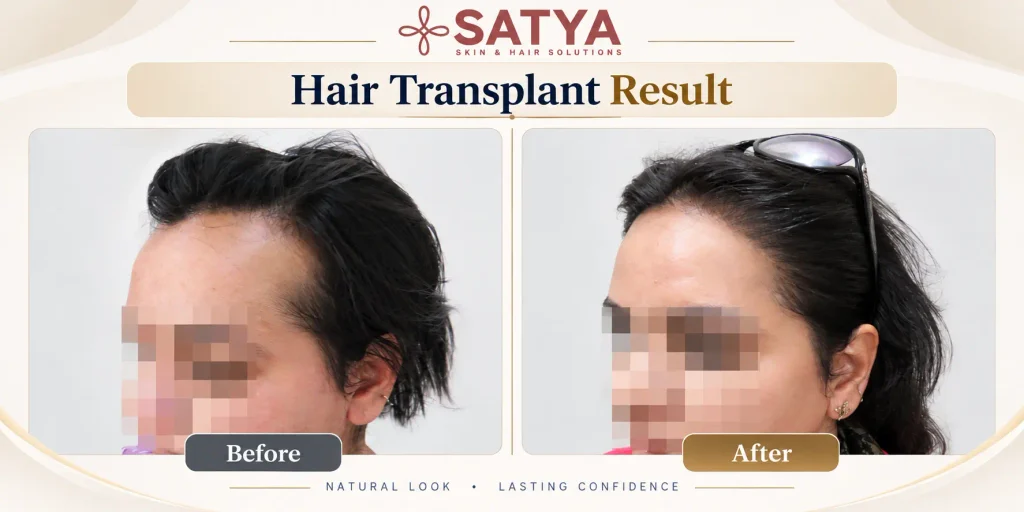
The techniques are the same as for men, but women’s hairstyles and donor characteristics change how they are applied.
- FUT (strip method): a narrow strip is taken from the back of the scalp. No shaving is needed and the fine linear scar is hidden under long hair, but women’s tighter scalps require conservative planning.
- FUE (follicular unit extraction): follicles are taken one by one, leaving tiny dot scars. It usually needs a small shaved patch, and it can visibly thin a donor that is already marginal.
- Unshaven and long hair transplant: grafts are extracted and implanted without shaving, so social downtime is shortest. Sessions are smaller and the cost per graft is higher. See hair transplant without shaving the head.
| Factor | FUT | FUE (Shaved Patch) | Unshaven / Long-Hair FUE |
|---|---|---|---|
| Shaving needed | No | Small patch, usually concealable | No |
| Donor scar | Fine line, hidden by long hair | Small dot scars | Small dot scars |
| Session size | Suited to larger sessions | Moderate to large | Smaller, as it is slower |
| Main limitation | Needs adequate scalp laxity | Can thin a marginal donor | Longer procedure, higher cost per graft |
Shock Loss: The Risk Women Should Know About
Placing grafts between existing hair can make some native hairs shed in the weeks after surgery. This shock loss is generally more common in women, because their thinning areas contain more miniaturised hairs. It is usually temporary, though severely miniaturised hairs may not all return, and careful site creation with medical treatment helps reduce the risk. See hair transplant side effects.
DR. SHAIL GUPTA ON DONOR PLANNING
A woman’s donor area is usually smaller and less forgiving, so the question is never how many grafts we can take, but how many we should. Our MHT™ planning protects the donor’s appearance and future reserve, and our DSFT™ protocol keeps grafts’ time outside the body short. At the front, our Mimic Nature Hairline™ approach creates a soft, slightly irregular edge of fine single hairs that follows the natural female curve.
Hair Transplant for a Big Forehead: Grafts or Hairline Lowering?
A naturally high hairline is one of the more predictable reasons women consider surgery, because it is usually not progressive hair loss. There are two routes:
| Factor | Hair Transplant | Surgical Hairline Lowering |
|---|---|---|
| How it works | Grafts placed in front of the hairline | Forehead skin removed; hair-bearing scalp advanced |
| Change | Gradual, maturing over 12 to 18 months | Immediate, often one to several centimetres |
| Scar | Small donor scars only | Fine incision along the hairline |
| Best suited to | Limited scalp laxity, temple reshaping, family history of hair loss | Good scalp elasticity, healthy frontal density |
| Sessions | A second session is sometimes needed for central density | Usually one procedure |
The two can be combined, with grafts softening a surgically advanced edge. The choice depends on scalp elasticity and family history, so it should follow an examination.
The Clinical Journey: Before, During, and After
Before: Preparation
- Any medical cause is treated first; many women begin medical therapy months before surgery to stabilise native hair.
- Blood thinners, some supplements, and smoking are reviewed and paused as advised.
- A written plan states the target area, graft estimate, technique, and what the procedure cannot achieve.
- Pregnancy plans are discussed, as surgery and several hair loss medicines are avoided in pregnancy and while breastfeeding.
During: Procedure Day
The procedure is done under local anaesthesia while you are awake, takes several hours (longer for unshaven methods), and you go home the same day. For most patients, the anaesthetic injections are the most noticeable part.
After: Recovery and Realistic Timelines
| Timeframe | What to Expect |
|---|---|
| Days 1 to 3 | Mild swelling and tenderness |
| Days 7 to 10 | Small crusts clear with gentle washing |
| Weeks 2 to 8 | Transplanted hairs shed, as expected; possible shock loss |
| Months 3 to 4 | New growth begins, fine at first |
| Months 12 to 18 | The result matures; final assessment |
Most women with long hair return to desk work within a few days. Tight hairstyles, colouring, and chemical treatments are paused for several weeks, on dates your surgeon specifies.
Why Medical Treatment Still Matters After a Hair Transplant for Women
A transplant moves hair; it does not stop the condition behind the thinning. In FPHL, native hair around the grafts can keep miniaturising, so long-term plans usually combine surgery with medical care:
- Topical minoxidil is approved for FPHL and remains first-line.
- Low-dose oral minoxidil is used off-label under supervision. A 2025 review in the American Journal of Clinical Dermatology reported excess facial or body hair in about 24% of users and listed pregnancy as a contraindication.
- Spironolactone may help selected women, especially with PCOS features, and requires reliable contraception. Finasteride is generally avoided in women who may become pregnant.
- PRP and GFC can be adjuncts, but the evidence is mixed and they do not replace proven medicines.
DR. RUCHI AGARWAL ON MEDICATION
In women, hair medication is a life-stage decision: what suits a 25-year-old planning a pregnancy differs from what suits a 52-year-old after menopause. Our MIN-MED™ approach means the lowest effective dose, reviewed as a woman’s plans change. Health bhi, hair bhi.
Female Hair Transplant Cost in India
Women’s hair transplant cost depends on the plan, not on gender. The main drivers are the number of grafts the donor can safely supply, the technique (unshaven methods cost more per graft), the medical workup, surgeon involvement, and any ongoing treatment.
As a worked example, at indicative Delhi NCR market rates of about ₹40 to ₹90 per graft for FUE and ₹30 to ₹50 for FUT, a 1,500-graft session works out to roughly ₹60,000 to ₹1,35,000 by FUE, or ₹45,000 to ₹75,000 by FUT. These are illustrative market ranges, not a Satya price list or quote. Our hair transplant cost in India guide explains graft-based pricing in more detail.
A reliable estimate needs a donor assessment. A graft number quoted before anyone has examined your scalp skips the most important step.
Questions to Ask Before Choosing a Clinic
- Who will diagnose the cause of my hair loss, and which tests are needed?
- Has my donor area been examined with trichoscopy, and is it stable?
- Which steps will the doctor perform personally?
- How much donor reserve will remain after this procedure?
- Is the medical treatment you recommend safe if I plan a pregnancy?
Be cautious of guaranteed density, discount-led urgency, and graft numbers offered before an examination. The National Medical Commission’s October 2026 guidelines on ethical medical advertising prohibit outcome guarantees and inducement offers, and ask doctors to publish their qualifications and registration details.
How We Approach Hair Restoration for Women at Satya
Our principle is less medicine, less donor, maximum skill. A dermatologist and a hair restoration surgeon assess each case together, the cause is diagnosed before surgery is discussed, and the plan is designed to look natural in ten years, not only ten months. For some women, the honest recommendation is medical treatment alone. Read how we plan each female hair transplant on our service page.
Frequently Asked Questions
Yes, if the hair loss is in a defined area, the donor zone at the back of the scalp is stable, and the cause has been diagnosed and controlled. Diffuse thinning that includes the donor area is usually better treated medically.
Grafts from a stable donor zone tend to keep growing long term, but the surrounding native hair can still thin. Most women need ongoing medical treatment, so it is long-lasting restoration rather than a guarantee against future loss.
It depends mainly on graft numbers and technique. At indicative Delhi NCR rates, a 1,500-graft session ranges from roughly ₹45,000 (FUT) to ₹1,35,000 (FUE), with unshaven methods costing more per graft.
Most women return to desk work within a few days. Crusts clear in 7 to 10 days, new growth starts at 3 to 4 months, and the result matures at 12 to 18 months.
Not as a first step. PCOS-related thinning is managed medically first, and a transplant is considered only if a thin area persists after the thinning stabilises and the donor is healthy.
It is best to wait. Post-pregnancy shedding usually recovers within 6 to 12 months, and surgery is generally planned after breastfeeding, because several medicines used alongside it are avoided while nursing.
The National Medical Commission’s 2026 guidelines on ethical advertising restrict doctors from displaying before-and-after photographs to promote surgical results. Your realistic outcome is best explained by a doctor who has examined your own scalp.
AN EVIDENCE-BASED NEXT STEP
If you are considering a hair transplant, start with a diagnosis. Schedule an evidence-based consultation with our dermatology and hair restoration team at Satya Skin & Hair Solutions in DLF Phase 4, Gurgaon, or Pitampura, Delhi. Please bring recent blood reports and a list of current medicines. Results vary from person to person, and any recommendation will follow your scalp and donor assessment.