

Dr. Shail Gupta compares two real Reddit journeys, one surgical, one medicine-only, and reveals why a graft count can fool you.
Two patients. Similar density. Completely different reasons, Dr. Shail Gupta explains the difference.
Two men post their hair-loss progress on Reddit. Both end up looking noticeably fuller. One had a reported 3,300-graft transplant; the other never went near an operating table. So when you scroll past a glowing “after” photo, how do you know what actually grew the hair, the surgery, or the medicine?
That’s the question at the heart of this review. Dr. Shail Gupta analyzes a patient who shared a 6.5-month result after a reported 3,300-graft procedure and compares it with another individual who achieved significant regrowth using medicines alone. Put side by side, the two cases expose one of the most misunderstood truths in hair restoration.
| Case A · Surgery- 3,300 Grafts · 6.5-Month Result | Case B · Medicine Only- Significant Regrowth · No Surgery |
| A patient shares his progress roughly six and a half months after a reported 3,300-graft transplant. The density looks strong, but how much of it is the grafts, and how much is the medication running alongside them? | A second individual achieves meaningful regrowth using medicines alone, no transplant at all. Proof that, for the right candidate, drugs like Minoxidil and Finasteride can do a great deal on their own. |
Why the Comparison Matters
The reason these two cases are so instructive is that they sit at opposite ends of the same spectrum. Hair transplant results are often influenced by both surgery and medical treatment, not surgery alone. When a transplant patient is also on medicines, the visible outcome is a combination of relocated grafts and the density those medicines add by thickening existing hair.
Case B removes the surgery from the equation entirely and shows just how much medicines can contribute on their own. Hold that against Case A, and it becomes clear why you can’t credit a transplant for the full result you see in a photo.
Two patients with similar graft counts can have very different outcomes,
because graft numbers alone don’t tell the whole story.
How Medicines Shape Cosmetic Density
Minoxidil and Finasteride can increase hair density in many patients, but individual responses vary, and not everyone experiences the same degree of improvement. That variability is exactly why two people with identical graft counts can land in very different places.
One patient may respond strongly to medication, so a modest transplant looks spectacular. Another may respond weakly, so even a high graft count looks underwhelming. The surgery didn’t necessarily differ, the medical response did. This is why graft estimates should always be interpreted alongside the planned medication strategy, never in isolation.

Why Graft Numbers Alone Don’t Tell the Whole Story
It’s tempting to treat a graft count as a score, more grafts, better result. But the number on a quote sheet says nothing about how those grafts were placed, how the donor was managed, or how the patient’s hair will respond to the medicines running alongside the surgery.
A genuinely successful plan treats surgery and medication as partners. Graft count tells you the scale of the operation; the medication strategy tells you how the surrounding hair will behave; and donor management and long-term planning decide whether the result still looks good years from now.
What Treatment Planning Should Actually Include
A strong hair restoration plan is about far more than a graft count. It weighs how surgery, donor management, medication and long-term planning work together to reach the best possible outcome. Skip any one of those, and you’re judging, or buying, a result on incomplete information.
Questions to Ask Before Choosing a Clinic
Before committing to any transplant, get clear answers on these:
- How much of my expected result depends on medicines like Minoxidil and Finasteride?
- What happens to my density if I stop those medicines later?
- How are you protecting my donor area for future hair loss?
- Is this graft count based on my actual need, or on a standard package?
- What does my result look like in five or ten years, not just at six months?
The Takeaway: Hair Bhi, Health Bhi
Neither surgery nor medicine is the villain here. The lesson is that they work together, and a result built on understanding that partnership is far more reliable than one judged on a single before-and-after frame. Watching real cases like these, with a surgeon explaining what’s actually happening, is how you make an informed decision instead of an impressed one.

Also Read:

How Long Do the Results of Hair Transplant Surgery Last?
Quick Answer Hair transplant results are considered long-lasting because transplanted follicles are taken from a…
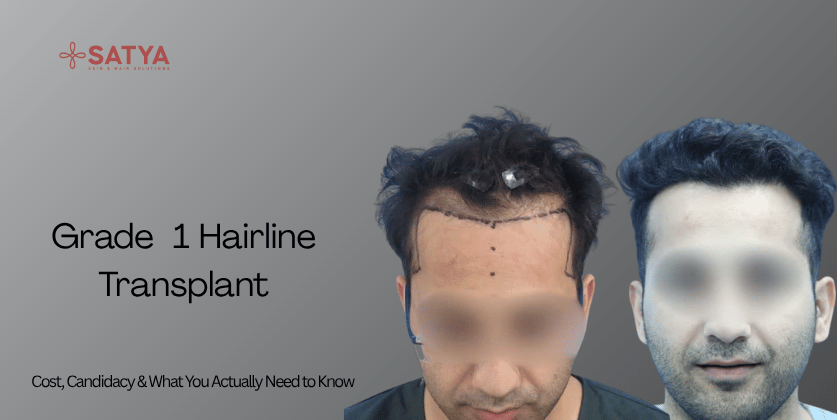
Grade 1 Hairline Transplant: Cost, Candidacy & What You Actually Need to Know (2026)
Before you read further: Clinically, “Grade 1” on the Norwood-Hamilton scale, the classification hair restoration…

Synthetic Hair Transplant Cost in India: A Dermatologist’s Complete Guide (2026)
Before you read further: A synthetic hair transplant is not the same procedure as a…
Frequently Asked Questions
For the right candidate, yes, the second case in this review shows significant regrowth from medicines alone. Minoxidil and Finasteride can increase density in many patients, though individual responses vary and not everyone improves to the same degree
Because the result isn’t just about grafts. Differences in how patients respond to medication, how grafts are placed, and how the donor is managed all affect the final look. A strong medication response can make a modest transplant shine; a weak one can flatten even a high graft count.
No. Graft count is only one factor. Placement, donor management, the medication plan and long-term strategy all matter. A graft estimate should always be read alongside the planned medication approach, not on its own.
It should account for surgery, donor management, medication and long-term planning together, plus honest expectations about how much of your density depends on continuing medicines. That combination, not a single number, is what makes a result durable.