You’ve completed your hair transplant. The grafts are in, the scabs have healed, and now comes the part nobody prepares you for, the waiting.
Somewhere in month two or three, when the transplanted hair sheds and the scalp looks thinner than before surgery, most patients start asking the same question: is there anything I can do to support this process?
This is often where PRP therapy enters the conversation. Many hair restoration specialists recommend PRP (Platelet-Rich Plasma) injections as a supportive treatment after transplant surgery. But it isn’t automatic, it isn’t for everyone, and the timing matters more than most people realise.
Here’s what you should understand before deciding.
What Is PRP Therapy?
PRP stands for Platelet-Rich Plasma. It is an autologous treatment, meaning it uses a component derived from your own blood rather than an external drug or synthetic substance.
How PRP Is Prepared
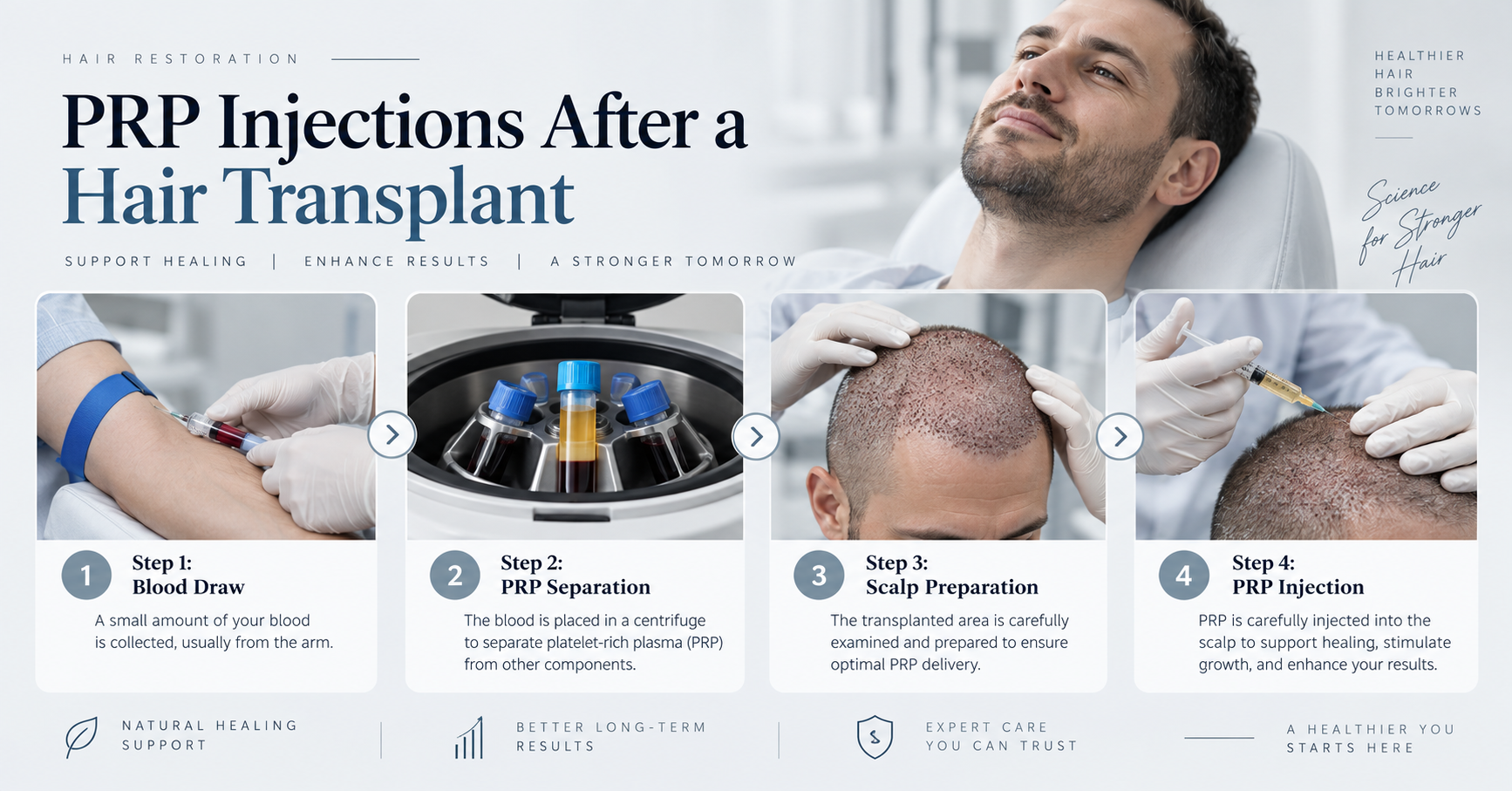
The process is relatively straightforward and is typically completed in a single clinic visit:
- Blood collection: A small quantity of blood is drawn from the patient’s arm, similar to a routine blood test.
- Centrifugation: The sample is spun in a centrifuge at a controlled speed. This separates the blood into layers: red blood cells, platelet-poor plasma, and the platelet-rich plasma layer.
- Extraction of the PRP layer: The concentrated platelet-rich portion is carefully separated.
- Scalp injection: The PRP is injected into the scalp at the level of the hair follicles, usually across the thinning or treated areas.
Why Platelets?
Platelets are best known for their role in clotting, but they also contain growth factors, biologically active proteins involved in tissue repair and cellular signalling. These include PDGF (platelet-derived growth factor), VEGF (vascular endothelial growth factor), EGF (epidermal growth factor), and IGF-1, among others.
The theory behind PRP in hair restoration is that concentrating these growth factors at the follicular level may help support the local healing environment, improve blood supply to the follicles, and influence the hair growth cycle. Research in this area is ongoing, and while a growing body of studies reports encouraging findings, results can vary considerably between individuals depending on platelet concentration, preparation protocol, and the underlying cause of hair loss.
Important: PRP is a supportive therapy. It is not a replacement for a hair transplant, and it is not a cure for hair loss. Its role is adjunctive; it works alongside surgery and, where indicated, medical treatment.
Why PRP Injections Are Recommended After a Hair Transplant
A hair transplant is, fundamentally, a surgical relocation of living tissue. Each graft is separated from its blood supply during extraction and must re-establish that connection in its new location, a process called revascularisation. The first few weeks after surgery are biologically demanding for these follicles.
Here’s why many specialists consider PRP a useful adjunct during this period.
1. May Support Graft Survival and Healing
Transplanted follicles depend on the recipient area developing adequate blood supply. The growth factors in PRP are associated with angiogenesis (formation of new blood vessels) and tissue repair. By introducing a concentrated dose of these factors into the scalp, the aim is to support a more favourable healing environment for the newly placed grafts.
It’s worth being clear here: PRP does not guarantee graft survival. Graft survival depends primarily on surgical technique, graft handling, out-of-body time, and post-operative care. PRP is best understood as one supportive element within a broader plan.
2. May Help Reduce the Severity of Shock Loss
Most patients experience shock loss in the weeks after a transplant, temporary shedding of transplanted hair and sometimes of existing native hair around the recipient area. This is a normal, expected phase of the hair cycle, and shed hairs typically regrow.
That said, shock loss is psychologically difficult. It often looks worse before it looks better. Some clinicians observe that PRP may help moderate the extent of shock loss and support earlier re-entry into the growth (anagen) phase, though individual responses differ and this is not a universal outcome.
3. May Support the Health of Existing Native Hair
A hair transplant addresses the areas that have already lost hair. It does not stop the underlying progression of androgenetic alopecia in the surrounding native hair.
This is one of the most under-discussed realities of transplant surgery. Without a long-term management plan, patients can find that while their transplanted hair grows well, the hair around it continues to thin, producing an uneven result over several years.
PRP is one of the tools a dermatologist may use, alongside medical therapy where appropriate, to help support the existing miniaturising follicles. Whether it is suitable for you depends on your specific pattern and stage of hair loss.
4. May Support the Overall Scalp Environment
Beyond individual follicles, PRP is used with the aim of improving the general condition of the scalp tissue, supporting microcirculation and the dermal environment in which follicles sit. A healthier scalp environment is generally considered favourable for hair growth, though the degree of benefit varies from patient to patient.
5. Autologous, Derived From Your Own Blood
Because PRP is prepared from the patient’s own blood, the risk of allergic reaction or immune rejection to the material itself is considered low. This does not mean the procedure is free of side effects; injection-site reactions, temporary swelling, tenderness, or mild bruising can occur, and there is a small infection risk with any injection. Suitability still requires medical assessment, particularly for patients with blood disorders, platelet dysfunction, active scalp infection, certain chronic conditions, or those on specific medications.
When Should You Have PRP After a Hair Transplant?
This is the question that matters most, and the honest answer is that there is no single universal schedule. Protocols vary between clinics and, more importantly, between patients.
That said, here is a general framework commonly used in clinical practice. Your own plan should be determined by your treating surgeon.
Before or During Surgery (Selected Cases)
Some surgeons administer PRP on the day of the transplant, or use it in graft holding solution, with the aim of supporting the grafts from the outset. Whether this is appropriate depends on the surgeon’s protocol and the individual case.
The First Few Weeks: Generally a Waiting Period
In the immediate post-operative period, typically the first 2 to 4 weeks, the scalp is healing, grafts are settling, and the area is fragile. Injecting into a freshly transplanted recipient area too early carries a risk of disturbing grafts.
Most protocols therefore avoid recipient-area PRP during this window. Your surgeon will advise the earliest safe point for your case.
Around Month 1: A Common Starting Point
Many clinics schedule the first post-transplant PRP session at approximately 4 weeks after surgery, once initial healing is complete, and the scalp can tolerate injections safely.
This timing is intended to coincide with the period when grafts are establishing themselves and when shock loss commonly begins — the window where supportive therapy is often considered most relevant.
Months 2–6: The Maintenance Phase
A typical course involves a series of sessions spaced approximately 4 to 6 weeks apart, often 3 to 4 sessions in the initial phase. This corresponds with the period during which transplanted follicles are re-entering the growth cycle.
Consistency matters here. A single PRP session is unlikely to deliver meaningful benefit; PRP Therapy is generally approached as a course rather than a one-off procedure.
Beyond 6 Months: Long-Term Support
After the initial course, some patients continue with maintenance sessions every 4 to 6 months, particularly those with ongoing androgenetic alopecia affecting their native hair. Whether maintenance is recommended, and at what interval, depends on your response to treatment and the progression of your hair loss.
Sample Timeline at a Glance
| Stage | Typical Timing | Purpose |
|---|---|---|
| Pre/intra-operative (select cases) | Day of surgery | Support graft environment from the start |
| Healing window | Week 1–3 | Generally no recipient-area PRP; scalp recovering |
| Session 1 | Around week 4 | Support early graft establishment |
| Sessions 2–4 | Every 4–6 weeks | Support growth phase, moderate shock loss |
| Maintenance | Every 4–6 months | Support native hair, long-term scalp health |
This table is illustrative. Your protocol will be individualised following medical assessment.
What Does a PRP Session Actually Involve?
For most patients, a session takes approximately 45 to 60 minutes from arrival to departure.
- Blood draw: A few minutes, similar to a standard blood test.
- Processing: 10–15 minutes in the centrifuge.
- Numbing: Topical anaesthetic or a scalp block may be used to improve comfort.
- Injection: The PRP is injected across the treatment area in a grid-like pattern. Most patients describe mild to moderate discomfort or a pricking sensation.
- Aftercare: Patients are typically advised to avoid washing the scalp for a short period, avoid strenuous exercise, saunas, swimming, and direct sun exposure for 24–48 hours, and to skip harsh chemical treatments for a few days.
Most people return to routine activity the same day, though this depends on individual tolerance and your doctor’s advice.
Who May Not Be Suitable for PRP?
PRP requires medical assessment, and it is not appropriate for everyone. A dermatologist may advise against it, or proceed with caution, in cases involving:
- Platelet disorders or low platelet count
- Blood clotting disorders or use of certain anticoagulant medications
- Active scalp infection, inflammation, or certain scalp conditions
- Active systemic infection
- Certain chronic liver, blood, or autoimmune conditions
- Active malignancy
- Pregnancy or breastfeeding (depending on clinical judgement)
- Heavy smoking or substance use, which may affect outcomes
This list is not exhaustive. A full medical history and, where indicated, blood investigations help determine suitability.
Possible Side Effects
PRP is generally well tolerated, but no medical procedure is without risk. Reported effects may include:
- Temporary scalp tenderness or soreness
- Mild swelling, particularly of the forehead
- Redness at injection sites
- Bruising
- Temporary headache
- Itching
- In rare cases, infection at the injection site
These effects are typically short-lived. Any persistent or worsening symptom should be reported to your treating doctor.
Setting Realistic Expectations
A few points worth being candid about:
PRP is supportive, not transformative on its own. It works best as part of a combined plan, surgery, medical therapy where indicated, scalp care, and lifestyle factors.
Results vary. Response to PRP differs between individuals based on platelet count and quality, age, cause and stage of hair loss, preparation protocol, and consistency of treatment. Some patients notice meaningful improvement; others notice less.
It takes time. As with the transplant itself, changes are gradual. Assessment of response generally happens over months, not weeks.
It does not stop genetic hair loss. Androgenetic alopecia is progressive. PRP may help support existing follicles, but ongoing management is usually required.
Any clinic promising certainty here is overstating the evidence. A responsible consultation will discuss probability, not guarantees.
Also Read: Best PRP Hair Treatment in Delhi
Frequently Asked Questions
No. PRP is an optional adjunct, not a mandatory part of transplant aftercare. Many patients achieve satisfactory results without it. Whether it is recommended for you depends on your scalp condition, hair loss pattern, and your surgeon’s assessment.
This varies. A common initial course involves 3 to 4 sessions spaced 4 to 6 weeks apart, with maintenance thereafter if indicated. Your dermatologist will advise a schedule based on your individual response.
Most patients report mild to moderate discomfort. Topical anaesthesia or a scalp block is typically used to improve comfort during the injections.
In some protocols, yes, particularly to support donor area healing. This depends on the surgeon’s approach and your individual case.
No. PRP may support existing and miniaturising follicles, but it cannot regenerate hair in areas where follicles are no longer viable. Transplant surgery and PRP address different problems.
Because PRP is derived from the patient’s own blood, it is generally considered to have a favourable safety profile. However, long-term suitability should be reviewed periodically with your dermatologist, particularly if your health status or medications change.
Speak to a Specialist Before Deciding
The value of PRP after a hair transplant lies in appropriate patient selection and correct timing, not in the treatment being universally applied. Whether it will benefit you, when you should start, and how many sessions are appropriate are clinical decisions that require examination of your scalp and review of your medical history.
At Satya Skin & Hair Solutions, our team assesses each patient individually to determine whether PRP is an appropriate addition to their post-transplant plan.