
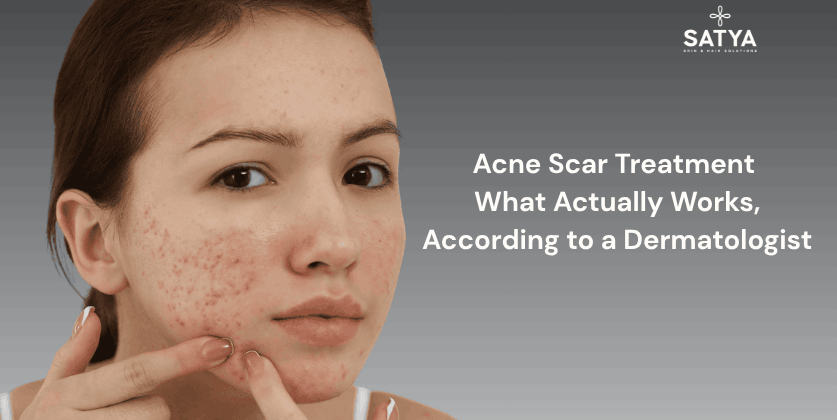
You controlled the breakouts. The acne is gone. But the marks it left behind, the pits, the dark spots, the uneven texture, those are still staring back at you every morning.
Acne scars treatment is one of the most searched skincare concerns in India, and for good reason. Scars can persist for years without the right intervention. If you have been waiting for them to fade on their own, this article will explain why that strategy rarely works, and what actually does.
What Are Acne Scars, and Why Do They Form?
Before choosing a treatment, it helps to understand what you are treating. Acne scars form when a breakout damages the deeper layers of skin. The body tries to repair itself, but the healing process is imperfect. Sometimes it produces too little collagen, creating a depressed pit. Sometimes it produces too much, leaving a raised scar
Many patients also struggle with hyperpigmented acne scars treatment, which technically refers to Post-Inflammatory Hyperpigmentation (PIH). These are the flat red or brown spots left behind after a pimple heals. While these are not true “scars” in the structural sense, they require specialized dermatological intervention to fade quickly.
Best Treatment for Acne Scars: A Multimodal Approach
There is no single “best” treatment; rather, the best treatment for acne scars is usually a combination of therapies tailored to your specific skin type and scar depth. At Satya Skin & Hair Solutions, we often utilize the following:
1. Fractional CO2 Laser Resurfacing
This is a gold standard for deep boxcar and rolling scars. The laser creates micro-channels in the skin, triggering a massive healing response and new collagen production.
2. Microneedling Radiofrequency (MNRF)
MNRF is excellent for those seeking minimal downtime. It delivers heat energy deep into the dermis to tighten the skin and smooth out indentations without damaging the top layer of the skin.
3. Chemical Peels for Pigmentation
When seeking hyperpigmented acne scars treatment, medical-grade peels (like TCA or Salicylic acid) are highly effective. They exfoliate the surface layer, lifting pigment and evening out the skin tone.
4. Subcision for Tethered Scars
Some scars are pulled down by fibrous bands beneath the skin. Dr. Ruchi Agarwal performs subcision to manually release these bands, allowing the skin to “lift” back to its original level.
Why Choosing “Acne Treatment Nearby” Matters in Delhi NCR
When searching for acne treatment nearby in Gurgaon or Delhi, local expertise is vital. The environmental factors in Delhi NCR high pollution levels and extreme heat can significantly impact how your skin heals post-treatment.
A local expert like Dr. Ruchi Agarwal understands these regional challenges and provides customized post-procedure care protocols to ensure your skin is protected from environmental stressors during the recovery phase.
Myth-Busting: What You Need to Know
- Myth: All scars can be removed 100% in one session.
- Fact: Scar revision is a journey. Depending on the depth, you may see a 50% to 80% improvement over several sessions.
- Myth: Over-the-counter creams can fix deep pits.
- Fact: Topical creams cannot rebuild the structural collagen needed to fill a deep atrophic scar. Only clinical Acne Scars Treatment can achieve this.
- Myth: Lasers are unsafe for Indian skin tones.
- Fact: When performed by an experienced dermatologist like Dr. Ruchi Agarwal using the correct settings, lasers are highly safe and effective for darker skin tones.
The Satya Philosophy
At Satya Skin & Hair Solutions, we do not follow a “package-based” sales model. Dr. Ruchi Agarwal conducts a thorough clinical assessment of your skin’s health, thickness, and scar type before recommending a protocol.
We prioritize skin safety and long-term health over quick, aggressive results that might lead to complications. Our goal is to provide a premium experience where science meets empathy.
There is no single best treatment, it depends entirely on scar type and skin tone. A combination approach using fractional laser, microneedling, and targeted peels tends to produce the most comprehensive results for most patients.
Structural improvements achieved through laser or microneedling are long-lasting. Filler-based corrections are temporary and may need to be repeated every six to eighteen months. Results also depend on continued sun protection and skincare.
Yes, when performed with appropriate protocols by an experienced dermatologist. Indian skin is more prone to post-inflammatory pigmentation, so treatment parameters must be adjusted accordingly. Dr. Ruchi Agarwal has extensive experience treating South Asian skin types.
This depends on the severity and type of scarring. Most patients require between three and six sessions of their primary treatment, spaced four to eight weeks apart. A detailed plan is provided at your initial consultation.
Active, inflamed acne should be controlled before beginning scar treatment. Treating scars on actively broken-out skin can worsen inflammation and create new marks. Dr. Agarwal often coordinates a phased approach, managing active acne first, then addressing scarring.
Satya Skin & Hair Solutions operates clinics in both Gurgaon and Delhi NCR, offering dermatologist-led consultations for acne and acne scar management.