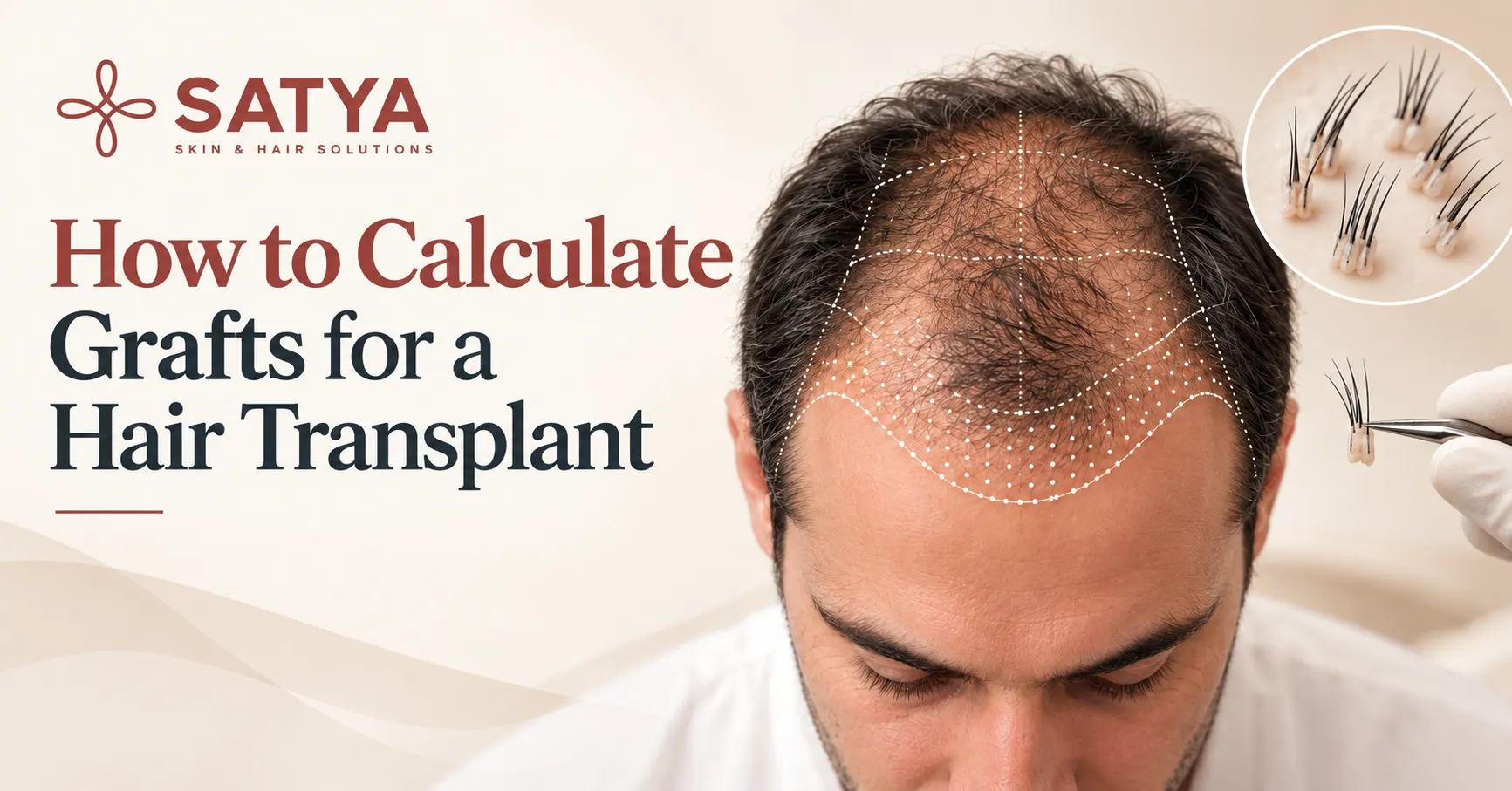
How many grafts do I need? It is usually the first question people ask about a hair transplant, and it often gets a single number in reply, such as 2,500 or 4,000, with no working shown. A graft count should never be a guess. To calculate grafts for a hair transplant, a surgeon needs three measurements: how large the area to be restored is, how dense each zone needs to be, and how many grafts your donor area can safely give.
This guide sets out that method step by step, using published data from Indian and Asian patients rather than Western averages, so you can check any graft estimate you are given, including ours.
Grafts needed = the area of each zone to be restored (cm²) × the density planned for that zone (grafts per cm²), added up across the hairline, mid-scalp and crown. That total is then checked against the donor supply: the grafts in the safe donor area × the share that can be removed without visible thinning. When the two numbers disagree, the donor sets the limit.
In a published Delhi series of 820 FUE patients, surgeons planted about 30 to 40 grafts per cm² at the front and 20 to 25 towards the crown, and limited scalp extraction to 25% of a donor zone they estimated at 10,000 to 15,000 grafts [3].
What Is a Graft in a Hair Transplant?
A graft is a follicular unit: the natural cluster of one to four hairs (rarely five) that grows from the scalp as a single group, moved with its surrounding tissue. Surgeons transplant these units intact because that is how hair grows naturally.
So a graft count is not a hair count. In a study of 146 healthy Han Chinese adults, about 28% of follicular units carried one hair, 53% carried two and 17% carried three, with four-hair units close to 1% [4]. Bernstein and Rassman described an average of about two hairs per unit [1], and published South Asian series work out to roughly 2.1 to 2.3 hairs per scalp graft [3, 5].
| Grafts | Approximate scalp hairs (at about 1.8 to 2.3 hairs per graft) |
|---|---|
| 1,000 | 1,800 to 2,300 |
| 2,500 | 4,500 to 5,750 |
| 4,000 | 7,200 to 9,200 |
| 5,000 | 9,000 to 11,500 |
Beard and body grafts carry fewer: the Delhi series totals work out to about 1.4 hairs per beard graft and 1.1 per body graft [3]. When comparing quotes, ask whether they count grafts or hairs, and from which donor source.
The Graft Calculation Formula
Every credible graft estimate rests on two calculations: what the thinning area needs (demand) and what your donor area can give (supply).
| Calculation | Formula |
|---|---|
| Demand | Grafts needed = (area of zone 1 × density for zone 1) + (area of zone 2 × density for zone 2) + (area of zone 3 × density for zone 3) |
| Supply | Safe graft supply = grafts in the safe donor area × the share that can be removed without visible thinning, plus beard or body grafts where suitable |
| Plan | The working graft number is the lower of the two, distributed by visual priority |
Step 1: Measure the Area That Needs Restoring
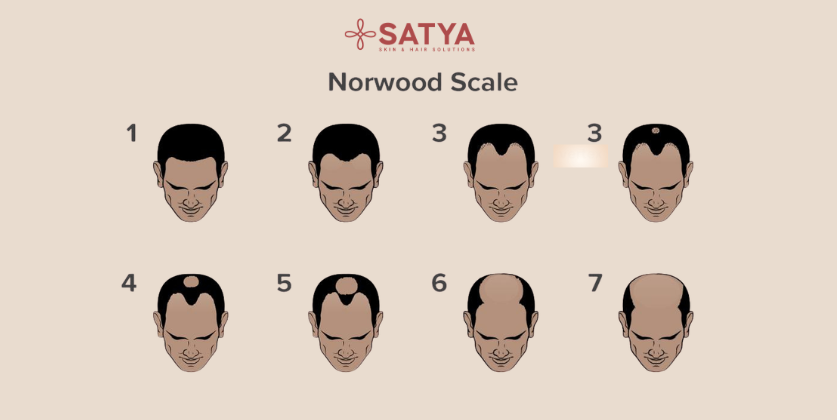
A Norwood stage labels a pattern of loss; it is not a measurement. Two men at Norwood 4 can have very different bald areas, depending on head size, hairline position and how much remaining hair is miniaturised (thinner and weaker than normal).
Area can be measured with transparent 1 cm² grid sheets, scaled photographs or 3D scalp scans. The PRECISE scale in Aesthetic Plastic Surgery scores one point per 30 cm² of bald scalp and counts thinning areas only partly [6].
Hairline position changes the arithmetic most. As an illustration, lowering a hairline by 1 cm across a 12 cm wide forehead adds about 12 cm², or roughly 400 grafts at 35 per cm², all from the same finite donor.
Step 2: Set a Density for Each Zone
A transplant does not need to restore your original density. Bernstein and Rassman observed that about half the hair in an area can be lost before thinning becomes noticeable [1], so the goal is the density that looks full, not a hair-for-hair replacement. For context, a 2025 biopsy study of 40 South Indian adults found roughly 8 follicular units in each 4 mm punch biopsy taken from the back of the scalp [2], which works out to about 64 units per cm² (our conversion from the reported per-biopsy count).
| Zone | Commonly planned density | Reasoning |
|---|---|---|
| Hairline and front | 30 to 40 grafts per cm² [3] | Frames the face and is seen first; single-hair grafts at the very edge keep the line soft |
| Mid-scalp | Graded down from the front | Gives the look of depth behind the hairline |
| Crown (vertex) | 20 to 25 grafts per cm² [3] | A larger, swirling area where loss often keeps progressing |
| Small focal zones (frontal core, temple points) | 40 to 60 grafts per cm² over 2.5 to 3 cm² [7] | Concentrates density where it shows most without raising the total much |
Higher density is not automatically better: it depends on blood supply, scalp thickness, site size and handling. In a two-patient 2005 case series, both grew well at 30 grafts per cm², while 40 and 50 per cm² gave inconsistent results [8]. The evidence is thin, so many surgeons keep high densities for small priority zones.
Step 3: Measure What Your Donor Area Can Safely Give
The donor area is the band at the back and sides of the scalp, usually less affected by androgenetic alopecia (genetic, hormone-driven pattern loss). It is finite: moved grafts are not replaced, which is why the International Society of Hair Restoration Surgery advises conserving donor hair for the future [11].
Donor density varies by ethnicity and person. The 2025 Indian biopsy study found unit counts similar to Korean data and lower than Caucasian figures, about 8 per biopsy against 14 [2], so charts built on Caucasian averages can overstate an Indian donor.
Published figures that help frame donor supply:
- Donor zone total: a Delhi series of 820 FUE patients estimated the stable donor zone at about 10,000 to 15,000 follicular units and limited extraction to 25% of it [3]. That is roughly 2,500 to 3,750 scalp grafts.
- Lifetime supply: for extensive male pattern baldness, Dr. Bernard Nusbaum estimates approximately 5,000 to 7,000 follicular units transplantable over a lifetime, while noting that individuals differ [10].
- Beard: in the same Delhi series, 1,000 to 1,500 follicular units could be taken from the beard in most cases [3].
- Body hair: can add grafts for some patients, but it is finer and better suited to the crown than the hairline. See body hair transplant.
These are population figures; your own supply is measured at consultation.
Step 4: Reconcile Demand With Supply
If demand is within supply, a responsible plan still leaves a reserve. If it is higher, the surgeon has to make choices rather than harvest more:
- Prioritise the hairline and front, which make the largest visible difference
- Plan the crown at a lower density, or defer it to a later session
- Set an age-appropriate hairline that will still suit you in later decades
- Stabilise native hair with medical treatment so fewer grafts are needed over time
- Add beard or body grafts where they are suitable
- Stage the work over two sessions, usually 12 months or more apart
A Worked Example: Calculating Grafts Step by Step
Illustrative example only. The figures below are assumptions for teaching purposes and do not describe a real patient.
Consider a 34-year-old man with a Norwood 4 pattern, medium-calibre straight black hair, a family history of further loss, and a donor zone estimated at about 12,000 follicular units, within the range reported in the Delhi series.
| Zone | Area (cm²) | Planned density (grafts per cm²) | Grafts |
|---|---|---|---|
| Hairline and front | 40 | 35 | 1,400 |
| Mid-scalp | 35 | 28 | 980 |
| Crown | 40 | 20 | 800 |
| Total demand | 115 | 3,180 |
Supply check: 25% of 12,000 is 3,000 grafts. Demand (3,180) is higher than the safe scalp supply (3,000), and covering everything now would leave nothing for future loss in a 34-year-old whose hair is likely to keep thinning.
A more defensible plan: treat the front and mid-scalp first, about 2,380 grafts or roughly 20% of the donor zone. Defer the crown, begin dermatologist-led medical treatment to protect native hair, and reassess at 12 months. That keeps about 620 grafts within the 25% limit in reserve, with beard grafts as a possible supplement later.
The final number is smaller than the full arithmetic suggests, and that is the point. A graft count is a decision about a lifetime budget, not only about today’s bald area.
Why Online Graft Calculators and Norwood Charts Often Miss
Online hair transplant graft calculators usually map a Norwood stage to a fixed range. That gives a first idea, but cannot account for your area, donor density or the hair qualities that decide how much each graft covers.
| Factor | Effect on the graft calculation |
|---|---|
| Hair calibre | Thick hair covers more scalp per graft; fine hair needs more grafts for a similar look [1, 7] |
| Hair and skin colour contrast | Dark hair on light skin makes gaps visible; lower contrast looks fuller with the same count [1] |
| Curl or wave | Curly and wavy hair gives more apparent coverage than straight hair [1] |
| Hairs per graft | More multi-hair units means more hair from each graft |
| Donor density | Lower density means a smaller safe supply; Indian figures are lower than Caucasian averages [2] |
| Age and progression | Younger patients with active loss need a larger reserve |
| Hairline design | A lower or flatter hairline adds recipient area |
Some surgeons combine these into one figure: the coverage value described by Dr. Koray Erdogan multiplies follicular unit density by hairs per unit and hair shaft diameter to rate donor quality and set extraction targets [9]. The same graft count can give very different results.
Photo-based estimates are fine as a first range, especially for patients outside Delhi NCR; a final number needs an in-person donor assessment.
Published Graft Numbers for Advanced Hair Loss: Indian Data
Rather than repeating a generic chart, the table below summarises a published Indian series: 820 men with Norwood 5 to 7 hair loss treated by FUE at a single centre in New Delhi between 2012 and 2017 [3]. These are not Satya figures, and the study grouped patients by coverage goal rather than by Norwood stage.
| Coverage goal | Minimum grafts the authors considered necessary | Mean grafts actually transplanted |
|---|---|---|
| Frontal forelock | 1,500 to 2,000 | 1,240 |
| Frontal | 3,000 to 3,500 | 2,982 |
| Front and mid-front | 4,500 to 5,000 | 4,164 |
| Crown (vertex) only | Not stated | 2,770 |
| Full coverage | 6,000 or more | 6,237 (scalp, beard and body combined) |
Three points stand out. The mean graft numbers in most groups fell below the authors’ own minimums, which reflects real donor limits. Full coverage needed beard and body hair in addition to the scalp. And satisfaction at 12 months was highest in the front and mid-front group (4.3 out of 5) and lowest in the crown-only group (2.8 out of 5), which supports prioritising the front.
Earlier stages vary too widely for a single chart. See our guides to Norwood stage 2, Norwood stage 3, Norwood stage 4, Norwood 5 and Norwood 6, and to 2,500 grafts, 4,000 grafts and 5,000 grafts.
The Donor Limit: Why “Maximum Grafts” Is the Wrong Goal
A higher graft number can sound like better value when a clinic prices per graft. But over-harvesting can leave the donor visibly thin, limit what can be done as loss progresses, and make correction harder; many repair cases begin with a depleted donor.
Dr. Shail Gupta on Graft Numbers
When a patient asks how many grafts I can take, I first ask how many we should take. I calculate the area and the density, then set that against the donor and the patient’s age, because the donor has to last a lifetime. Sometimes the honest number is lower than the one quoted elsewhere, or the plan becomes two stages instead of one. A hairline can be refined later. A depleted donor cannot be rebuilt.
Signs that a graft estimate may not be well founded:
- A number given before your donor area has been examined
- The same number quoted for very different patterns of loss
- No breakdown by zone and no explanation of density
- Promises of original or “full” density for advanced loss in a single session
- A figure in hairs presented as if it were grafts
What the Graft Number Cannot Tell You
A graft count is an input, not a result. Survival depends on extraction, storage, handling and implantation, and falls with time out of the body: in a 1992 study cited by the IAHRS, about 95% at two hours, 90% at four and 88% at six [10]. For sessions of 5,000 grafts or more, there are no scientific studies of survival [10].
Growth commonly begins at 3 to 4 months, the front is largely mature by about 12 months, and the crown can take 12 to 18. Our guide on reading hair transplant results explains how to judge progress.
Questions to Ask Before You Accept a Graft Number
- How was my recipient area measured, and how large is it in cm²?
- What density are you planning for each zone?
- What is my donor density, and what share of my donor will this plan use?
- How many grafts will remain in reserve for future loss?
- Will beard or body grafts be needed?
- Who performs the extraction and the implantation?
- Will I receive a written record of the final count, broken down into one-, two- and three-hair grafts?
Before Counting Grafts: Is a Transplant the Right Step?
A graft calculation assumes patterned hair loss with a stable donor, which needs confirming first. Shedding after illness or stress (telogen effluvium) is often temporary. Diffuse thinning can involve the donor area itself, which changes the whole calculation. Patchy loss from alopecia areata is usually managed medically. Women need their own assessment; see female hair transplant.
Dr. Ruchi Agarwal on Medical Treatment and Graft Numbers
Medical treatment changes the graft calculation. If we stabilise the native hair, the transplant only has to cover what is already lost, not everything that may be lost over the next ten years. So we examine the scalp, review blood tests where needed and discuss medical options before a graft number is final. Health bhi, hair bhi.
For how medicine and surgery work together, see minoxidil and finasteride vs hair transplant and medicine first or transplant first.
How Graft Planning Works at Satya Skin & Hair Solutions
At our clinics in DLF Phase 4, Gurgaon and Pitampura, Delhi, a graft plan follows the same sequence described in this guide:
- Diagnosis: the type of hair loss and whether surgery is appropriate now
- Donor assessment: examining donor density, hairs per graft and hair calibre [confirm instrument, for example trichoscopy]
- Area mapping: marking the hairline and measuring each zone
- Zone densities: front, mid-scalp and crown
- Lifetime budget: checking the total against the donor, with a reserve
- Written plan: a zone-wise graft number, the technique (FUE, FUT or a combination) and the timeline
This reflects the clinic’s “Less Donor” principle: the fewest grafts that achieve a natural result. As most clinics charge per graft, the number also drives cost; our hair transplant cost in India guide explains graft-based pricing.
Start With Your Donor Assessment
A graft number is only as reliable as the measurements behind it. Schedule an evidence-based consultation with our hair restoration team at Satya Skin & Hair Solutions in DLF Phase 4, Gurgaon, or Pitampura, Delhi. You will receive a zone-wise graft plan and the reasoning behind each number. Results vary from person to person, and any graft number we recommend will follow your donor and scalp assessment.
Frequently Asked Questions
It depends on the size of the area being restored, the density planned for each zone and what your donor area can safely supply. The method is area (cm²) × density for each zone, checked against donor capacity. In a published Delhi series of advanced cases, frontal coverage needed about 3,000 to 3,500 grafts and front plus mid-front coverage about 4,500 to 5,000. Earlier stages usually need fewer, but only measurement can give your own number.
Usually about 1,800 to 2,300 scalp hairs, because most scalp grafts carry around two hairs. Beard and body grafts carry fewer, often closer to one hair each.
It can give a rough starting range. It cannot measure your recipient area, donor density, hair calibre or likely future loss, which together decide both how many grafts you need and how many you can safely have.
Published Indian practice places about 30 to 40 grafts per cm² at the front and 20 to 25 towards the crown. Small priority zones are sometimes packed at 40 to 60 per cm². Thick, wavy or low-contrast hair may look full at the lower end of these ranges.
There is no safe universal maximum. The limit is set by your donor density, the size of the safe donor area, the share that can be removed without visible thinning, and the team’s ability to keep out-of-body time short. A plan should state the donor share it uses, not just the total.
Often, yes. In a Delhi series, 1,000 to 1,500 grafts could be taken from the beard in most cases. Beard and body grafts are finer and carry fewer hairs, so they are generally used for the crown or for added density rather than the hairline
Clinics may assume different hairline positions, densities and treatment areas, may quote hairs rather than grafts, or may not have assessed your donor area. Ask each clinic for its zone-wise breakdown and the donor share it plans to use, then compare the reasoning, not just the number.
Medical disclaimer: This article is for general education and does not replace an individual medical consultation. Suitability for any procedure, and any graft number, requires in-person assessment by a qualified doctor. Figures from published studies describe the patients in those studies and may not apply to you.