What happens when you want a hair transplant, but the hair at the back of your head is not enough?
This is a common concern among patients with advanced baldness, a naturally weak donor area, or previous unsuccessful hair transplants. Many assume that once their scalp donor hair is limited, they have no options left for restoring their hair.
However, that is not always the case.
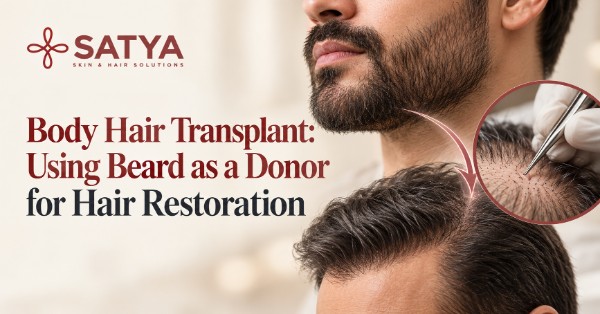
Body Hair Transplant (BHT) is a surgical technique that allows suitable hair follicles to be extracted from other parts of the body, particularly the beard, and transplanted onto the scalp. For carefully selected patients, beard hair can provide additional grafts and improve coverage when scalp donor hair alone is insufficient.
At Satya Skin & Hair Solutions, under the guidance of Dr. Shail Gupta and Dr. Ruchi Agarwal, hair restoration planning focuses on preserving the available donor area, selecting appropriate graft sources, and creating natural-looking results without unnecessary overharvesting.
What Is a Body Hair Transplant?
A Body Hair Transplant is a hair restoration procedure in which follicles are extracted from body areas other than the scalp and implanted into areas experiencing hair loss.
Unlike conventional hair transplantation, which primarily uses follicles from the back and sides of the head, BHT allows surgeons to consider additional donor sources such as the beard, chest, abdomen, and other suitable body areas.
The procedure generally uses the Follicular Unit Extraction (FUE) technique. Individual follicular units are carefully extracted using small punches and then implanted into the recipient area.
Body hair transplantation is particularly valuable when the available scalp donor supply cannot provide adequate coverage.
However, not every body hair follicle behaves like scalp hair. Differences in thickness, growth cycles, texture, and length must be considered before selecting a donor source.
Why Is Beard Hair Preferred for Body Hair Transplant?
Among the various body donor areas, beard hair is often considered one of the most useful options for scalp restoration.
Beard follicles, particularly those found beneath the chin and along the upper neck, are generally thicker and coarser than scalp hair. This can make them valuable for improving the appearance of density in selected scalp regions.
Beard Hair Provides Better Visual Coverage
Hair thickness plays an important role in how full a transplanted area appears.
Because beard hair is often coarser, carefully placed beard grafts can add visual coverage without requiring the same number of fine hair shafts.
This makes beard hair particularly useful for patients with advanced baldness who need additional coverage in the mid-scalp or crown.
However, thicker hair does not automatically mean a better aesthetic result. The surgeon must carefully distribute the grafts to avoid an unnatural appearance.
Beard Hair Can Supplement a Limited Scalp Donor
Patients with Grade 6 or Grade 7 baldness may have extensive areas requiring restoration but relatively limited scalp donor reserves.
In these cases, using only scalp hair may not provide the desired coverage.
A beard-to-scalp hair transplant can supplement the available scalp grafts, allowing the surgeon to distribute donor resources more strategically.
At Satya, the objective is not simply to extract the maximum possible number of grafts. It is to use the available donor hair responsibly while preserving options for future treatment.
Who Is a Good Candidate for Beard-to-Scalp Hair Transplant?
A Body Hair Transplant is not necessary for every patient. It is generally considered when conventional scalp donor resources are limited or when additional grafts could improve an otherwise carefully planned restoration.
Patients With Advanced Baldness
Individuals with extensive hair loss may require more grafts than their scalp donor area can safely provide.
For selected patients, beard hair can be combined with scalp hair to improve coverage while reducing pressure on the scalp donor supply.
Patients With a Poor or Weak Scalp Donor
Some individuals naturally have low hair density or finer hair in the donor region.
Using excessive scalp grafts in such cases may leave the donor area visibly thin.
A suitable beard donor may provide additional grafts without placing all the demand on the scalp.
Patients Seeking Repair Hair Transplants
Patients who have undergone previous hair transplant surgeries sometimes experience donor depletion, unnatural hairlines, or inadequate coverage.
A Body Hair Transplant for repair surgery may help provide additional grafts when the remaining scalp donor is insufficient.
Beard hair can also be considered for camouflaging selected scars from previous hair transplant procedures.
However, suitability depends on the condition of the recipient scalp, scar tissue, remaining donor reserves, and realistic expectations.
How Is a Body Hair Transplant Using Beard Hair Performed?
A beard-to-scalp hair transplant requires careful planning because beard follicles differ from scalp follicles in their structure and growth characteristics.
Step 1: Donor Area Assessment
The surgeon first evaluates the scalp and beard donor regions.
This includes examining beard density, hair calibre, skin condition, available donor distribution, and the amount of hair required for restoration.
Not every patient with a thick beard is automatically suitable for beard hair extraction.
Step 2: Beard Hair Extraction Using FUE
Suitable follicles are extracted individually, usually from beneath the chin or upper neck.
Small FUE punches are used to remove follicular units while attempting to minimize damage to surrounding follicles.
Beard extraction requires precision because the angle at which the hair emerges from the skin may differ from the direction of the follicle beneath it.
Poor extraction technique can increase follicular damage and cause visible scarring or patchiness.
Step 3: Graft Preparation and Recipient Planning
Extracted grafts are assessed and prepared for implantation.
The surgeon decides where beard hair will be most useful and where scalp hair should be prioritized.
At Satya Skin & Hair Solutions, this planning is particularly important because different scalp regions require different hair characteristics to produce a natural appearance.
Step 4: Implantation and Hair Direction
The grafts are placed into carefully prepared recipient sites, taking into account hair direction, angle, density, and the surrounding natural hair.
The aim is to create balanced coverage rather than simply increasing the graft count.
Can Beard Hair Be Used to Create a Natural Hairline?
This is one of the most important questions in Body Hair Transplant planning.
Although beard hair can be useful for increasing coverage, it is generally not the preferred choice for creating the frontal hairline.
The natural hairline contains relatively fine hairs that emerge at carefully controlled angles. Beard hair is usually thicker and may have a different texture.
If coarse beard grafts are placed prominently along the front hairline, the result may look unnatural.
Why Combining Beard and Scalp Hair Matters
At Satya, scalp hair is generally preferred for the delicate frontal hairline and temples, where natural appearance is especially important.
Beard hair may be distributed behind the hairline or in areas where additional volume is needed.
This combination can help create a more natural transition between the frontal hairline and the denser regions behind it.
The goal is not to make beard hair look exactly like scalp hair, but to use each donor source where its characteristics are most suitable.
Beard Hair vs Scalp Hair: What Is the Difference?
Although both can be transplanted, beard and scalp hair have important biological differences.
| Feature | Beard Hair | Scalp Hair |
|---|---|---|
| Hair thickness | Usually thicker and coarser | Variable, often finer |
| Follicular units | Commonly contain one hair | May contain one to four hairs |
| Growth characteristics | Different growth cycle and length potential | Typically longer growth phase |
| Preferred placement | Mid-scalp, crown, selected repair areas | Hairline, temples and general coverage |
| Main advantage | Additional donor supply and visual bulk | Better match with existing scalp hair |
Beard hair generally retains many of its original characteristics after transplantation. Therefore, proper donor selection and strategic placement are essential.
What Are the Benefits and Limitations of Body Hair Transplant?
The main advantage of Body Hair Transplant is that it expands the potential donor supply for patients who cannot achieve adequate coverage using scalp hair alone.
It may also help preserve remaining scalp donor resources and provide options for selected corrective procedures.
However, BHT has limitations.
Body hair follicles often contain fewer hairs per follicular unit than scalp grafts. Their growth cycles and textures may also differ, which can affect the final appearance.
Furthermore, extracting beard follicles requires technical skill. Excessive harvesting may produce visible thinning, small scars, or uneven beard density.
Graft survival is not guaranteed, and outcomes depend on donor quality, extraction technique, recipient-site preparation, and individual healing.
For these reasons, beard hair transplantation should be considered a supplementary technique rather than a universal replacement for scalp hair transplantation.
How Long Does It Take for Transplanted Beard Hair to Grow?
After a beard-to-scalp hair transplant, some transplanted hairs may shed during the initial weeks. This is a normal part of the postoperative process and does not necessarily indicate graft failure.
New growth may begin becoming noticeable after approximately three to four months.
Visible coverage generally develops gradually over the following months, with a more meaningful assessment often possible around 9–12 months. Some patients may require longer for the final appearance to mature.
Once established, transplanted beard follicles can continue growing on the scalp, although their texture and growth characteristics may remain different from native scalp hair.
Long-term outcomes also depend on the progression of hair loss in the surrounding native hair.
Why Donor Preservation Matters at Satya Skin & Hair Solutions
One of the most important principles of successful hair restoration is understanding that donor hair is limited.
At Satya Skin & Hair Solutions, Dr. Shail Gupta emphasizes responsible donor management, natural hairline design, and long-term treatment planning.
Rather than recommending a fixed technique for every patient, the clinic evaluates whether FUE, FUT, or a combination approach such as MHT™ (Maximum Harvest Technique) is appropriate.
For patients with extensive baldness or previous unsuccessful surgeries, beard hair may be considered as an additional donor source.
Dr. Ruchi Agarwal’s dermatology expertise also supports the clinic’s broader approach to evaluating scalp and hair health.
The emphasis remains on selecting the right treatment for the individual, explaining limitations clearly, and avoiding unnecessary procedures.
Body Hair Transplant in Gurgaon and Delhi NCR
Patients considering a Body Hair Transplant in India should look beyond graft counts and treatment packages.
A thorough consultation should establish whether beard hair is suitable, how much can safely be harvested, where the grafts will be placed, and what degree of coverage is realistically achievable.
Satya Skin & Hair Solutions offers hair restoration consultations in Gurgaon and Delhi, including assessment for advanced baldness, limited donor areas, and repair hair transplantation.
For patients exploring beard-to-scalp transplantation, the first step is a detailed evaluation of both scalp and beard donor quality.
Conclusion: Is Beard Hair a Good Donor for Hair Transplant?
Beard hair can be a valuable donor source for patients who need additional grafts because of advanced baldness, poor scalp donor density, or previous hair transplant surgeries.
However, successful Body Hair Transplant surgery depends on more than the availability of beard hair.
The surgeon must understand the differences between beard and scalp follicles, preserve the donor area, and carefully plan graft placement to achieve a balanced appearance.
At Satya Skin & Hair Solutions, the philosophy is simple: preserve your health, protect your donor, and plan your hair restoration for the long term.
If you are considering a Body Hair Transplant in Gurgaon or Delhi NCR, a consultation with Dr. Shail Gupta can help determine whether beard hair is a suitable option for your individual hair loss pattern.
Visit Satya Skin & Hair Solutions to explore your hair restoration options.
Frequently Asked Questions About Body Hair Transplant
Yes. Beard follicles can be extracted using FUE and implanted into suitable scalp regions. They are commonly used to supplement scalp grafts in patients with advanced baldness or limited donor reserves.
Transplanted beard follicles can provide long-lasting growth when they survive and establish themselves. However, results vary, and surrounding native scalp hair may continue to thin.
Not generally. Scalp hair is usually preferred because it matches the existing hair more closely. Beard hair is useful as an additional donor source, especially when scalp grafts are insufficient.
It can be performed safely in appropriately selected patients by a qualified, experienced surgeon. Potential risks include infection, scarring, follicular damage, uneven beard density, and poor graft growth.
There is no fixed number suitable for everyone. The safe extraction capacity depends on beard density, donor distribution, skin characteristics, and the patient’s aesthetic preferences.
Yes, selected patients with advanced baldness may benefit from combining beard and scalp hair. However, the achievable coverage depends on the total available donor supply and surgical planning.
Beard hair can grow after being transplanted to the scalp, but it may retain its original thickness, texture, and growth characteristics. This is why placement is important.
Body Hair Transplant cost in India depends on the number of grafts, donor areas involved, surgical complexity, and surgeon expertise. Beard graft extraction may require additional time and technical precision. A personalized assessment is necessary for an accurate estimate.
Yes. In selected repair cases, beard hair can supplement depleted scalp donor reserves and improve coverage. Suitability depends on the remaining donor hair, existing graft placement, scarring, and recipient scalp condition.