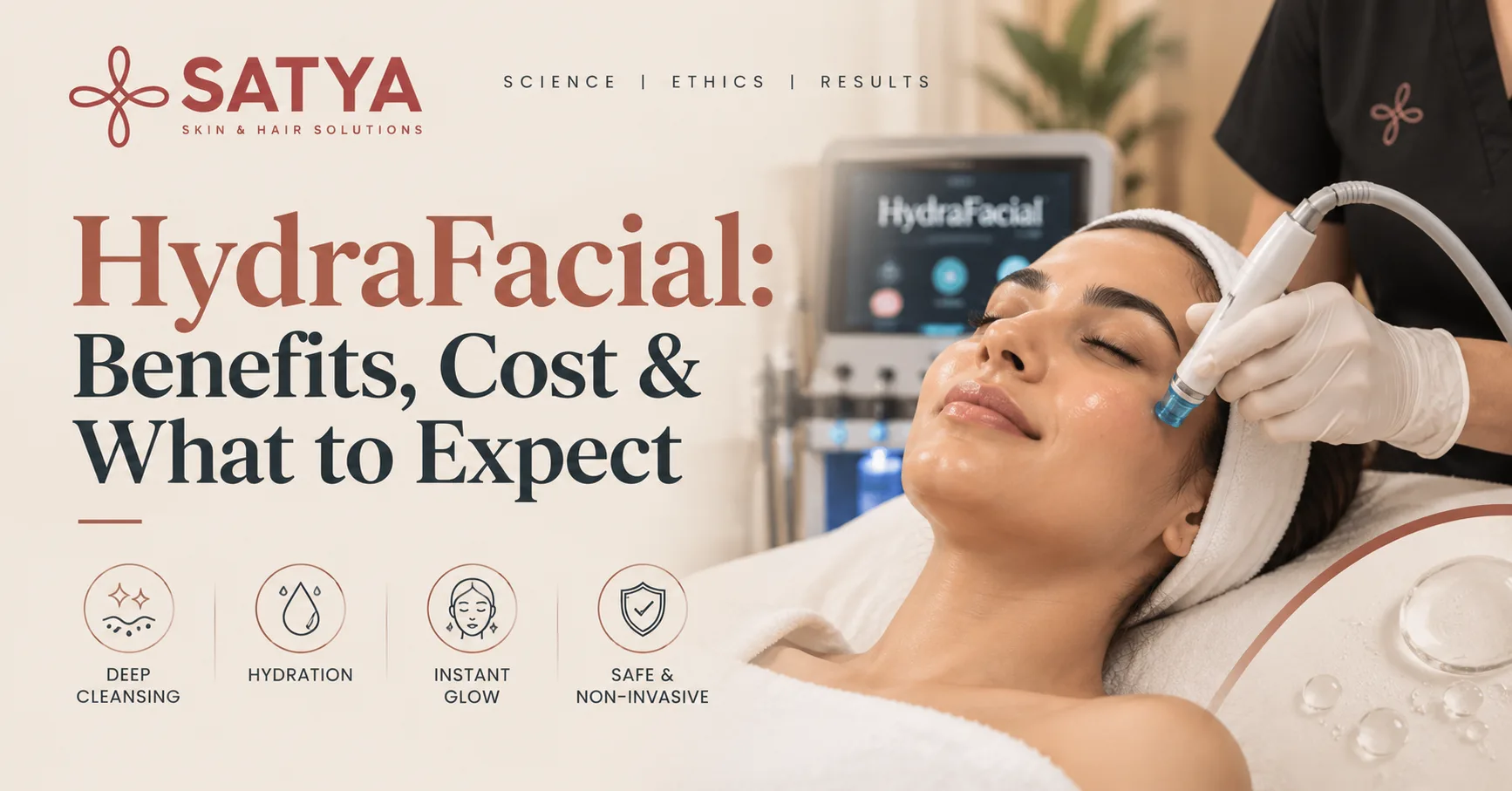
A Hydrafacial is a device-based facial that cleanses, exfoliates, extracts and hydrates the skin in one session of about 30 to 45 minutes, using a patented vortex suction system. The main Hydrafacial benefits are clearer pores, smoother texture, better hydration and a brighter look, with no downtime. The glow is immediate but temporary, so it is most useful as regular maintenance, usually every four weeks. In India, a session commonly costs about ₹4,000 to ₹30,000 for the branded system. It is not a treatment for acne scars, melasma, deep wrinkles or sagging skin.
A common belief is that a Hydrafacial can treat pigmentation, acne scars or ageing. It cannot. It is more accurately described as an advanced cleansing and hydration treatment: genuinely useful for skin health and maintenance, but not a substitute for diagnosing and treating a skin condition. Knowing that difference helps you decide when it is worth the cost.
What Is a Hydrafacial?
Hydrafacial is a branded treatment system that uses what its maker calls patented Vortex-Fusion technology: a handpiece that exfoliates while a spiral suction tip lifts out debris and delivers serums at the same time. The general technique is called hydradermabrasion, and many clinics and salons use generic machines with similar names. Results, hygiene and serum quality can differ, so it is reasonable to ask which device a clinic uses.
The Treatment Steps
| Step | What Happens |
|---|---|
| Cleanse and exfoliate | A textured tip removes dead surface cells and surface oil |
| Gentle peel | A mild acid solution loosens buildup in pores, without visible peeling |
| Extraction | Vortex suction lifts out blackheads, oil and debris from pores |
| Hydrate and protect | Serums with hydrating and antioxidant ingredients are infused into the skin |
| Optional add-ons | Targeted booster serums, LED light, or lymphatic drainage in longer versions |
Hydrafacial Benefits: What It Can and Cannot Do
Most Hydrafacial benefits come from three actions: clearing pores, gentle exfoliation, and hydration. These are the effects people notice most:
- Cleaner, less congested pores, with fewer visible blackheads and whiteheads
- Smoother texture from gentle removal of dead surface cells
- Better hydration, which makes skin look plumper and more even
- A brighter, fresher look, which is why many people book one before an event
- No downtime, so you can return to work the same day
What the Research Shows
The published evidence is limited. Small studies by Dr. Bernard Freedman (2008 and 2009) reported a thicker epidermis and fewer fine lines after six treatments given 7 to 10 days apart, but they involved few participants, used the device maker’s serums, and have not been widely repeated.
A 2014 review in Clinical, Cosmetic and Investigational Dermatology describes hydradermabrasion as suitable for darker skin tones, sensitive areas, and oily or dry skin. The fair conclusion is that Hydrafacial benefits are real but modest and temporary, from a gentle, low-risk treatment.
| Concern | What It Can Do | What Usually Works Better |
|---|---|---|
| Dull, dehydrated skin | Visible improvement in glow and hydration | Daily barrier care maintains it |
| Blackheads, congested pores | Clears them for a few weeks | Regular maintenance and a suitable routine |
| Active, inflamed acne | Not advised during a flare | Medical acne treatment first |
| Acne scars | No meaningful change | Microneedling or laser for scars |
| Pigmentation, melasma | Mild brightening at most | Dermatologist-led pigmentation treatment |
| Fine lines, sagging | Temporary plumping only | Anti-ageing or skin tightening treatments |
Dr. Ruchi Agarwal on Choosing a Facial
A facial cannot fix a problem that has not been diagnosed. If your skin is dull because of dehydration or congestion, this treatment is a sensible choice. If it is dull because of melasma, a thyroid problem or a damaged skin barrier, we treat that first. Healthy skin before glowing skin.
Hydrafacial vs Other Facial Treatments
| Treatment | How It Works | Suits | Downtime |
|---|---|---|---|
| Hydrafacial | Suction exfoliation, extraction and serum infusion | Dullness, congestion, dehydration | None |
| Regular salon facial | Manual cleansing, massage, masks | Relaxation, basic cleansing | None |
| Microdermabrasion | Mechanical exfoliation | Rough texture, mild dullness | None to minimal |
| Chemical peel | Acid exfoliation at set depths | Pigmentation, acne, texture | A few days, by depth |
| Carbon facial | Laser with a carbon layer | Oily skin, open pores | Minimal |
For deeper pigmentation or acne marks, a medical peel planned by a dermatologist usually does more. See our guide to chemical peel types and recovery.
What to Expect: Before, During and After
Before Your Session
- Stop retinoids, exfoliating acids and scrubs about 48 hours before.
- Avoid waxing, threading and bleaching on the face for 48 hours.
- Tell your doctor about any medicines, allergies, pregnancy, or recent isotretinoin use.
- Arrive without makeup if possible.
During the Treatment
A standard session takes about 30 to 45 minutes. Most people describe it as a cool, light suction with occasional tingling during the peel step. Extraction is done by suction rather than squeezing, so it is usually comfortable.
After the Treatment
Mild redness can occur and usually settles within 24 hours. Resume your normal skincare after a day, avoid exfoliants for at least two days, and use a broad-spectrum sunscreen, because freshly exfoliated skin burns more easily.
| Timeframe | What Usually Happens |
|---|---|
| Immediately | Skin looks cleaner, smoother and more hydrated |
| Next few days | The glow is usually most visible |
| 2 to 4 weeks | Pores refill and the effect gradually fades |
| With regular sessions | More consistent texture and clarity, if your routine supports it |
How Often Should You Get a Hydrafacial?
For maintenance, every four weeks is the usual interval. People with oily or congested skin are sometimes advised every two to three weeks, but more frequent sessions are not better. Over-exfoliating can irritate the skin and weaken its barrier. See our guide to repairing your skin barrier.
Who Should Avoid or Postpone This Treatment
- Active skin infections, cold sores, or open wounds on the face
- A flare of severe rosacea or eczema
- Sunburn, or very recently treated skin after a laser or peel
- Active, inflamed or cystic acne, until it is controlled
- Recent isotretinoin use, without your dermatologist’s approval
- Pregnancy or known allergies to serum ingredients, without checking with your doctor first
Hydrafacial Cost in India
Prices vary widely because the word “hydrafacial” is used for very different treatments. Lower-priced hydra facials are often quoted at about ₹1,500 to ₹3,500, while the branded Hydrafacial system is commonly priced at about ₹4,000 to ₹15,000 per session in India, depending on the version and add-ons.
| Cost Factor | How It Affects the Price |
|---|---|
| Device | The branded system costs more than generic hydradermabrasion machines |
| Treatment version | Longer versions with boosters, LED or lymphatic drainage cost more |
| Setting | A dermatologist-led clinic with a skin assessment differs from a salon service |
| Number of sessions | Maintenance means the yearly cost matters more than one session |
| Satya session price | [₹ price per session] |
When comparing prices, ask which device is used, what the session includes, and who assesses your skin first. Our guides to skin brightening treatments and Korean glass skin cover related options.
Hydrafacial for Indian Skin and Delhi NCR Conditions
Pollution, humidity and sweat clog pores quickly in Delhi NCR, which is where regular deep cleansing helps. Because the treatment uses no heat and a mild peel, it is generally well suited to brown skin. If you have melasma or very sensitive skin, the peel strength should be adjusted and strict sun protection continued afterwards. See our melasma treatment guide.
How We Approach Facial Treatments at Satya
Every facial at Satya starts with a short skin assessment by our dermatology team. If the treatment suits your skin, we tell you what it will and will not do, and we add boosters only when there is a clear reason. If the real issue is acne, pigmentation or a damaged barrier, we treat that first. Health bhi, glow bhi.
Dr. Shail Gupta on Transparency
Whether a patient comes to us for hair or for skin, the principle is the same: explain what a treatment can do, and be just as clear about what it cannot. A patient who knows the limits of a treatment chooses better and is rarely disappointed.
Frequently Asked Questions
Clearer, less congested pores, smoother texture, better hydration and a brighter look, with no downtime. The benefits are real but temporary, so regular sessions maintain them.
The glow is usually most visible for a few days, and the cleaner, smoother feel typically fades over two to four weeks as pores refill. That is why monthly maintenance is common.
The branded system is commonly priced at about ₹4,000 to ₹15,000 per session, depending on the version and add-ons. Lower-priced hydra facials, often ₹1,500 to ₹3,500, usually use generic machines.
It can help with blackheads and congestion in oily or acne-prone skin. It should be avoided during a flare of inflamed or cystic acne, which needs medical treatment first.
Generally yes. It uses no heat and a mild peel, so the risk of pigmentation is low. People with melasma or very sensitive skin should have the peel adjusted and use strict sun protection afterwards.
No. Mild redness can occur and usually settles within 24 hours. You can return to work the same day, resume skincare after a day, and should avoid exfoliants for two days.
For deep cleansing, extraction and hydration, it is usually more consistent than a manual salon facial. For pigmentation, acne scars or ageing, neither is the right tool, and a medical treatment plan works better.
Before You Decide
The right facial depends on what your skin actually needs. Schedule an evidence-based consultation with our dermatology team at Satya Skin & Hair Solutions in DLF Phase 4, Gurgaon, or Pitampura, Delhi. Results vary from person to person, and any recommendation will follow your skin assessment.