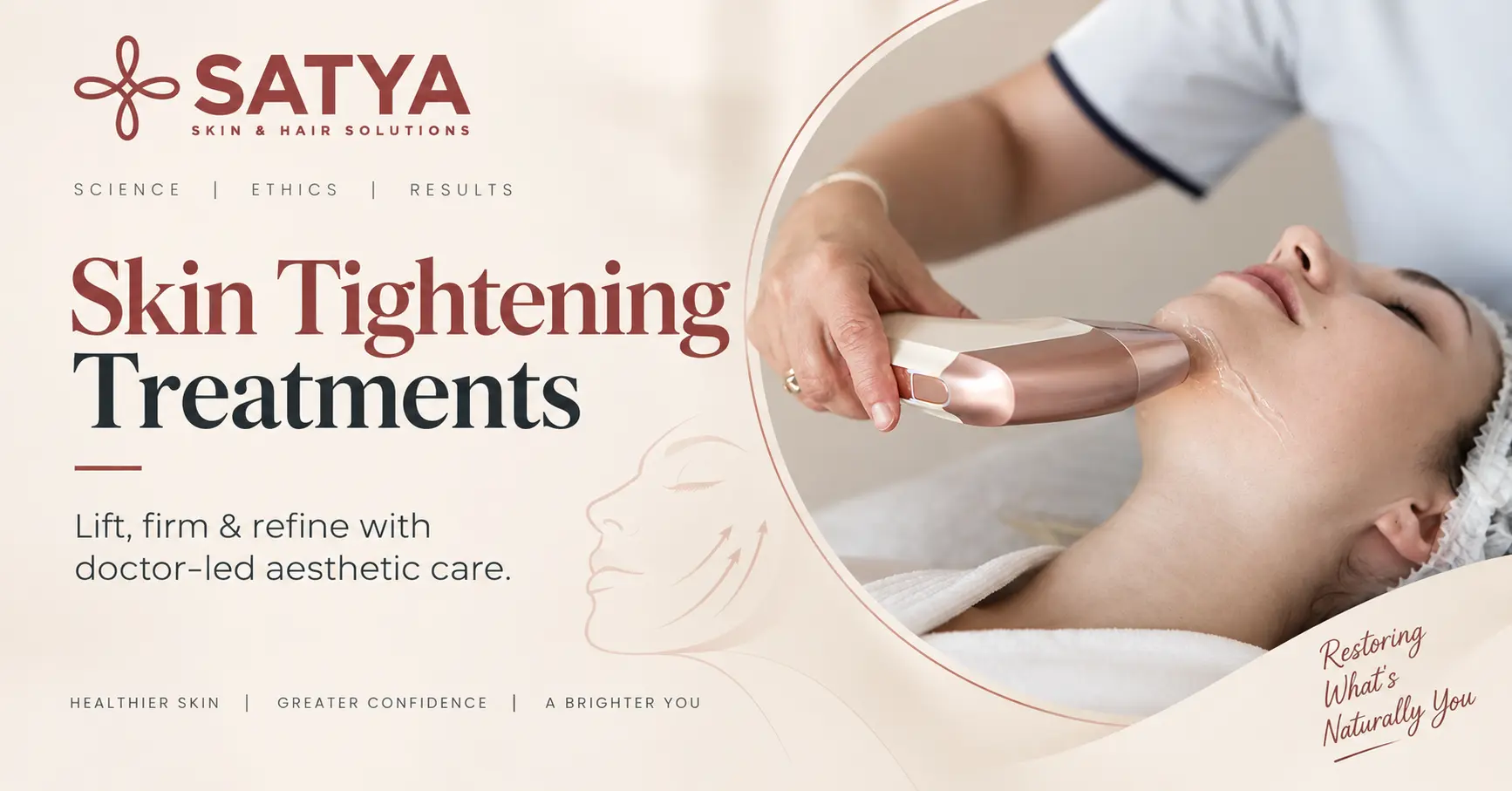
Skin tightening treatments fall into two groups. Non-surgical treatments such as HIFU, radiofrequency, RF microneedling and fractional lasers heat deeper layers of the skin to stimulate new collagen. They suit mild to moderate laxity, need little or no downtime, and give gradual, modest results over 2 to 6 months that need maintenance. Surgical options such as a facelift, neck lift or tummy tuck remove excess skin and reposition deeper tissue. They suit moderate to severe laxity and give larger, longer-lasting change, but involve anaesthesia, scars and several weeks of recovery. The deciding factor is how much loose skin you have, not your age.
A common belief is that one machine can tighten any skin if you have enough sessions. It cannot. Heat-based devices can firm skin that is starting to loosen, but they cannot remove skin that is already hanging. Choosing between surgical and non-surgical treatment starts with understanding why your skin has loosened, and by how much.
Why Skin Loses Firmness
Skin owes its firmness to collagen, which gives it strength, and elastin, which lets it spring back. Both decline gradually from early adulthood, and several factors speed that up:
- Menopause: a review in Menopause International (2007) reports that as much as 30% of skin collagen is lost in the first five years after menopause.
- Sun exposure: ultraviolet light breaks down collagen and elastin, which matters in India’s year-round sun.
- Deeper changes: facial fat pads thin and descend, and facial bone gradually remodels, so the skin above has less support.
- Weight change and pregnancy: stretched skin may not fully recoil after significant or rapid weight loss.
- Smoking and pollution: both add oxidative stress that accelerates collagen breakdown.
Dr. Ruchi Agarwal on Diagnosis
Many people who ask for skin tightening actually have volume loss or wrinkles, which need different treatment. Volume loss is restored with dermal fillers or biostimulators, and expression lines respond to anti-wrinkle injections. Loose skin needs collagen stimulation or surgery. Diagnose the layer first. Then choose the tool.
How Much Laxity Do You Have?
Doctors judge laxity by how far skin has descended and whether there is excess skin to remove. This rough grading shows how the choice changes:
| Laxity | What It Looks Like | Usual Direction |
|---|---|---|
| Mild | Early softening of the jawline, slight crepiness, skin that recoils slowly when pinched | Non-surgical treatments and prevention |
| Moderate | Early jowls, softer neck contour, visible folds at rest | Non-surgical treatments, or surgery for a larger change |
| Severe | Clear jowls, neck bands or hanging neck skin, overhanging skin on the body | Surgery is usually the realistic option |
Non-Surgical Skin Tightening Treatments
Most non-surgical treatments work the same way: controlled heat injures deeper collagen, which contracts and then rebuilds over the following months. Results are therefore gradual, typically building over 2 to 6 months, and the change is modest compared with surgery.
HIFU (High-Intensity Focused Ultrasound)
HIFU focuses ultrasound energy at set depths, reaching the deep layer that surgeons lift in a facelift, without cutting the skin. In a rater-blinded study by Alam and colleagues (Journal of the American Academy of Dermatology, 2010), 86% of 35 subjects showed a clinically significant brow lift at 90 days, with an average elevation of 1.7 mm. That is a measurable but subtle change. There is no downtime, though treatment can be uncomfortable over bony areas.
Radiofrequency (RF)
RF devices such as Forma heat the dermis through the skin surface. They are usually given as a series of sessions, suit early laxity and skin texture, and involve little or no downtime.
RF Microneedling (MNRF)
RF microneedling delivers radiofrequency through fine insulated needles, so heat reaches the dermis while the surface is largely spared. A systematic review of 42 studies presented in 2021 found side effects were transient and usually settled within about 5 days. Because surface heating is limited, it is generally considered lower-risk for pigmentation in brown skin than ablative lasers.
Fractional CO2 Laser
Fractional CO2 resurfaces the skin in microscopic columns, tightening it while improving texture, lines and scars. It brings more downtime, often around a week of redness and peeling, and a higher risk of post-inflammatory pigmentation in Indian skin, so settings and preparation matter. See our CO2 laser guide.
Biostimulators and Skin Boosters
Injectable biostimulators stimulate collagen gradually rather than lifting directly. In the study supporting its 2009 US approval, poly-L-lactic acid maintained its effect for up to 25 months. Skin boosters improve hydration and skin quality but do not lift sagging tissue.
Thread Lifts
Dissolvable threads give an immediate, small lift and some collagen stimulation. PDO threads are absorbed over about 4 to 8 months, and long-term evidence is limited, so results are short-lived and dimpling or thread extrusion can occur.
| Treatment | Suits | Downtime | Main Limitation |
|---|---|---|---|
| HIFU | Mild to moderate laxity of brow, jaw, neck | None to minimal | Subtle lift; can be uncomfortable |
| Radiofrequency | Early laxity, skin texture | None | Needs a series of sessions |
| RF microneedling | Laxity with texture, pores or scars | About 2 to 5 days | Gradual, moderate change |
| Fractional CO2 | Laxity with lines, texture or scars | About a week | Pigmentation risk in brown skin |
| Biostimulators | Thinning, crepey skin and mild sagging | Swelling for a few days | Builds slowly over months |
| Thread lift | Small, short-term lift | A few days | Short-lived; limited evidence |
Surgical Skin Tightening: What It Involves
Surgery is the only way to remove excess skin. A facelift tightens the deeper muscle layer (SMAS) and removes surplus skin from the lower face, often with a neck lift. Eyelid surgery and brow lifts treat the upper face. For the body, a tummy tuck, arm lift or thigh lift removes overhanging skin after major weight loss or pregnancy.
These procedures are performed by plastic surgeons under general anaesthesia or sedation, leave scars placed in natural creases or hairlines, and usually need two to three weeks before you look presentable, with swelling settling over months. The American Society of Plastic Surgeons states that minimally invasive treatments cannot achieve the same results as a facelift.
Risks and Durability
In an analysis of 11,300 facelift patients (Aesthetic Surgery Journal, 2016), the major complication rate was 1.8%, with haematoma the most common at 1.1%. Male sex was the strongest risk factor for haematoma. On durability, a study by Jones and Lo (Plastic and Reconstructive Surgery, 2012) found 76% of patients still looked younger than before surgery at an average of 5.5 years, with the neck showing the most relapse. Surgery resets the clock, but ageing continues.
Surgical vs. Non-Surgical Skin Tightening: Side by Side
| Factor | Non-Surgical | Surgical |
|---|---|---|
| Suits | Mild to moderate laxity | Moderate to severe laxity, excess skin |
| What it changes | Firms and tightens existing skin | Removes excess skin, repositions deeper tissue |
| Anaesthesia | None or numbing cream | General anaesthesia or sedation |
| Downtime | None to about a week | Usually two to three weeks |
| When results show | Gradually, over 2 to 6 months | After swelling settles, over weeks to months |
| How long results last | Typically a year or more, with maintenance | Several years; ageing continues |
| Scars | None | Yes, placed in natural creases |
| Main risks | Temporary redness, swelling, pigmentation | Haematoma, infection, scarring, nerve injury |
Skin Tightening for Indian Skin
Brown skin (Fitzpatrick types IV and V) has more active pigment cells, so any treatment that heats or injures the surface carries a higher risk of post-inflammatory pigmentation. That does not rule treatment out, but it changes the plan:
- Devices that spare the surface, such as HIFU and RF microneedling, are often preferred over aggressive ablative settings.
- Existing melasma or pigmentation is treated and stabilised first. See our guide to melasma treatment options.
- Skin is prepared beforehand and protected afterwards, with daily broad-spectrum sunscreen.
- A test patch may be advised before laser treatment.
Who Should Avoid or Delay Skin Tightening
- Pregnancy and breastfeeding
- Active infection, cold sores, or inflamed acne in the treatment area
- Recent isotretinoin use, before microneedling or laser treatment
- Pacemakers or some metal implants, for radiofrequency devices
- A tendency to keloid scarring, uncontrolled diabetes, or bleeding disorders
- Expectations of a surgical result from a non-surgical treatment
What Affects the Cost of Skin Tightening Treatments
Cost depends on the treatment, the area, the number of sessions, and whether treatments are combined. Indicative ranges per session are shown below; your plan is confirmed after assessment.
| Treatment | Usual Course | Indicative Cost |
|---|---|---|
| HIFU (face and neck) | Usually one session, repeated yearly | [₹ range per session] |
| Radiofrequency | A series of sessions | [₹ range per session] |
| RF microneedling | Usually 3 to 4 sessions | [₹ range per session] |
| Fractional CO2 | 1 to 3 sessions | [₹ range per session] |
| Surgical facelift | One procedure, by a plastic surgeon | Quoted by the surgeon |
Making Results Last
Whichever route you choose, the skin keeps ageing. These habits protect your result:
- Daily broad-spectrum sunscreen, reapplied when outdoors
- A dermatologist-guided retinoid routine, introduced gradually
- A stable weight and no smoking
- Maintenance sessions for non-surgical treatments, usually reviewed yearly
- A healthy skin barrier. See our guide to repairing your skin barrier.
How We Approach Skin Tightening at Satya
We start with diagnosis: which layer has changed, how much laxity there is, and your skin type. We then recommend the least invasive treatment that can realistically reach your goal, often a combination, such as HIFU for lift with RF microneedling for texture. The aim is enhancement, not alteration.
If your assessment shows that surgery would serve you better, we will tell you so plainly. You can read more about our skin tightening treatment options and face lifting without surgery.
Dr. Shail Gupta on Choosing Less
Whether we are planning for hair or for skin, the principle is the same: choose the least invasive option that can genuinely achieve the goal, and be honest when it cannot. A patient who understands the limits of a treatment makes a better decision than one who was promised too much.
Frequently Asked Questions
It depends on how much laxity you have. For excess or hanging skin, surgery gives the largest and most predictable change. For mild to moderate laxity, HIFU, RF microneedling and radiofrequency can firm the skin with little downtime, often in combination.
Not for moderate to severe sagging. The American Society of Plastic Surgeons states that minimally invasive treatments cannot achieve the same results as a facelift. Non-surgical treatments can delay the need for surgery or suit people who want a subtler change.
New collagen builds over 2 to 6 months, and improvement typically lasts a year or more. Because ageing continues, most people need maintenance sessions, often reviewed yearly.
HIFU can feel uncomfortable over bony areas, and RF microneedling is done after numbing cream. Most people tolerate both well. Surgery is done under anaesthesia, with some discomfort during recovery that is managed with medicines.
There is no fixed age. What matters is your degree of laxity. Many people notice mild changes in their thirties or forties, and sun protection and a retinoid routine help at any age.
Non-surgical treatments can improve mild laxity on the abdomen, arms and thighs. Overhanging skin after major weight loss usually needs surgical removal, such as a tummy tuck or arm lift. See our body contouring page.
Yes, when the device and settings suit your skin type. Brown skin has a higher risk of pigmentation after heat-based treatment, so surface-sparing devices, careful preparation and strict sun protection are important.
Next Step
The right skin tightening plan starts with an accurate diagnosis of your skin and how much laxity you have. Schedule an evidence-based consultation with our dermatology team at Satya Skin & Hair Solutions in DLF Phase 4, Gurgaon, or Pitampura, Delhi. Results vary from person to person, and any recommendation will follow your skin assessment.
Call: +919999570494 | Book: online