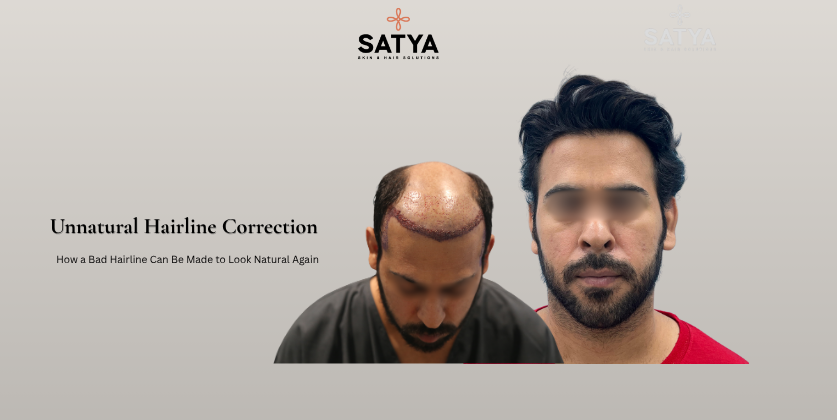
If you look in the mirror and your hairline feels too straight, too low, or simply “not yours,” you are not imagining it. A poorly designed hairline is one of the most common reasons people seek unnatural hairline correction. The good news is that an unnatural hairline can almost always be improved.
Unnatural hairline correction is a specialised repair procedure that rebuilds the front of your scalp so it follows the natural rhythm of how hair actually grows. In this guide, our doctors explain why hairlines look fake, when correction is needed, and how the right approach can give you a result that no one can spot.
What Is an Unnatural Hairline?
An unnatural hairline is a frontal hairline that does not match how hair grows in nature. Instead of looking soft and gradual, it looks drawn on. People often describe it as “fake,” “pluggy,” “doll-like,” or “a wall of hair.”
A natural hairline is never a perfect line. It has tiny irregularities, soft single hairs at the very edge, and a slightly uneven shape. When a transplant or an old procedure ignores these details, the result stands out. That is when patients start looking for unnatural hairline correction.
Why Do Hairlines Look Unnatural After a Hair Transplant?
Most unnatural hairlines are not bad luck. They come from design and technique choices made during the first procedure. The most common reasons include:
1. The Hairline Was Placed Too Low or Too Straight
A hairline that sits too far forward, or runs in a straight line across the forehead, almost always looks artificial. Natural hairlines curve and soften with age.
2. Thick Grafts Were Used at the Front Edge
The very front of the hairline should use single-hair follicles. When two, three, or four hair grafts are placed at the edge, the result looks dense and blunt instead of feathered.
3. Wrong Angle and Direction
Hair at the hairline grows forward and flat, not upward. Grafts placed at the wrong angle catch the light and look planted rather than grown.
4. Old “Plug” Techniques
Patients who had transplants many years ago sometimes have large round grafts, known as plugs. These create the classic doll-hair look and are a frequent reason for correcting unnatural hairlines.
5. No Irregularity or Transition Zone
Nature blends. A good hairline has a soft transition zone of scattered hairs before the denser area begins. Without it, the hairline looks like a hard border.
Signs You May Need Unnatural Hairline Correction
You may be a candidate for unnatural hairline correction if you notice any of the following:
- Your hairline looks like a straight line rather than a soft curve
- The front edge feels too thick or “bushy”
- Individual grafts look like dots or clumps
- Your hairline sits too low for your face and age
- Hair at the front grows in an odd direction
- The result simply does not look like your old, natural hairline
If one or more of these sound familiar, a proper assessment can tell you what is realistic for your case.
How Unnatural Hairline Correction Works
Correcting unnatural hairlines is more detailed than a first transplant. The aim is not just to add hair. It is to undo what looks wrong and rebuild the front in a natural pattern. Depending on your case, the approach may include the following steps.
Redesigning the Hairline
The surgeon first plans a new hairline shape that suits your face, forehead, and age. This design uses gentle curves, soft corners, and natural irregularity instead of a flat line.
Removing or Reducing Misplaced Grafts
If thick grafts or old plugs are sitting at the front, some of them may be removed using fine extraction. These follicles can sometimes be re-implanted further back where density is helpful.
Refining With Single-Hair Follicles
Single-hair follicular units are placed along the new leading edge. This creates the feathered, see-through look that makes a hairline believable.
Correcting Angle and Density
Grafts are added at the correct forward angle, and density is balanced so the front blends smoothly into the rest of the scalp.
Because repair work depends on your existing grafts, scarring, and donor supply, every plan is built case by case. There is no single fixed method for unnatural hairline correction.
Also Read:
Correcting Unnatural Hairlines vs a First Hair Transplant
It helps to understand why repair is treated as a specialised procedure.
| Factor | First Transplant | Correcting Unnatural Hairlines |
|---|---|---|
| Starting point | Clean scalp, no prior work | Existing grafts, possible scarring |
| Donor supply | Usually full | Often partly used already |
| Main goal | Add density | Redesign and refine, then add |
| Complexity | Standard | Higher, very detail driven |
This is why correcting unnatural hairlines should be handled by surgeons experienced in repair work, not treated as a routine top-up.
Check All- Advanced Hair Treatment Services
What Makes a Hairline Look Natural
A natural-looking hairline follows a few simple rules of nature:
- Irregular edge. Small ups and downs along the front, never a straight line.
- Single hairs in front. Fine, single follicles at the very edge.
- Soft transition. A scattered zone before the denser area.
- Correct angle. Hair lying forward and flat against the scalp.
- Age-appropriate position. A height that suits your face today and in ten years.
When all five are respected, the result looks like hair you were always meant to have. That is the real goal of any good unnatural hairline correction.
The Satya Approach to Correcting Unnatural Hairlines
At Satya Skin & Hair Solutions, hairline repair is treated as both an art and a medical procedure. Our co-founders bring two sides of the same problem together. Dr. Shail Gupta, our hair transplant surgeon, focuses on graft design, angle, and the precise rebuilding of a natural front edge. Dr. Ruchi Agarwal, MD Dermatology, assesses scalp health, hair quality, and the medical factors that protect your long-term result.
Every correction begins with an honest assessment. Not every hairline can be made perfect, and we believe in telling you what is realistic before anything else. Our philosophy is simple and it guides each plan
we make: Truth in Beauty. Rooted in Science.
We see patients across our Delhi NCR clinics in Pitampura, Gurgaon, and at the IGI Airport location, including many who come to us after a result elsewhere left them unhappy.
Recovery and What to Expect
Recovery after unnatural hairline correction is similar to a standard transplant. Most patients return to light routines within a few days. Tiny crusts settle over one to two weeks, and transplanted hairs shed early before regrowing over the following months.
Final results usually take eight to twelve months, because hair grows slowly and the front edge needs time to soften and blend. Patience is part of the process, and a good clinic will guide you through every stage rather than promise overnight change.
Talk to Our Doctors Before You Decide
If your hairline does not look like your own, you deserve a clear and honest opinion before any decision. A consultation with our team can tell you whether unnatural hairline correction is right for you, what is realistically possible, and what your options are.
Frequently Asked Questions
Yes. In most cases an unnatural hairline can be corrected by redesigning the shape, removing or refining misplaced grafts, and adding single-hair follicles at the front. The degree of improvement depends on your existing grafts and donor supply, which is why an in-person assessment matters.
The most common reasons are a hairline placed too low or too straight, thick grafts used at the front edge, grafts at the wrong angle, or no soft transition zone. Correcting unnatural hairlines focuses on reversing these specific issues.
The procedure is done under local anaesthesia, so you should feel little to no pain during treatment. Mild soreness afterwards is normal and usually settles within a few days.
Early changes appear as the area heals, but the natural final result takes about eight to twelve months. The front edge needs time to grow in and soften.
Yes. A low hairline can often be improved by removing grafts from the lowest line and reshaping the front to a more natural height. This is a common part of unnatural hairline correction.
Generally yes. Repair work has to deal with existing grafts, possible scarring, and a partly used donor area, so it requires more planning and a surgeon experienced in correction.