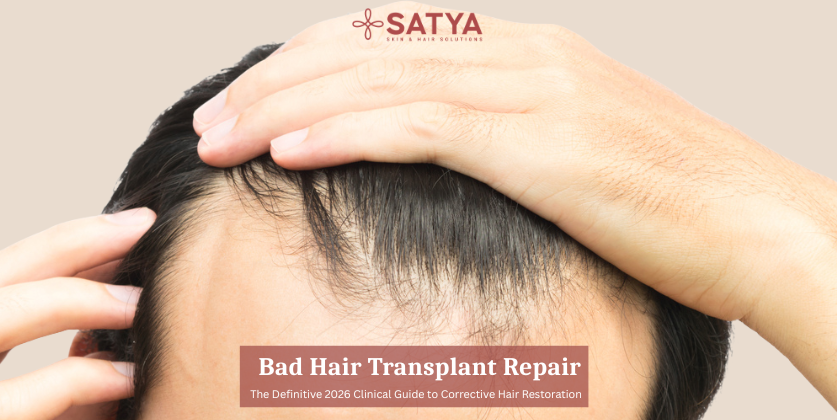
Bad hair transplant repair is a specialised corrective hair transplant procedure that fixes the results of a previous surgery an unnatural hairline, low density, patchy growth, visible scarring, or an over-harvested donor area. The goal is to protect your limited remaining donor hair, redesign a natural-looking hairline, and rebuild density safely.
Not every case can be fully corrected, but most can be meaningfully improved with the right surgical strategy. Because the scalp has already been operated on, a repair is more complex than a first-time transplant and should only follow a thorough scalp and donor assessment.
A hair transplant is meant to give you back your confidence not take it away. Yet many patients arrive at our clinic searching for bad hair transplant repair after a first procedure left them with an unnatural hairline, thin patchy growth, or scarring they cannot hide. If you are one of them, you are not alone, and your situation is rarely hopeless.
A carefully planned corrective hair transplant can often undo much of the visible damage and restore a result that looks like it was always yours. This doctor-led guide explains what bad hair transplant repair involves, why transplants fail, and how an experienced surgical team approaches unnatural hairline correction without exhausting your remaining donor reserve.
What Is Bad Hair Transplant Repair?
Bad hair transplant repair also called revision or corrective hair transplant surgery is a second procedure performed to improve or fix the outcome of an earlier transplant. It is one of the most technically demanding procedures in hair restoration, because the surgeon is no longer working with a fresh, untouched scalp. The donor area may already be partly used. The recipient zone may contain misangled grafts, scar tissue, or grafts that were placed too low or too thick.
In simple terms, the first surgery decides how much room is left to work with. A repair is not about adding as many grafts as possible it is about using a smaller, smarter number of grafts to correct what looks wrong while preserving what little donor hair remains for the future.
Signs You May Need a Corrective Hair Transplant
Patients often sense something is wrong long before they understand why. If you searched for what a failed hair transplant looks like, these are the most common signs that a corrective hair transplant may help.
An Unnatural or “Pluggy” Hairline
The single most common complaint is an unnatural hairline. Older techniques and rushed work can leave grafts that look like rows of doll’s hair, a hard straight line, or a hairline placed too low for the patient’s age and face. Unnatural hairline correction focuses on softening this front edge so it blends with the rest of the scalp.
Low Density or Patchy Growth
Some patients see only a fraction of the grafts they paid for actually grow. Thin coverage, visible gaps, and see-through patches usually point to poor graft handling, over-dense packing that cut off blood supply, or a clinic that promised more grafts than the donor could safely give.
Visible Scarring
A linear strip scar from FUT, or scattered white dots from a badly extracted FUE, can be hard to disguise especially with short hair. Scar camouflage and careful re-grafting can reduce how visible these marks are.
Donor Area Depletion
Aggressive over-harvesting can leave the back and sides of the scalp looking moth-eaten or unnaturally thin. This is one of the hardest problems to fix, because the donor zone is your only permanent supply once it is gone, it does not come back.
Most patients who come to us for a repair do not need more hair they need their existing hair placed correctly. The first question is never how many grafts we can add, but how much healthy donor hair is still left to use safely.”
Dr. Shail Gupta, Lead Hair Transplant Surgeon, Satya Skin & Hair Solutions
Why Do Hair Transplants Go Wrong?
Understanding the cause matters because a good Repair Hair Transplant plan depends on it. A hair transplant most often goes wrong for reasons that have nothing to do with bad luck and everything to do with planning and skill:
- Poor hairline design: a line that is too low, too straight, or wrong for the patient’s age and facial proportions.
- Incorrect graft angle and direction: hair that grows straight out or sideways instead of following the natural flow of the scalp.
- Over-harvesting the donor area: removing too many grafts in one session, thinning the permanent zone.
- Graft mishandling: follicles left out of solution too long, or packed too densely, leading to poor survival.
- Untreated scalp conditions: active dandruff, inflammation, or untreated pattern hair loss undermine the result.
This is why the first step at Satya is never the operating table. It is a medical and surgical assessment to find out exactly what went wrong before deciding whether and how a corrective hair transplant should proceed.
How Is a Bad Hair Transplant Repaired?
Bad hair transplant repair is a staged, evidence-led process. At Satya Skin & Hair Solutions a doctor-led clinic operating since 2005, we approach every revision case in three deliberate steps.
Step 1: Scalp and Donor Health Assessment
Before any surgical plan, the scalp must be healthy. Our dermatology lead examines the skin, checks for active hair loss or inflammation, and uses trichoscopy to measure how much usable donor hair genuinely remains. Pattern hair loss often continues after a transplant, so medical management may be advised first to stabilise the existing hair before a repair is even considered.
A repair built on an unstable scalp will fail again. We treat the underlying hair loss and confirm the donor reserve first. Healthy skin and a calm scalp are the foundation of any lasting correction health bhi, hair bhi.”
Dr. Ruchi Agarwal, Consultant Dermatologist, Satya Skin & Hair Solutions
Step 2 Surgical Planning and Hairline Redesign
Next, the surgical team redesigns the hairline and maps where correction is needed. Using our Mimic Nature Hairline approach, single follicular units are placed at the front edge at natural, irregular angles to break up any hard or pluggy line. Older, poorly angled grafts may be carefully removed and re-implanted in the correct direction. The plan always protects the donor area using our Maximum Harvesting Technique (MHT), which spreads extraction thinly across a wider zone so the back and sides never look depleted.
Step 3 Graft Redistribution and Scar Camouflage
Finally, density is rebuilt where it is missing, and grafts are placed into or around scars to soften their appearance. Our Direct Stimulated Follicular Transplant (DSFT) technique aims to improve graft survival, which matters even more in a repair where every single follicle counts. The guiding principle throughout is conservation, Less Medicine, Less Donor, Maximum Skill because in revision surgery, restraint is what produces a natural result.


Corrective Hair Transplant vs First-Time Surgery: Why Repair Is Harder
A revision is not simply a second transplant. The starting conditions are fundamentally different, and this table explains why an experienced surgeon is essential for repair work.
| Factor | First-Time Transplant | Corrective / Repair Transplant |
|---|---|---|
| Donor supply | Full, untouched reserve | Partly used; must be conserved |
| Scalp condition | Healthy, no scar tissue | Scar tissue and reduced blood supply |
| Hairline | Designed from scratch | Must correct and disguise the existing line |
| Graft numbers | Larger sessions possible | Smaller, precise sessions |
| Difficulty | Standard | High demands advanced skill |
| Realistic goal | Full restoration | Significant improvement, not perfection |
Unnatural Hairline Correction: The Satya Approach
Unnatural hairline correction is the most requested part of any bad hair transplant repair. The fix is rarely about adding bulk; it is about artistry at the very front of the scalp. We soften a harsh line by adding fine single-hair grafts in an irregular pattern, adjusting the angle of misdirected hair, and lowering density toward the front so the hairline fades naturally into the forehead rather than starting abruptly. Where a hairline was placed too low for the patient’s age, selected grafts may be removed to restore a balanced, age-appropriate position.
Can Every Bad Hair Transplant Be Fixed?
Honesty matters more than reassurance here. Most poor results can be meaningfully improved, but not every case can be made perfect. The limiting factor is almost always the donor area. If a previous clinic has heavily over-harvested the back and sides, there may simply not be enough permanent hair left to fully rebuild. In such cases, a realistic plan might combine a conservative corrective hair transplant with medical therapy and a sensible hairstyle strategy. Any clinic that guarantees a flawless outcome before examining your scalp should be treated with caution. Responsible bad hair transplant repair begins with realistic expectations.
The Satya Philosophy: Less Medicine. Less Donor. Maximum Skill.
Repair surgery is where this philosophy matters most. A depleted donor area cannot afford waste, so we plan every graft to do maximum work. Founded in 2005 and led by Dr. Shail Gupta and Dr. Ruchi Agarwal, Satya Skin & Hair Solutions combines surgical precision with dermatological care across our centres in Gurgaon (DLF Phase 4 / Galleria Market) and Pitampura, Delhi. For patients across Delhi NCR seeking corrective hair transplant care, the focus stays on safe, natural, conservation-first results rather than chasing graft numbers.
Thinking About a Corrective Hair Transplant?
If you are living with the results of a hair transplant gone wrong, the most useful next step is a proper assessment, not another rushed surgery. A consultation lets our doctors examine your scalp, measure your remaining donor reserve, and tell you honestly what bad hair transplant repair can and cannot achieve in your case.
Book a Repair Assessment Consultation Talk with our doctor-led team at Satya Skin & Hair Solutions, Gurgaon & Delhi. Call: +919999570494
Frequently Asked Questions
Yes, most poor results can be improved through a corrective hair transplant, though the outcome depends heavily on how much healthy donor hair remains. A surgeon can refine an unnatural hairline, add density to patchy areas, and camouflage scars. Full perfection is not always possible, but meaningful improvement usually is.
A corrective or revision hair transplant is a second procedure done to fix or improve the result of an earlier transplant. It addresses problems such as a pluggy hairline, wrong graft angles, low density, and visible scarring, while carefully protecting the remaining donor area.
Repair surgery is usually priced per graft and varies with the number of grafts needed and the complexity of the case. Because revision work is more demanding than a first transplant, an in-person assessment is the only accurate way to estimate cost. Contact our Gurgaon or Delhi clinic at [Phone Number] for a personalised quote.
An unnatural look usually comes from a poorly designed hairline, grafts placed at the wrong angle, or hair packed too densely in a hard straight line. Unnatural hairline correction softens this front edge with fine single-hair grafts placed at natural, irregular angles.
Scars cannot always be erased, but they can often be made far less visible. Options include placing grafts into or around the scar to break it up, scalp micropigmentation, and dermatological scar treatment. The right approach depends on whether the scar is a FUT strip line or scattered FUE dots.
Most surgeons recommend waiting at least 10 to 12 months after the first procedure. This allows transplanted hair to fully grow and the scalp to heal, so the surgeon can assess the true result before planning any corrective hair transplant.
Yes. A repair must work around scar tissue, reduced blood supply, and a partly used donor area, all while correcting visible problems. This is why bad hair transplant repair should be performed by an experienced surgical team that prioritises donor conservation.