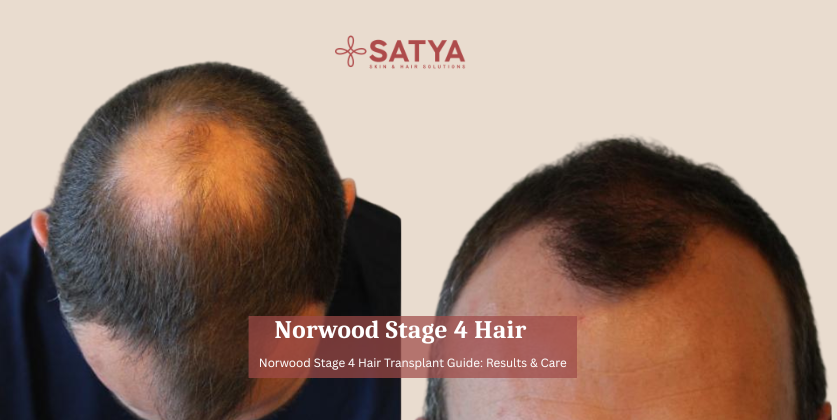
If your hairline has receded deeply at the temples and a thin or bald patch has appeared on your crown, you may be at Norwood Stage 4 Hair loss. Norwood Stage 4 Hair is one of the most common stages at which men finally decide to seek treatment the loss is now clearly visible, yet there is usually still enough donor hair on the back and sides of the scalp to restore good coverage. The good news: a well-planned Norwood Stage 4 hair transplant can rebuild a natural, age-appropriate hairline and cover the crown in a single, carefully designed procedure.
This guide, prepared with the medical team at Satya Skin & Hair Solutions, explains what Norwood Stage 4 Hair really means, why it happens, how many grafts it usually needs, and how to decide whether a transplant is right for you.
What Is Norwood Stage 4 Hair Loss?
The Norwood Scale is the standard medical tool doctors use to classify male pattern baldness, from Stage 1 (no real loss) to Stage 7 (extensive loss). Norwood Stage 4 Hair sits in the middle of this scale and marks a clear turning point.
At Norwood Class 4, two things are happening at the same time:
- The hairline has receded significantly at both temples, often forming a deep “M” or “U” shape.
- A separate area of thinning or baldness has developed at the crown (the top-back of the head).
What separates Norwood Stage 4 Hair from later stages is the bridge of hair that still runs across the top of the scalp, keeping the front and crown loss as two distinct zones. In the Norwood Class 4A variant, the loss is concentrated at the front rather than the crown.
Signs You May Be at Norwood Stage 4 Hair Loss
- A noticeably high, receded hairline that no longer matches your younger photos.
- A visible thin patch or bald spot at the crown, especially under bright light.
- Styling that no longer hides the scalp, even when hair is grown longer.
- Hair feeling finer and shorter in the affected zones.
If several of these apply, a clinical scalp assessment is the only reliable way to confirm whether you are truly at Norwood Stage 4 Hair or at an earlier or later stage.
Why Does Norwood Class 4 Hair Loss Happen?
Norwood Class 4 is most often caused by androgenetic alopecia genetically inherited male pattern baldness. In genetically sensitive men, a hormone called DHT (dihydrotestosterone) gradually shrinks hair follicles in the front and crown. Over years, these follicles produce thinner, shorter hairs until they stop growing altogether.
Key contributing factors include:
- Family history of baldness on either side.
- Age the pattern typically deepens through the 30s and 40s.
- Hormonal sensitivity to DHT.
- Stress, poor nutrition and certain medical conditions, which can accelerate an existing pattern.
Importantly, the hair at the back and sides of the scalp is genetically resistant to DHT. This is why it remains even at Norwood Stage 4 Hair loss and why it makes such a reliable donor area for a transplant.
Treatment Options at Norwood Stage 4 Hair Loss
Not everyone at Norwood Stage 4 needs surgery on day one. A doctor will usually consider the full range of options:
Medical and non-surgical management
Prescription medicines and clinically supervised therapies (such as those that reduce DHT activity or support existing follicles) can slow further loss and improve the hair you still have. These work best on miniaturising hair, not on areas that are already fully bald.
Hair transplant surgery
Once an area is completely bald, as is common at Norwood Class 4, only a transplant can physically restore hair there. A Norwood Stage 4 hair transplant relocates DHT-resistant follicles from the donor area to the receding hairline and crown, where they continue to grow naturally for life.
In most cases, the best long-term result combines a well-planned transplant with ongoing medical care to protect the native hair around it.
Also Read: All About Norwood Stage 3 Hair Restoration
Norwood Stage 4 Hair Transplant: How Many Grafts Are Needed?
Graft numbers always depend on individual scalp area, hair characteristics and donor supply, so the figures below are general guidance not a fixed quote. At Norwood Stage 4 Hair loss, two zones usually need coverage: the frontal hairline and the crown.
| Area Treated | Typical Graft Range | Goal |
| Frontal hairline + temples | 2,000 – 3,000 | Frame the face, lower the hairline naturally |
| Crown / vertex | 1,500 – 2,500 | Cover the bald patch, restore swirl pattern |
| Combined Norwood Stage 4 case | 3,000 – 5,000+ | Full, balanced coverage of both zones |
These ranges are indicative only and are confirmed during an in-person scalp and donor assessment.
FUE or FUT for a Norwood Stage 4 Hair Transplant?
Two main techniques are used, and the right choice depends on your donor density and how many grafts you need.
- FUE (Follicular Unit Extraction): follicles are extracted individually, leaving no linear scar. Ideal for most Norwood Class 4 patients and for those who keep their hair short.
- FUT (Follicular Unit Transplantation): a strip of donor skin is removed and dissected into grafts, allowing a very high graft yield in a single session useful in larger Norwood Stage 4 cases with strong donor reserves.
A good surgeon recommends the method that protects your donor area for the future, rather than the one that is simply fastest.
The Satya Approach to Norwood Stage 4 Hair Transplant
At Satya Skin & Hair Solutions, our philosophy is simple: “Less Medicine. Less Donor. Maximum Skill.” For a Norwood Stage 4 hair transplant, this matters more than at any other stage because the donor area must cover two zones today while still leaving reserves for the future.
Dr. Shaiil Gupta, our hair transplant surgeon, plans every Norwood Stage 4 case around long-term donor management. Using techniques such as the Maximum Harvesting Technique (MHT) and Direct Stimulated Follicular Transplant (DSFT), the aim is to achieve full coverage with the fewest grafts necessary, so that hair remains available if the pattern progresses with age.
Our Mimic Nature Hairline design ensures the restored hairline looks age-appropriate and natural rather than artificially low, while the Zero-Pain Anaesthesia Protocol keeps the experience comfortable from start to finish.
Dr. Ruchi Agarwal, our dermatologist, reviews scalp and follicle health before and after surgery, so that medical therapy protects the native hair surrounding the grafts. This combined surgical and dermatological care is what gives Norwood Class 4 patients a result that holds up over the years.
Satya has been treating hair loss since 2005, with clinics in Gurgaon and Delhi (Pitampura) and patients travelling from across India and abroad.
What to Expect After a Norwood Stage 4 Hair Transplant
- First 2 weeks: tiny scabs form and fall off; transplanted hairs shed (this is normal).
- Months 3–4: new growth begins from the transplanted follicles.
- Months 6–9: visible density and a maturing hairline.
- Months 12–15: full, final result with natural thickness.
Because transplanted follicles are DHT-resistant, the restored hair is permanent though looking after your remaining native hair stays important.
Thinking about your options?
If you recognise yourself in Norwood Stage 4 Hair loss, the most useful next step is a proper scalp and donor assessment with a qualified doctor. The team at Satya Skin & Hair Solutions can review your stage, explain whether a transplant suits you, and outline a plan built around long-term, natural results with no pressure to proceed.
Frequently Asked Questions: Norwood Stage 4 Hair
For most men, yes. At Norwood Stage 4 there is usually a healthy donor area and clearly defined bald zones, which makes it a very treatable stage. A single well-planned procedure can restore both the hairline and crown.
Most Norwood Stage 4 cases need roughly 3,000 to 5,000+ grafts to cover both the frontal area and crown, depending on scalp size and donor density. The exact number is confirmed at an in-person assessment.
Fully bald areas cannot regrow on their own. Medication and therapies can slow loss and strengthen thinning hair, but a transplant is the only way to restore hair in completely bald zones at Norwood Class 4.
The transplanted follicles are taken from DHT-resistant areas, so they continue to grow for life. Protecting your remaining native hair with medical care helps keep the overall look consistent over time.
In standard Norwood Class 4, loss affects both the hairline and the crown. In Class 4A, the loss is concentrated at the front and mid-scalp, with the crown relatively preserved.
With careful hairline design such as Satya’s Mimic Nature Hairline approach the result is built to look natural and age-appropriate, using single hairs at the front edge for a soft, undetectable line.