You’ve done your research. You’ve watched videos, scrolled through before-and-afters, and you’ve arrived at one question that almost every patient asks before booking a consultation:
“Should I get FUE or FUT?”
It sounds like a simple choice. It isn’t. And getting it wrong or choosing a clinic that makes the decision based on convenience rather than your individual anatomy is one of the most common reasons patients end up dissatisfied with their hair transplant results.
This guide will walk you through exactly what separates FUE vs FUT hair transplant techniques, who each approach is best suited for, what the real pros and cons are, and how the team at Satya Skin & Hair Solutions approaches this decision for every patient in Delhi and Gurgaon.
What Is FUE Hair Transplant?
FUE Follicular Unit Extraction is the technique most people have heard of. It is the most widely offered method across India today.
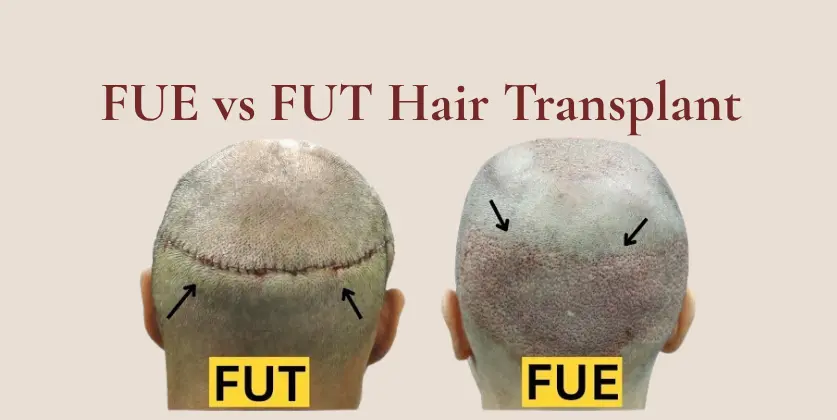
In FUE, individual follicular units (groups of 1 to 4 hair follicles) are extracted one by one from the donor area at the back and sides of the scalp using a micro-punch instrument, typically 0.8 mm to 1.0 mm in diameter. Each extracted graft is then implanted into the recipient area.
Why patients are drawn to FUE:
- No linear scar healing leaves only tiny circular dots that are largely invisible even with a shaved head
- Suitable for patients who prefer shorter haircuts post-surgery
- Slightly shorter recovery time for most patients
- Can be used to harvest donor hair from the beard or body in certain cases
What FUE does not eliminate: FUE does not eliminate post-operative downtime, the risk of poor graft survival from improper handling, or the possibility of visible scarring if done by an inexperienced operator. The quality of FUE varies enormously between clinics.
What Is FUT Hair Transplant?
FUT Follicular Unit Transplantation, is the older and, in many skilled hands, more powerful of the two techniques. It is sometimes called the strip method.
In FUT, a narrow strip of scalp skin is surgically removed from the donor zone. The follicular units within that strip are then meticulously dissected under microscopic magnification and implanted into the recipient area.
The donor incision is closed with a technique called trichophytic closure, which allows hair to grow through the scar, making it largely undetectable in most patients over time.
Also Read: Hair Transplant Cost in India 2026
Why FUT remains clinically relevant:
- Higher graft yield per session, more grafts can be harvested from the same donor area
- Grafts are handled for a shorter time outside the body, which can support higher survival rates
- Suitable for patients with advanced hair loss (Norwood Grade 5, 6, 7) who need large numbers of grafts
- Long-term donor area is less depleted compared to aggressive FUE extraction
What FUT involves: A linear scar does result from the donor incision. With trichophytic closure performed by an experienced surgeon, this scar is typically a fine, well-concealed line, but it does exist. Patients who plan to wear their hair very short should factor this in during planning.
FUE vs FUT Hair Transplant: A Direct Comparison
| Factor | FUE | FUT |
|---|---|---|
| Scarring | Tiny circular dots | Fine linear scar (trichophytic closure) |
| Graft yield per session | Moderate | High |
| Graft survival rate | Excellent with skilled extraction | Excellent with microscopic dissection |
| Recovery time | 7–10 days (social) | 10–14 days (donor site healing) |
| Suitable for short haircuts | Yes | Requires longer coverage at donor area |
| Best for | Mild–moderate loss, younger patients, women | Advanced loss, large sessions, repeat procedures |
| Cost in Gurgaon/Delhi NCR | Higher per graft (time-intensive) | Slightly lower per session |
| Donor zone depletion risk | Higher if extraction is aggressive | Lower with precise strip planning |
FUE vs FUT Success Rate: What the Data and Experience Show
One of the most common questions patients ask is: “Which technique has a better success rate?“
The honest clinical answer is that FUE vs FUT success rate differences are largely technique- and surgeon-dependent, not inherent to the method itself.
When performed by an experienced surgical team:
- FUE graft survival typically ranges between 85–95%
- FUT graft survival with proper microscopic dissection is similarly high, often 90–95%
What matters more than the technique label is:
- How carefully the grafts are extracted and handled
- How promptly they are implanted
- The quality of the implantation (angle, depth, density)
- Post-operative care protocol
At Satya Skin & Hair Solutions, Dr. Shail Gupta and Dr. Ruchi Agarwal follow a no-touch graft handling protocol at every stage, which is among the most important variables in determining final hair density and naturalness of result. The objective is not to complete the most procedures, it is to maximise what grows back.
Also Read: Hair Transplant India Vs Turkey
FUE vs FUT Pros and Cons: Honest Assessment
FUE Pros and Cons
Pros:
- No linear scar
- Flexibility for shorter post-operative hairstyles
- Can harvest from body or beard donor areas if scalp donor is limited
- Well-suited for women (who typically do not need to shave the full scalp)
Cons:
- Random extraction across the donor zone can deplete the safest (DHT-resistant) follicles if not mapped carefully
- More time-intensive per graft, which means fewer grafts per session in some clinics
- Quality is highly variable the punch diameter, speed, and depth all affect transection rates
FUT Pros and Cons
Pros:
- Higher graft numbers in a single session important for advanced Norwood grades
- Precise microscopically-controlled graft dissection
- Preserves the widest portion of the permanent donor zone for future sessions
- Established track record in high-density restoration
Cons:
- Linear donor scar, requires careful surgical closure
- Slightly longer donor area recovery
- Not suitable for patients committed to very short haircuts
FUE vs FUT Hair Transplant for Female Hair Loss
This is a topic that receives far less attention than it deserves.
Female hair loss is fundamentally different from male pattern baldness. Most women experience diffuse thinning across the crown and mid-scalp, a pattern described by the Ludwig scale, rather than the receding frontal hairline seen in men. This affects both technique selection and donor zone planning in important ways.
For most women considering hair transplant in Delhi or Gurgaon:
- FUE is typically more appropriate because it does not require shaving the entire scalp small sections can be harvested while leaving surrounding hair in place, making the procedure invisible during recovery
- The donor zone must be mapped with precision to ensure only DHT-resistant follicles are selected, as women with diffuse loss may have donor hair that is itself susceptible to future thinning
- A significant proportion of women presenting with hair loss are not immediately surgical candidates underlying causes including thyroid dysfunction, iron deficiency, hormonal imbalances, and autoimmune conditions must be investigated and addressed first
Dr. Ruchi Agarwal evaluates all female patients with a thorough trichoscopic analysis and blood panel before any surgical planning. A hair transplant is a long-term investment, and the planning horizon for women must account for how the underlying loss pattern may evolve over 10 to 15 years.
FUE vs FUT Hair Transplant Cost in Gurgaon and Delhi NCR
Cost is a legitimate consideration and should be discussed transparently.
In Gurgaon and Delhi NCR, hair transplant cost is typically quoted per graft:
- FUE cost in Gurgaon/Delhi: ₹30 to ₹80 per graft at most clinics; the total cost depends on the number of grafts required
- FUT cost in Gurgaon/Delhi: Slightly lower per graft in some cases due to the higher yield per session, but total cost depends on session complexity and surgical team
What drives the real cost difference is not the technique, it is the surgical team, the protocol, and the number of grafts required for your specific grade of hair loss.
A Norwood Grade 3 patient may require 1,500–2,500 grafts. A Grade 6 patient may require 4,000–6,000 grafts. The technique matters less to the final bill than the extent of your hair loss.
A few things to be wary of when evaluating cost in Delhi NCR:
- Clinics that quote a low per-graft rate but harvest more grafts than necessary
- Graft counts that are not independently verified
- “Package” pricing that does not specify technique or minimum quality standards
At Satya Skin & Hair Solutions, consultations include a detailed graft estimate, a surgical planning discussion, and transparent pricing, with no pressure to proceed.
The Satya Approach: “Less Medicine. Less Donor. Maximum Skill.”
At Satya Skin & Hair Solutions, the choice between FUE and FUT is never decided in advance. It is determined during your consultation, based on:
- Your current Norwood or Ludwig grade
- Your donor density and donor zone quality
- The number of grafts required to achieve a natural, durable result
- Your lifestyle, haircut preferences, and future loss trajectory
Dr. Shail Gupta and Dr. Ruchi Agarwal operate on a principle they call Balanced Hair Transplant: the goal is to restore natural-looking density using the minimum necessary grafts from the smallest possible donor footprint, preserving donor capacity for future sessions if needed.
This is not about choosing the most advanced-sounding technique. It is about surgical judgement and long-term planning.
Their proprietary approach, the Direct Stimulated Follicular Transplant (DSFT), combined with the Maximum Harvesting Technique (MHT), optimises graft yield while protecting the long-term viability of the donor zone a consideration that becomes critical as a patient ages.
Myth Busting: FUE vs FUT
Myth: FUE is always better than FUT
Not accurate. For patients with advanced hair loss who need large graft numbers, FUT may deliver a better outcome. The “best” technique is the one matched to your anatomy and goals.
Myth: FUT always leaves a visible scar
With trichophytic closure performed by an experienced surgeon, the FUT scar in most patients becomes a fine, hair-covered line that is not visible with normal hairstyles.
Myth: FUE leaves no scars
FUE does leave scars they are small, circular dots rather than a line. With aggressive extraction or large sessions, these dots can become visible if the head is shaved.
Myth: Women cannot get hair transplants
Appropriately selected female candidates achieve excellent results with FUE. Careful pre-operative evaluation is the key variable.
Myth: One procedure lasts forever
Hair transplants are permanent for the transplanted grafts. But hair loss may continue in non-transplanted areas. Long-term planning with a surgeon who thinks 10–15 years ahead is essential.
Frequently Asked Questions
There is no universal answer. FUE is better suited for mild-to-moderate hair loss, patients who prefer short haircuts, and most women. FUT is often the stronger choice for advanced hair loss where large graft numbers are needed in a single session. The right technique depends entirely on your individual hair loss pattern, donor zone, and surgical goals.
Both techniques achieve graft survival rates of 85–95% when performed by an experienced team with proper handling protocols. Success rate differences between FUE and FUT are more closely tied to surgical skill and clinical standards than to the technique itself.
Yes, when performed on appropriate candidates. Women with genetic hair loss, traction alopecia, or hairline recession can be excellent FUE candidates. However, diffuse hair loss requires careful evaluation to rule out medical causes before surgical planning.
Most patients resume social and work activities within 7–14 days. FUE typically has a slightly shorter donor site recovery than FUT. Full cosmetic results take 10–14 months as transplanted hair sheds and then regrows.
Hair transplant cost in Gurgaon varies by the technique, the number of grafts, and the surgical team. At Satya Skin & Hair Solutions in DLF Phase 4, transparent graft-based pricing is provided during the consultation. Contact us at 9999570494 or visit –Satya Skin & hair Solution to schedule a consultation.
The best technique is the one that is matched to your anatomy, your hair loss stage, and your long-term goals. At Satya Skin & Hair Solutions, the choice between FUE and FUT is made after a detailed surgical consultation, not before.
Yes. Many patients have their first procedure with FUE and, if further coverage is needed years later, can incorporate FUT to maximise donor yield. This is why long-term surgical planning at the outset matters.
Take the Next Step
If you are weighing FUE vs FUT hair transplant in Delhi or Gurgaon, the most important step is a consultation with a surgeon who has no vested interest in a particular technique only in giving you the result that is right for your hair.
At Satya Skin & Hair Solutions, Dr. Shaiil Gupta and Dr. Ruchi Agarwal have been performing hair restoration procedures since 2005. Every patient receives a complete assessment, an honest opinion, and a surgical plan built around their hair not around a procedure menu.
Schedule a consultation today. No obligation, no pressure just clarity.
This article is for educational purposes only. All treatment decisions should be made in consultation with a qualified hair restoration surgeon following a personal examination.