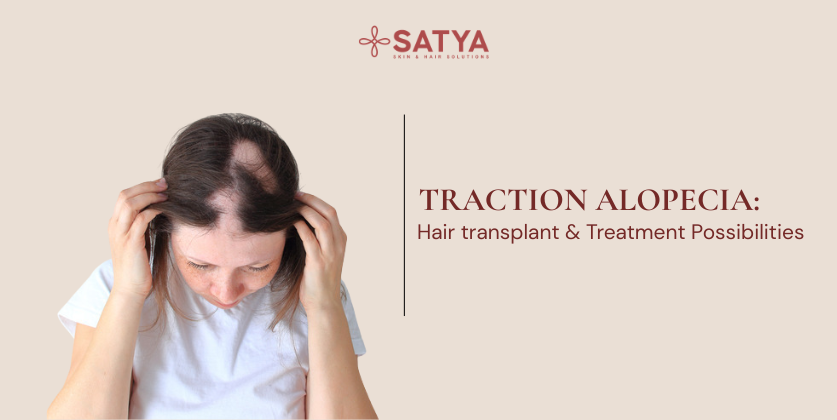
Male pattern baldness affects nearly 50% of men by the age of 50 yet most men wait years before understanding what is actually happening to their hair. Whether you have noticed a receding hairline in your 20s or thinning at the crown in your 40s, the biology behind male pattern baldness follows a predictable pattern.
Knowing which stage you are at, what is driving the hair loss, and what your real options are can mean the difference between preserving your hair and spending years trying to recover what was avoidable to lose.
At Satya Skin & Hair Solutions, Gurgaon and Delhi, our clinical team led by Dr. Shail Gupta evaluates and manages male pattern hair loss every day. This guide is written to give you the same clarity our patients receive in consultation.
What Is Male Pattern Baldness?
Male pattern baldness medically called androgenetic alopecia is the most common form of hair loss in men. It is a genetically programmed sensitivity of hair follicles to a hormone called dihydrotestosterone (DHT), a by-product of testosterone.
Over time, DHT causes susceptible follicles primarily those on the front, top, and crown of the scalp to miniaturise. The hair growth cycle shortens, the hairs become thinner and lighter with each cycle, and eventually those follicles stop producing visible hair altogether.
The follicles themselves are not destroyed they become dormant. This is why hair restoration remains possible even at advanced stages, provided the donor area at the back and sides of the scalp remains intact.
Hair follicles at the back and sides of the scalp are genetically resistant to DHT. This is the biological foundation of hair transplantation follicles harvested from this “safe zone” retain their DHT-resistance even when moved to thinning areas.
Hair Loss: Symptoms and Causes of Male Pattern Baldness
Symptoms: What to Look For
Male pattern baldness does not happen overnight. Its progression is gradual and follows recognisable patterns. Common early signs include:
- A hairline that begins receding at the temples, forming an “M” shape
- Thinning at the crown or vertex, sometimes before the hairline shows any change
- Hair that appears finer, shorter, or lighter in specific zones
- Increased hair shedding noticed on the pillow, in the shower, or on a comb
- A widening parting, especially visible under direct light
Many men dismiss early symptoms as normal shedding. The distinction is important: shedding 50–100 hairs per day is normal. When shedding exceeds this consistently, or when regrowth becomes visibly thinner, that is a clinical signal worth investigating.
Causes: The Biology Behind the Hair Loss
The root causes of male pattern baldness are well-established:
- Genetics: The primary driver. You can inherit the predisposition from either parent’s side. If your father, maternal grandfather, or uncles experienced significant hair loss, your risk is meaningfully elevated.
- DHT Sensitivity: Genetically susceptible follicles bind to DHT, triggering miniaturisation. This is not about testosterone levels it is about follicle sensitivity to DHT.
- Age: The probability increases with age. Hair loss beginning in the 20s tends to progress more aggressively than loss starting in the 40s.
- Scalp Microcirculation: Poor blood supply to follicles can accelerate miniaturisation in susceptible areas.
- Lifestyle Accelerants: Chronic stress, poor nutrition, smoking, and disrupted sleep can worsen the rate of progression, though they are not primary causes.
It is important to rule out other causes of hair loss including thyroid imbalance, iron deficiency, and alopecia areata before a diagnosis of male pattern baldness is confirmed. At Satya Skin & Hair, all patients undergo a structured clinical evaluation before any treatment recommendation is made.
The 7 Stages of Hair Loss: The Norwood-Hamilton Scale
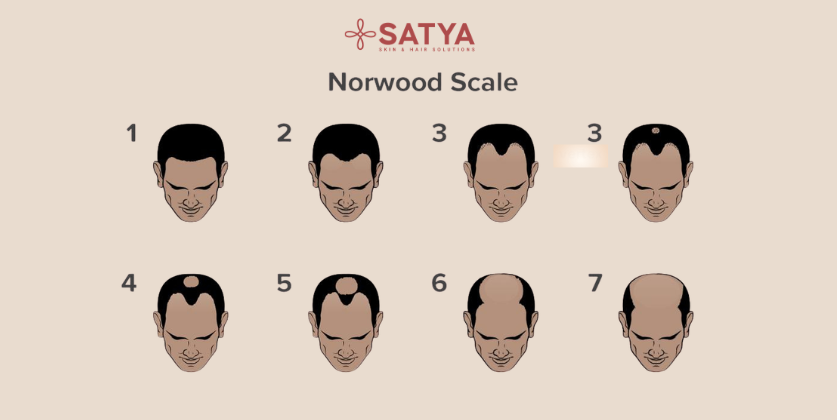
The Norwood-Hamilton scale is the internationally recognised classification system for male pattern baldness. It defines seven stages of hair loss, from a normal hairline to extensive baldness, and serves as the foundation for assessing hair loss grade and planning treatment.
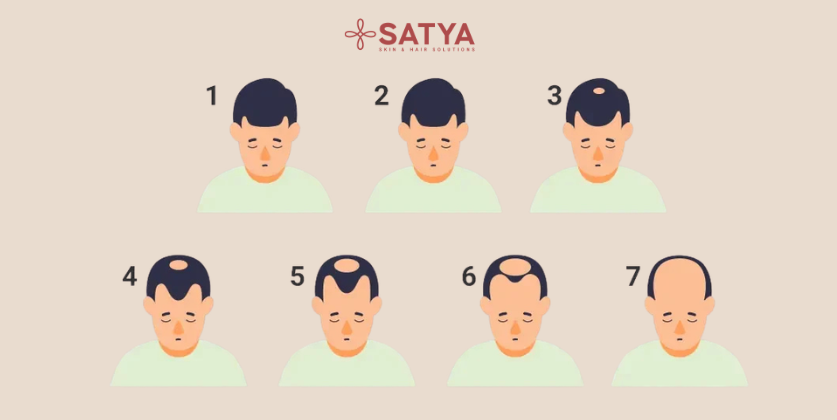
Understanding your Norwood stage is not merely academic. It determines the number of grafts needed for a transplant, the viability of your donor area, and the realistic outcomes of restoration.
| Stage | What You See | Typical Approach | Hair Loss Grade |
|---|---|---|---|
| Stage I | Normal hairline, no significant hair loss | None required | Low–Moderate |
| Stage II | Slight recession at the temples | Monitor; lifestyle changes | Moderate–High |
| Stage III | Noticeable recession; possible vertex thinning | Medical therapy | Low–Moderate |
| Stage IV | Deep recession; significant crown loss | Medical or early surgical | Moderate–High |
| Stage V | Recession and crown loss begin to merge | Hair transplant candidacy | Low–Moderate |
| Stage VI | Bridge of hair between front and crown disappears | Hair transplant | Moderate–High |
| Stage VII | Only a narrow band of hair remains on sides and back | Advanced restoration | Low–Moderate |
Note: The Norwood scale also includes a Type A variant in which hair loss progresses from front to back rather than the classic bimodal (temple + crown) pattern. Accurate staging requires clinical examination, not self-assessment from a mirror.
At Satya Skin & Hair, we see patients as young as 22 presenting with Stage III-IV loss. Early-stage patients are often the ones who benefit most from intervention when the hair is thinning but still present, both medical management and surgical planning can deliver significantly better long-term outcomes.” Dr. Shail Gupta, Hair Transplant Surgeon
How Is Male Pattern Baldness Diagnosed?
Diagnosis involves a combination of clinical examination and history-taking. At Satya Skin & Hair, our evaluation process includes:
- A detailed scalp and hairline assessment to assign the correct Norwood stage
- Trichoscopy a magnified examination of the scalp to assess follicle density, miniaturisation ratio, and scalp health
- Blood panel where indicated, to rule out thyroid, hormonal, or nutritional factors
- Family history review to assess genetic risk and likely progression trajectory
- Donor area assessment to evaluate the long-term supply of DHT-resistant follicles
This comprehensive approach ensures that the treatment plan is matched to your actual hair loss pattern and your future trajectory not just today’s presentation.
Treatment Options: From Medical Management to Hair Transplant
Stage I to III: Medical Management First
At early stages, the priority is slowing or halting progression. Clinically validated medical options include:
- Minoxidil (topical): Increases blood flow to follicles and prolongs the growth phase. Effective for early-stage miniaturisation.
- Finasteride (oral): Inhibits the conversion of testosterone to DHT. Prescription-only. Clinical evidence supports stabilisation and partial regrowth in the majority of users at early stages.
- Low-Level Laser Therapy (LLLT): Used as an adjunct to improve scalp circulation and follicular metabolism.
- Nutritional support: Biotin, zinc, iron, and vitamin D correction where deficiencies are identified.
Medical therapy works best when started early and maintained consistently. It does not reverse advanced loss it is a stabilisation tool, not a restoration tool.
Stage III to VII: When Hair Transplant Becomes the Right Solution
For patients with significant, stable hair loss who are seeking permanent restoration, hair transplant surgery is the only treatment that delivers definitive results. At Satya Skin & Hair, we perform hair transplants using our proprietary DSFT (Direct Stimulated Follicular Transplant) technique a refinement of the FUE method that combines precision extraction, follicle stimulation, and natural hairline design.
Dr. Shail Gupta’s philosophy of “Less Medicine. Less Donor. Maximum Skill” guides every transplant case at Satya. This means:
- Harvesting the minimum number of grafts needed to achieve maximum natural density
- Preserving the donor area for future procedures if loss progresses
- Designing a hairline using the Mimic Nature principle mathematically calibrated to your facial structure and age
- Planning for the long term using our Future-Ready Transplant framework, which anticipates future hair loss patterns before they occur
A well-planned hair transplant at Stage IV or V can restore a natural appearance that lasts a lifetime. But a poorly planned transplant one that ignores future loss or over-harvests the donor area can leave a patient worse off at Stage VII. Planning is everything.” Dr. Shail Gupta
Zero-Pain Anaesthesia at Satya Skin & Hair
One of the most common fears associated with hair transplant procedures is the pain of local anaesthesia injections. At Satya Skin & Hair, we use our Zero-Pain Anaesthesia protocol a combination of topical numbing, micro-needle delivery, and vibratory distraction to ensure the procedure is as comfortable as possible from the first moment to the last.
Scalp Health and Male Pattern Baldness: The Dermatology Perspective
While Dr. Shail Gupta leads hair transplant and surgical planning at Satya Skin & Hair, Dr. Ruchi Agarwal brings her expertise in medical dermatology to cases where scalp health plays a role in hair loss severity.
Scalp conditions such as seborrheic dermatitis, folliculitis, or chronic inflammation can accelerate follicular miniaturisation in men already genetically predisposed to male pattern baldness. Dr. Ruchi Agarwal evaluates and treats these underlying conditions as part of a comprehensive hair loss management approach ensuring that the scalp is in optimal condition before medical or surgical hair restoration begins.
For patients presenting with both pattern hair loss and active scalp conditions, a combined medical dermatology and hair transplant consultation is recommended.
Common Myths About Male Pattern Baldness Addressed
- “It comes from your mother’s side.” Partially true. The AR gene on the X chromosome is maternally inherited and associated with hair loss but susceptibility genes from both parents contribute. Maternal and paternal family history both matter.
- “Wearing a cap causes baldness.” No clinical evidence supports this. Regular cap use does not affect follicle DHT sensitivity.
- “Shampooing too often makes you go bald.” Increased shedding after washing is normal — those are hairs already in the telogen phase. Shampooing does not cause pattern baldness.
- “Hair transplants look unnatural.” Results from modern FUE and DSFT techniques, when performed by an experienced surgeon with strong hairline design principles, are indistinguishable from natural hair.
- “You must wait until baldness is complete before a transplant.” Incorrect. The right timing depends on the stability of loss and the quality of the donor area not on reaching a specific Norwood stage.
Satya Skin & Hair Solutions: Expert Hair Restoration in Gurgaon and Delhi
Satya Skin & Hair Solutions has been serving patients across Delhi NCR since 2005. Our clinics in DLF Phase 4, Gurgaon, and Pitampura, Delhi, are equipped for the full spectrum of hair loss evaluation and treatment from early-stage medical management to advanced multi-session hair transplant procedures.
If you are in Gurgaon, or anywhere across Delhi NCR and have noticed your hairline changing, early evaluation is always the right first step. A consultation with Dr. Shail Gupta allows you to understand your exact Norwood stage, your likely progression, and your genuine options surgical and non-surgical.
We do not recommend procedures unless they are clinically appropriate. We do not promise results we cannot deliver. And we do not treat a 25-year-old the same way we treat a 45-year-old. Every plan at Satya is built around long-term outcomes for that specific patient.
Book a consultation: [+919999570494] | [Www.satyaskinhair.com]
Clinic locations: 4301, Galleria Boulevard, Sector 28, DLF Phase IV, Gurugram | Pitampura, Delhi
About the Clinic
Satya Skin & Hair Solutions was established in 2005 and has since built a clinical reputation across Delhi NCR for honest, outcome-focused hair restoration. Dr. Shail Gupta leads hair transplant procedures using proprietary DSFT and MHT techniques. Dr. Ruchi Agarwal heads dermatology and scalp health management. Together, they provide a complete medical and surgical approach to male pattern baldness from the earliest signs to advanced restoration.
Frequently Asked Questions About Male Pattern Baldness
Male pattern baldness can begin as early as the late teens or early 20s, though it most commonly becomes noticeable in the 30s. Men who begin losing hair at a younger age typically experience more progressive loss over time. Early evaluation allows for earlier intervention and better long-term preservation of hair density.
The 7 stages of hair loss are classified using the Norwood-Hamilton scale. Accurate staging requires a clinical examination trichoscopy, hairline mapping, and donor area assessment rather than self-evaluation. At Satya Skin & Hair, we provide a full Norwood staging assessment as part of an initial consultation.
Yes. Once follicles have miniaturised significantly, the loss in those areas is permanent without surgical restoration. This is why early medical intervention to slow or halt progression is recommended wherever possible. At advanced stages, hair transplantation using DHT-resistant donor follicles is the only reliable method to restore permanent hair growth.
At Stages I to III, medical management with minoxidil and finasteride can effectively slow progression and, in some cases, produce partial regrowth. However, these treatments require long-term use and do not restore lost hair at advanced stages. For Stages IV and above, hair transplant surgery offers the only permanent solution.
Graft requirements depend on the Norwood stage, the area to be covered, and the desired density. Stage III patients may require 1,500–2,500 grafts for the hairline zone, while Stage VI patients may need 3,500–5,000+ grafts across the front and crown. At Satya Skin & Hair, Dr. Shail Gupta provides precise graft estimates following donor area assessment and density mapping.
Hair loss grade and Norwood stage are often used interchangeably. The Norwood stage (I to VII) defines the pattern and extent of hair loss. Hair loss grade is sometimes used in clinical or treatment planning contexts to further classify density loss within a given stage. At Satya, both classifications inform our treatment planning.
Stress does not directly cause male pattern baldness that is determined by genetics and DHT sensitivity. However, severe or prolonged stress can trigger a separate condition called telogen effluvium, where a large number of hairs enter the shedding phase simultaneously. This can accelerate the visible appearance of genetic hair loss in susceptible men. A clinical evaluation is the best way to distinguish between the two.
When performed by a trained and experienced surgeon, hair transplant is a safe, minimally invasive procedure. Risks including temporary scalp redness, swelling, minor folliculitis, or shock loss of existing hair are well-documented and typically resolve within weeks. The risk of permanent complication with modern FUE and DSFT techniques is very low. At Satya Skin & Hair, all procedures are performed under sterile surgical conditions by Dr. Shail Gupta.
Yes when designed correctly. Natural results depend on hairline design philosophy, single-follicle placement at the hairline, angle and direction calibration of implanted grafts, and appropriate density distribution. At Satya Skin & Hair, our Mimic Nature Hairline concept ensures the transplanted hairline reflects the natural irregularity and graduation of a real hairline avoiding the pluggy or linear appearance associated with older techniques.
Hair transplant costs in India are typically calculated per graft, ranging from approximately Rs. 25 to Rs. 80 per graft depending on the clinic, technique, and city. For a 3,000-graft procedure suitable for moderate male pattern baldness costs generally fall between Rs. 75,000 and Rs. 2,40,000. At Satya Skin & Hair, Gurgaon, pricing is provided following a donor assessment and graft count estimate. [LINK: Hair Transplant Cost in India Detailed Guide]