By Dr. Shail Gupta, MBBS, MD (Dermatology), Founder & Hair Restoration Surgeon, Satya Skin & Hair Solutions, Gurgaon & Delhi
Quick Answer
There is no single “best” PRP hair treatment in Delhi, only a best-fit protocol for your specific stage of hair loss, administered correctly. Platelet-Rich Plasma (PRP) therapy uses your own blood, processed to concentrate growth factors, then injected into the scalp to support follicular activity in cases of early to moderate androgenetic alopecia (pattern hair loss). Clinical research shows it can meaningfully increase hair density, though results are not uniform across patients and it works best as part of a full course, typically 4 to 6 sessions, followed by ongoing maintenance.
In Delhi, per-session pricing generally ranges from ₹6,000 to ₹15,000 depending on the protocol and clinical oversight. What separates a clinically sound PRP treatment from a marketing-led one is covered in detail below.
What Is PRP Hair Treatment, and How Does It Actually Work?
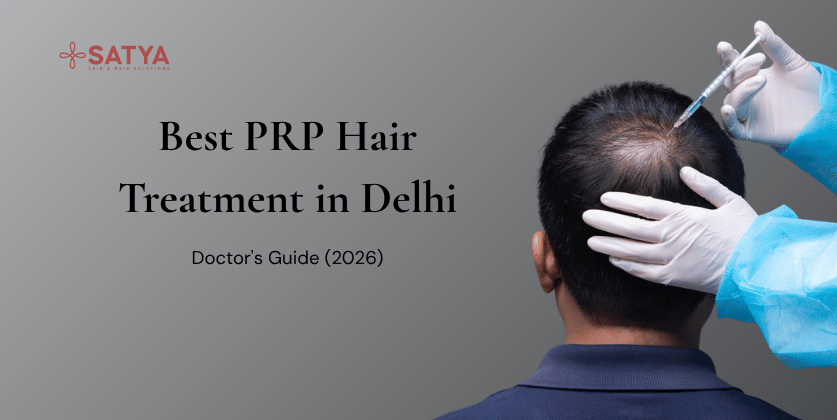
Platelet-Rich Plasma therapy is a regenerative, in-clinic procedure, not a topical product or an over-the-counter serum. A small volume of your blood is drawn and processed in a centrifuge to separate and concentrate platelets, which are then re-injected into the scalp’s dermal layer.
Platelets are not just involved in clotting. They carry growth factors, including Platelet-Derived Growth Factor (PDGF), Vascular Endothelial Growth Factor (VEGF), Epidermal Growth Factor (EGF), and Insulin-like Growth Factor (IGF-1), that signal tissue repair and cell proliferation. In the scalp, these growth factors act directly on the hair follicle’s dermal papilla, the structure that regulates hair growth cycling.
At a cellular level, current research points to a few specific mechanisms:
- VEGF stimulates angiogenesis around the follicle, improving the blood and nutrient supply the follicle depends on during its active growth phase.
- EGF supports renewal of bulge stem cells while helping protect the follicle from inflammatory damage.
- FGF and IGF-1 upregulate Wnt/β-catenin signaling in dermal papilla cells, a pathway that androgens (specifically DHT) are known to suppress in androgenetic alopecia.
In plain terms: androgenetic alopecia progressively miniaturizes follicles by disrupting the signaling that keeps hair in its active growth (anagen) phase. PRP does not reverse this hormonal process, but it delivers a concentrated, localized signal that can help counteract some of that suppression and extend the anagen phase in follicles that are still viable, not dormant or scarred.
Does PRP Actually Work? What the Research Shows
We would rather cite the evidence than assert a claim. A 2023 meta-analysis published in Aesthetic Plastic Surgery, pooling 10 randomized controlled trials across 318 participants, found that PRP produced a statistically significant increase in hair density compared to placebo (mean difference of 25.09 hairs/cm², 95% CI 9.03–41.15, p = 0.002). The same analysis found no significant improvement in hair shaft diameter, meaning PRP’s primary measurable effect is on follicle density and activity, not on thickening individual existing strands.
A subgroup analysis in the same review found male participants responded more strongly than mixed-sex cohorts (p = 0.02), which is a relevant, honest data point for anyone comparing PRP outcomes across genders.
The research also comes with real limitations we think patients should know before treatment, not after:
- Most published trials followed patients for 12 months or less, so long-term durability data beyond a year is limited.
- PRP preparation protocols (spin speed, platelet concentration, activation method) are not standardized across studies or clinics, which is a major reason outcomes vary between providers.
- Individual platelet response varies; not every patient responds equally, and PRP does not work on follicles that have already scarred or gone permanently dormant.
This is the clinical reality: PRP is a legitimate, peer-reviewed adjunct therapy for pattern hair loss, not a stand-alone solution for advanced baldness, and not a treatment that produces identical results for every patient.
The Ideal Candidate for PRP Hair Treatment
Who PRP Is Suited For
- Patients with early to moderate androgenetic alopecia (broadly Norwood-Hamilton grade 2–4 in men, or Ludwig grade 1–2 in women), where follicles are miniaturizing but still viable.
- Patients experiencing early diffuse thinning, where the goal is to stabilize shedding and support existing follicles rather than replace lost ones.
- Patients using PRP as a supportive therapy alongside a hair transplant, where it can support the health of the surrounding native hair, not the transplanted grafts themselves in the early weeks.
- Patients who understand and accept that PRP requires an initial course plus ongoing maintenance, not a one-time fix.
Who PRP Is Not Suited For
- Patients with advanced, extensive baldness where the scalp has no clinically active follicles left to stimulate; here, a transplant assessment is more appropriate than PRP alone.
- Patients with scarring (cicatricial) alopecia, where the follicle itself has been structurally destroyed.
- Patients with active scalp infection, low platelet count, platelet or blood clotting disorders, certain cancers, or who are pregnant.
- Patients recently using NSAIDs, systemic steroids, or blood-thinning medication, which can interfere with platelet function and should be discussed with your treating doctor before scheduling.
- Anyone expecting a single session to deliver visible, lasting density, that expectation does not match how PRP biologically works.
We would rather tell a patient they are not a suitable candidate for PRP than administer a treatment we do not expect to meaningfully help their specific pattern of hair loss.
PRP Hair Treatment Cost in Delhi: What Actually Drives the Price
Search “PRP hair treatment cost in Delhi” and you will see numbers from ₹3,000 to over ₹20,000 per session, often without context on what is included. Broadly, the current Delhi market falls into this range:
| Component | Typical Cost in Delhi | Notes |
|---|---|---|
| PRP scalp session (single) | ₹6,000 – ₹15,000 | Varies by doctor involvement, kit quality, and PRP volume |
| Full initial course (4–6 sessions) | ₹25,000 – ₹75,000 | Sessions typically spaced 4–6 weeks apart |
| Maintenance session (post-course) | ₹6,000 – ₹15,000 | Usually recommended roughly every 4–6 months |
| GFC session, for comparison | ₹8,000 – ₹15,000 | A related but distinct protocol, see comparison below |
These are indicative market ranges, not a fixed Satya price list, since your specific protocol and session count should follow a scalp assessment, not a generic package.
What genuinely drives cost, beyond geography, includes:
- Who administers the injection. A doctor-led session, where the treating physician performs the injection and adjusts technique to your scalp’s specific pattern, differs clinically from a technician-only session, even when both are labeled “PRP.”
- PRP preparation system. Double-spin centrifugation systems that concentrate platelets more precisely produce a materially different product than a single-spin, lower-concentration draw, even though both are marketed under the same name.
- Volume of blood drawn and PRP yield. A larger draw generally yields more concentrated plasma for injection across the full scalp, not just the visibly thinning area.
- Diagnostic work before treatment. A trichoscopic evaluation to confirm androgenetic alopecia (and rule out other causes of hair loss, such as telogen effluvium or thyroid-related shedding) should precede any PRP recommendation, and that assessment is part of what a responsible quote reflects.
PRP vs. GFC vs. Hair Transplant: How They Actually Differ
Patients researching PRP frequently encounter GFC (Growth Factor Concentrate) as an alternative, and confuse both with a substitute for transplant surgery. They are not interchangeable.
| Factor | PRP | GFC | Hair Transplant |
|---|---|---|---|
| What it is | Concentrated platelets from your own blood | A cell-free concentrate of growth factors, without red or white blood cells | Surgical relocation of donor follicles |
| Best suited for | Early to moderate thinning with viable follicles | Similar candidacy to PRP; some patients report less scalp irritation | Areas with permanent follicle loss and adequate donor supply |
| Mechanism | Platelet-released growth factors stimulate follicular activity | Growth-factor signaling without platelet/leukocyte components | Physically relocates functioning follicles to bald areas |
| Downtime | Minimal; mild redness for 24–48 hours | Minimal; often described as slightly gentler on the scalp | Days to weeks, depending on technique |
| Role in advanced baldness | Limited; cannot regenerate absent follicles | Limited, same constraint as PRP | Direct solution, when donor supply supports it |
A recent comparative clinical study found both PRP and GFC produce measurable trichoscopic improvement in pattern hair loss, with some patients tolerating GFC with less post-injection discomfort. Neither, however, is a substitute for a transplant once an area has no functioning follicles left. At Satya, we treat this as a sequencing decision, not a competition: PRP or GFC to manage early thinning and support donor and native hair health, and a transplant assessment when follicle loss is already established.
Recommending PRP for a patient who is a clearer transplant candidate, purely because it is a lower-commitment sale, is not a decision we consider ethical.
The Clinical Journey: What to Expect
Before Your Session
- A trichoscopic scalp evaluation to confirm the diagnosis and rule out non-androgenetic causes of shedding.
- Avoid blood-thinning medication (aspirin, NSAIDs) for 48–72 hours before treatment unless your physician advises otherwise.
- Stay hydrated and avoid alcohol for 24 hours prior, both of which affect blood draw quality.
During the Procedure
- A blood sample (typically 10–30 mL) is drawn, similar to a routine lab test.
- The sample is centrifuged on-site to separate the platelet-rich layer.
- The scalp is cleaned, and topical or local numbing may be applied depending on your sensitivity.
- The concentrated plasma is injected in a grid pattern across the treatment area using fine needles.
- The full session typically takes 45–60 minutes.
After the Procedure
- Mild redness, tenderness, or pinpoint bruising at injection sites is common for 24–48 hours.
- Avoid washing your hair for 24 hours and avoid strenuous exercise or excessive sweating for 24–48 hours.
- Avoid hair coloring or chemical treatments for at least 48–72 hours.
- Most patients return to normal activity and work the same day or the next day; PRP carries minimal downtime compared to surgical options.
Realistic Timelines: When to Expect What
We state this plainly because setting accurate expectations is part of ethical patient care, not a way to soften a slower result.
| Timeframe | What to Expect |
|---|---|
| Weeks 1–4 | Mild scalp sensitivity resolves; no visible change in hair yet |
| Weeks 4–8 | Some patients notice reduced shedding, the first meaningful sign of response |
| Months 3–4 | Early improvements in hair texture and scalp coverage may become visible |
| Months 5–6 | Most patients complete the initial 4–6 session course; density changes, where they occur, are more apparent |
| Month 6 onward | Maintenance sessions roughly every 4–6 months to sustain gains |
PRP is a follicular support and stabilization therapy, not an overnight regrowth treatment, and it does not eliminate the underlying hormonal process driving androgenetic alopecia. Discontinuing maintenance typically means the treated follicles gradually return to their pre-treatment trajectory over time.
How to Evaluate the “Best” PRP Clinic in Delhi
Rather than take a marketing claim of being “the best” at face value, these criteria are more useful in an actual consultation:
- A diagnosis before a prescription. A trichoscopic scalp assessment should precede any PRP recommendation, not follow it.
- Transparency on the PRP system used. Ask whether the clinic uses a double-spin, medically validated kit, and whether platelet concentration is measured, not assumed.
- Doctor involvement, not a technician-only injection protocol, particularly for your first session where technique calibration matters most.
- An honest conversation about candidacy, including a clinic willing to say PRP is not the right fit if your hair loss has progressed past the point PRP can meaningfully support.
- Clarity on total session count and maintenance cost, not just a single discounted first-session price.
We would encourage you to apply these criteria to any clinic you shortlist in Delhi, not only ours.
Also Read:Hair Transplant Cost in Delhi: A Doctor’s Honest Price Guide (2026)
Frequently Asked Questions
Peer-reviewed research shows PRP produces a statistically significant increase in hair density compared to placebo in patients with early to moderate androgenetic alopecia. It does not work equally for everyone, and it does not regenerate follicles that have already scarred or gone permanently dormant.
Most protocols involve an initial course of 4 to 6 sessions spaced 4 to 6 weeks apart, followed by maintenance sessions roughly every 4 to 6 months. A single session is not expected to produce a lasting, visible change.
Most patients describe mild discomfort during the injections and tenderness for 24–48 hours afterward, comparable to a series of small pinpricks. Topical numbing can reduce discomfort during the session.
Per-session pricing in Delhi generally ranges from ₹6,000 to ₹15,000, with a full initial course typically totaling ₹25,000 to ₹75,000, depending on the clinic, PRP system, and doctor involvement.
Both work on a similar mechanism using growth-factor signaling, and comparative studies show measurable improvement with each. Some patients tolerate GFC with slightly less scalp irritation. Neither is inherently superior; suitability depends on your specific scalp and hair loss pattern, which should be assessed individually.
PRP is sometimes recommended after a transplant to support the health of surrounding native hair, not the transplanted grafts directly in the early weeks. It is not a mandatory add-on for every transplant patient, and any recommendation should be based on your specific case.
Yes. Women with early diffuse thinning consistent with female pattern hair loss (Ludwig grade 1–2) are commonly suitable candidates, though causes of hair thinning in women are more varied and should be confirmed with a proper diagnostic work-up before treatment.
Benefits are not typically permanent. Without periodic maintenance sessions, most patients see treated follicles gradually return toward their pre-treatment growth pattern, since PRP supports follicular activity but does not alter the underlying hormonal process.
An Evidence-Based Next Step
PRP can be a clinically useful tool for the right stage of hair loss, and an unnecessary expense for the wrong one. Whether it is the appropriate therapy for your scalp, on its own or alongside another approach, depends on a proper diagnosis, not a generic package. If you want a personalized assessment of whether PRP hair treatment is right for you, schedule an evidence-based consultation with our trichology and hair restoration specialists at Satya Skin & Hair Solutions, Gurgaon & Delhi. Results vary from person to person, and any recommendation you receive will be based on your scalp assessment, not a fixed treatment plan.