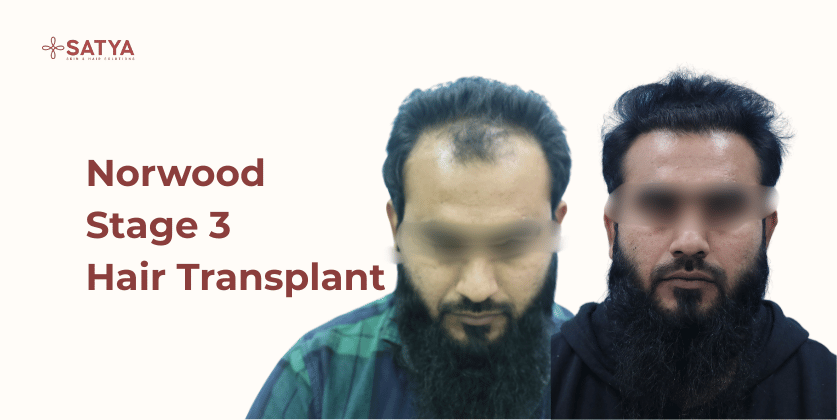
Realizing that your hairline has noticeably receded past the point of a simple “mature hairline” can be a deeply unsettling experience. For many men across Gurgaon and Delhi NCR, noticing deep, hollowed-out temporal corners or a visible thinning at the crown marks a turning point in their hair health. If your hairline now forms a distinct, sharp “M” or “V” shape, you are likely dealing with Norwood Stage 3 Hair loss. This phase is clinically recognized as the first stage of established, visible male pattern baldness.
When searching for answers in 2026, navigating past shallow, regurgitated content or generic AI summaries is essential, as Google’s latest search algorithm heavily downranks unverified text in favor of lived clinical experience. To safely navigate options like a Norwood Stage 3 Hair Transplant, you require authentic, doctor-led guidance. At Satya Skin & Hair Solutions, our founders Dr. Shail Gupta and Dr. Ruchi Agarwal treat hair loss as a progressive medical condition. This comprehensive guide will detail what this stage means for your hair architecture, compare preventive and surgical pathways, and explain how to achieve permanent, natural results.
What is Norwood Stage 3 Hair Loss?
The Norwood Scale serves as the global medical benchmark used by certified hair restoration specialists to classify and track the progression of androgenetic alopecia (male pattern baldness). While stages 1 and 2 represent minimal to minor changes, Norwood Stage 3 Hair is the threshold where hair thinning becomes clinically significant and cosmetically obvious.
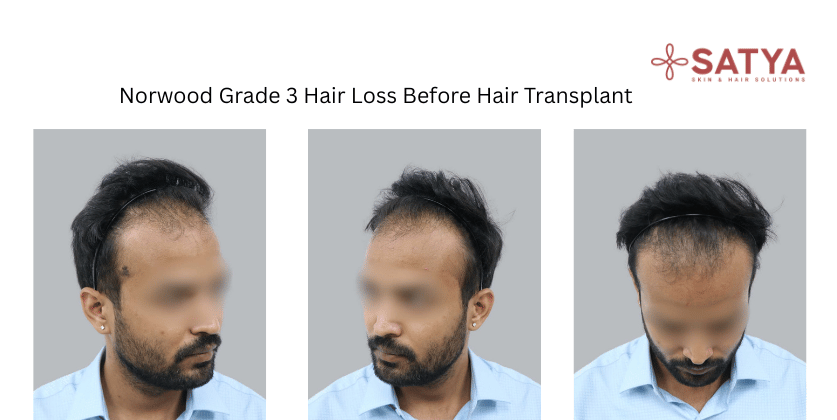
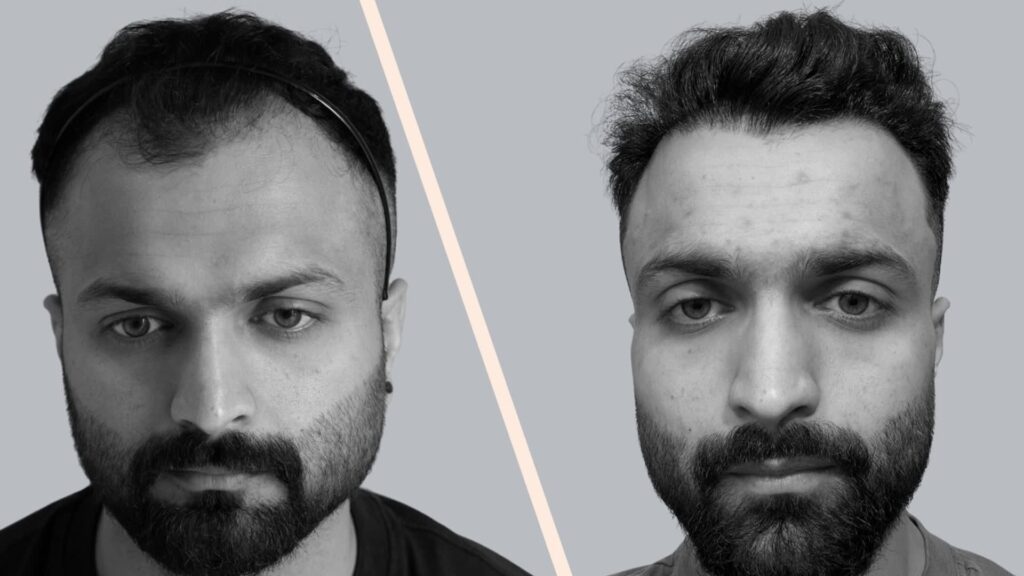
At this stage, the recession at both temples deepens dramatically, extending backward toward the ear canal line. The hair at the frontal corners becomes extremely sparse or entirely absent, creating a pronounced, bare forehead border. Depending on where the thinning concentrates, this phase is generally split into two clinical variations:
- Norwood Stage 3 Vertex: The hairline displays clear temple recession, but a distinct, circular thinning patch also begins to appear concurrently at the crown (vertex) of the head.
- Norwood Stage 3 Anterior (or 3A): The hairline recedes uniformly across the entire front, shifting the entire frontal hair border significantly further back without early crown involvement.
Identifying the Visual Reality: Norwood Stage 2 vs. Norwood Class 2 vs. Stage 3
It is very common for patients to confuse an advanced mature hairline with active, progressive pattern baldness.
The Border of Norwood Class 2
During a Norwood Class 2 phase, a man experiences a mild, localized recession limited strictly to the temporal corners. The center of the hairline remains low on the forehead, and the hair density immediately behind the temples stays relatively thick. It is often a manageable, stable adult transition that does not always require surgical correction.
The Transition to Stage 3 Thinning
The shift to Stage 3 is confirmed when the temporal recession deepens into a sharp, deep wedge. The hair strands right along the receding edge undergo a process called miniaturization becoming progressively finer, shorter, and lighter until the skin beneath becomes entirely visible under normal ambient light. Once the temporal corners hollow out completely, the structural frame of the face changes, prompting many patients to seek a permanent clinical solution.
The Biological Catalyst: The Science of Follicular Miniaturization
To properly treat advanced temple recession, it helps to understand the underlying cellular mechanics occurring beneath the scalp’s surface. Pattern baldness is not triggered by poor local hygiene or wearing caps; it is an inherited genetic sensitivity to Dihydrotestosterone (DHT), a potent byproduct of testosterone.
When you inherit follicles that are sensitive to DHT, this hormone binds to the androgen receptors within your hair roots specifically at the hairline and crown. Once bound, DHT shortens the follicle’s active growth phase (anagen) and prolongs its resting phase (telogen). Over consecutive growth cycles, the affected hair roots shrink in size. They produce hair shafts that are progressively weaker and thinner until the follicle stops producing hair entirely and goes dormant. At the Stage 3 phase, the follicles at your temples have completely miniaturized, meaning topical oils or cosmetic modifications can no longer revive them.
When is a Norwood Stage 3 Hair Transplant Necessary?
When a patient presents with established Stage 3 recession, they have reached an ideal window for clinical hair restoration. Because the hair loss is localized mostly to the front and temples, a Norwood Stage 3 Hair Transplant can effectively rebuild the lost architectural frame of the face, delivering high density and a completely natural appearance.
Surgical restoration at this stage is typically executed using advanced Follicular Unit Extraction (FUE) or Follicular Unit Transplant (FUT) techniques. Healthy, DHT-resistant hair roots are precisely harvested from the permanent donor zone at the back of the head and artistically implanted into the bare temporal zones. This procedure fills in the deep “M” shaped gaps and restores a youthfully balanced hairline.
The Critical Factor: Combining Surgery with Continuous Medical Maintenance
A common misconception among patients looking into a Norwood Stage 3 Hair Transplant is that a surgical procedure serves as an immediate, standalone cure for baldness. This is a significant medical error that often leads to compromised long-term results.
To understand how a hair transplant maintains its visual volume over several years, you must look at the biological relationship between your hair types:
The newly implanted hair follicles taken from the back of your head are genetically programmed to resist DHT and will continue to grow for a lifetime. However, the original, native hair positioned right behind your new transplant remains highly sensitive to genetic thinning.
If you undergo a transplant but fail to follow a consistent medical maintenance routine, your original native hair will continue to miniaturize and shed over the following years. This creates an unnatural, sparse look where a dense patch of transplanted hair sits isolated in front of an expanding balding zone. To avoid this outcome, continuous medical therapy is required to protect your original hair roots from further DHT damage.
Also Read: Male Pattern Baldness
Medically Proven Strategies for Total Hair Preservation
To secure your surgical investment and prevent active thinning from spreading to the crown, a comprehensive treatment plan must include evidence-based medical therapies:
1. Targeted DHT Suppression
Prescription-based oral or topical medical therapies act as the primary defense against pattern baldness. By safely blocking the specific enzyme responsible for converting testosterone into DHT, these treatments shield your vulnerable native follicles from hormonal damage and stop progressive shedding in its tracks.
2. Topical Micro-Vessel Vasodilators
Applying clinical-grade vasodilating solutions directly to the scalp helps widen local blood vessels. This increased micro-circulation delivers a steady surge of oxygen, amino acids, and essential nutrients directly to the hair roots, extending the active growth phase and thickening fine hair strands.
3. Clinical Growth Factor Therapy
This non-surgical procedure involves concentrating specialized growth factors from your own blood and carefully infusing them into the scalp matrix. This serves as a powerful biological stimulant, reviving fatigued cells and encouraging weak follicles behind your hairline to produce thicker, stronger hair.
The Satya Philosophy: Dr. Shail and Dr. Ruchi’s Approach to Restoration
At Satya Skin & Hair Solutions, we do not believe in high-volume, commercial sales models that treat hair restoration like a simple transactional package. Achieving lifelong success with a Norwood Stage 3 Hair Transplant requires rigorous medical ethics, long-term pattern planning, and expert surgical precision.
Our founders, Dr. Shail Gupta and Dr. Ruchi Agarwal, practice a strict philosophy of “Donor Stewardship.” Your donor hair at the back of the head is a finite, strictly limited resource. If a surgeon harvests and exhausts your donor reserve carelessly to build an aggressively low hairline in your 20s, you may run out of hair roots if you experience extensive thinning at the crown later in life.
Our comprehensive diagnostic process begins with an in-depth trichoscopy to evaluate your exact percentage of hair miniaturization and assess your donor density. Dr. Shail Gupta personally designs every single hairline, aligning the graft placement with your natural facial geometry, age, and hair exit angles to ensure a seamless blend. Concurrently, Dr. Ruchi Agarwal addresses your systemic dermatological health, checking for nutritional deficiencies or metabolic stressors to ensure your scalp provides the healthiest possible environment for long-term growth.
Managing North Indian Environmental Variables in Delhi NCR
Living in a bustling metropolitan hub like Gurgaon or Delhi introduces distinct external challenges that can actively impact post-transplant recovery and graft survival. The high levels of particulate air pollution common across the Delhi NCR region introduce intense oxidative stress, generating free radicals that can trigger micro-inflammation around newly implanted hair roots during the critical first ten days of healing.
Furthermore, the hard water prevalent across many residential sectors in Gurgaon can make the hair shaft brittle, leading to premature breakage of your remaining native hair. When you choose Satya, our post-operative care protocols are explicitly customized to address these regional challenges. We combine your medical therapies with custom, protective scalp-cleansing routines and anti-pollution barriers, ensuring your hair follicles have a safe, clean environment to thrive.
Reclaim Your Hairline with Medical Certainty
Reversing an advanced temple recession is entirely possible when you transition away from temporary cosmetic cover-ups and invest in evidence-based clinical solutions. By understanding the true biological framework of Norwood Stage 3 Hair loss, you can make an informed choice to protect your appearance and your confidence for life.
Frequently Asked Questions (FAQs)
Stage 3 represents the first phase of established, clinically significant male pattern baldness. It is characterized by deep, symmetrical recession at the temples that forms a clear “M” or “V” shape, while the hair center point shifts back or the crown begins to thin.
Yes, individuals at Stage 3 are generally excellent candidates for a hair transplant. Because the hair loss is concentrated primarily along the frontal border, a specialist can harvest healthy grafts from the dense donor area at the back of the head to completely rebuild a natural, high-density hairline.
While the transplanted hair is genetically permanent and resistant to balding, your remaining natural hair behind the transplant is still sensitive to DHT. Without ongoing medical treatments, this native hair will continue to thin and recede, which can eventually leave an unnatural gap behind your transplanted hairline.
A maturing hairline is a normal adult transition where the hairline naturally stabilizes 1–2 cm higher on the forehead by age 24. A Norwood Class 2 features mild, localized temple recession, while a Stage 3 represents a deep, progressive recession that alters the structural frame of your face.
The total investment depends on the exact extraction technique chosen (FUE or FUT), the total number of grafts required to achieve optimal density across your temporal zones, and the experience of your surgeon. We provide a completely transparent, itemized cost estimate during your comprehensive clinical scalp evaluation.