Norwood Stage 1 Hair loss is the most reassuring place to be on the hair loss spectrum and, paradoxically, the most important time to act. At Norwood Stage 1, your hairline is still intact. There is no visible recession, no thinning crown, and no bald patch. Most people at this stage are told, “You have nothing to worry about.” But that assessment misses the point entirely.
Hair loss is a progressive condition. The follicles at your temples and crown that are vulnerable to DHT (dihydrotestosterone) do not recover once they miniaturise past a certain threshold. Norwood Stage 1 sometimes called Norwood Class 1 represents a window of opportunity. Understanding it correctly, and responding to it clinically, can determine whether you retain a full head of hair at 50 or require a hair transplant at 40.
This guide explains exactly what Norwood Stage 1 Hair loss means, how to identify it with photos, what treatment options exist, and when if ever a Norwood Stage 1 hair transplant becomes relevant.
What Is the Norwood Scale?
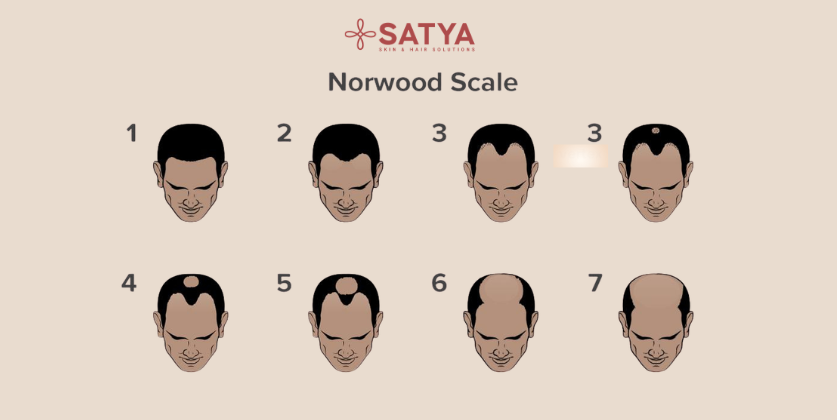
The Norwood-Hamilton scale is the internationally accepted classification system for male pattern hair loss (androgenetic alopecia). Developed in the 1950s and refined by Dr. O’Tar Norwood in 1975, it divides hair loss progression into seven primary stages from Stage 1 (no visible loss) to Stage 7 (extensive baldness across the scalp).
Each stage describes a characteristic pattern of recession, thinning, or baldness. The scale is used by dermatologists and hair transplant surgeons worldwide to assess the degree of loss, predict progression, and design surgical plans.
In clinical practice at our centres in Gurgaon and Delhi, the Norwood scale forms the foundation of every initial hair loss consultation. It tells us not just where a patient is today, but where they are likely to be in five, ten, or twenty years without intervention.
Norwood Scale at a Glance
| Norwood Stage | Characteristics | Recommended Action |
| Stage 1 (Norwood Class 1) | No visible recession. Juvenile hairline intact. | Prevention, monitoring, lifestyle optimisation |
| Stage 2 | Slight temples recession. Hair loss begins. | Early medical therapy, PRP |
| Stage 3 | Temples deeply receded. Visible balding begins. | Medical therapy + possible hair transplant |
| Stage 4 | Crown loss begins. Frontal band still separates. | Hair transplant evaluation recommended |
| Stage 5–7 | Extensive loss. Single large bald area emerging. | Surgical hair restoration |
Also Read: Male Pattern Baldness
What Is Norwood Stage 1 Hair loss (Norwood Class 1)?
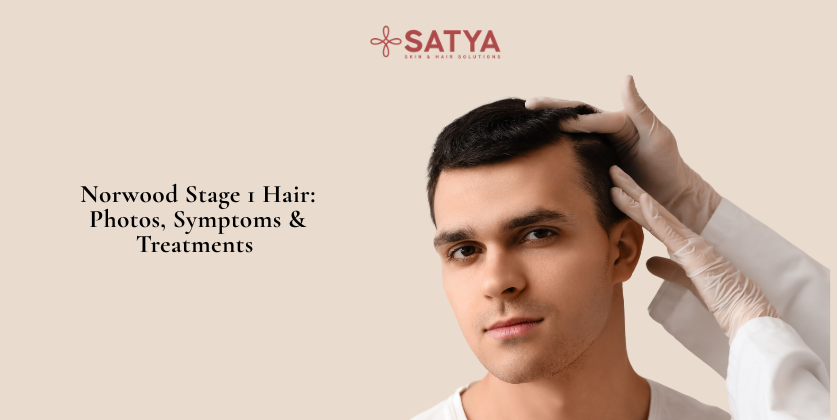
Norwood Stage 1 also written as Norwood Class 1 describes a hairline that is intact and age-appropriate. There is no temple recession, no frontal thinning, and no bald spot at the crown. The hairline follows the natural juvenile pattern without meaningful departure.
However, Norwood Stage 1 does not mean “no hair loss risk.” It simply means visible loss has not yet occurred. A person can be genetically predisposed to significant future loss and still present as Stage 1 in their late twenties or early thirties. The vulnerability is already programmed into the follicles what has not yet happened is the visible expression of that vulnerability.
What Does Norwood Stage 1 Look Like? (Photo Characteristics)
In photographs, Norwood Stage 1 presents as:
- A complete hairline without recession at the temples
- Uniform hair density across the scalp no thin patches or visible scalp
- No retreating frontal hairline
- No thinning or bald area at the crown (vertex)
- A hairline shape consistent with the individual’s age
The confusion arises because some individuals present with a naturally high hairline that is sometimes misread as recession. A dermatologist or trichologist can distinguish between a congenitally high hairline and early androgenetic recession through scalp analysis, hair density mapping, and family history review.
Why Does Norwood Stage 1 Matter? The Case for Early Action
The biology of hair loss is well understood. In androgenetic alopecia, DHT binds to susceptible follicles and progressively shortens the anagen (growth) phase. Over time, terminal hairs become vellus hairs thinner, shorter, lighter and eventually cease growing entirely. This process is gradual and often silent in its earliest stages.
By the time a patient notices visible thinning, follicular miniaturisation may already be 40–50% advanced in the affected zones. The follicles that generate visible hair are not the ones that show the earliest DHT sensitivity the first casualties are the finer, less-noticed hairs that formed the density buffer.
This is why Norwood Stage 1 is clinically significant. It is the stage at which:
- Preventive medical therapy has the highest probability of success
- DHT-blocking agents can preserve follicles before significant miniaturisation
- PRP therapy can stimulate and strengthen existing follicles while they are still viable
- Lifestyle and nutritional factors can be addressed before deficiencies accelerate loss
- A baseline scalp assessment can be established for future monitoring
Waiting until Stage 3 or 4 to begin treatment means working with a depleted follicle population. The goal at Stage 1 is prevention, not reversal.
Is a Hair Transplant Needed at Norwood Stage 1?
In most cases, no. A Norwood Stage 1 hair transplant is not indicated because there is no significant area of loss to address surgically. Hair transplantation is a procedure that moves permanent follicles from a donor zone to areas of loss. At Stage 1, the recipient zone simply does not meet surgical criteria.
However, there are specific clinical scenarios where a consultation that begins as a Stage 1 assessment may identify other concerns:
- Strong family history of rapid-onset, severe loss (Stage 6–7 in father and paternal grandfather)
- Scalp analysis revealing high miniaturisation ratios despite intact appearance
- Patient presenting with diffuse thinning across the scalp rather than a patterned recession
- Prior hair loss treatment failure with continued progression despite therapy
In these cases, Dr. Shaiil Gupta may discuss future surgical planning including a concept we call Future-Ready Transplant which accounts for likely progression zones when designing any hairline or graft placement. This ensures that a transplant performed at a later stage does not create an unnatural appearance as natural loss continues around it.
| Dr. Shaiil Gupta | “A patient at Norwood Stage 1 who asks me about a hair transplant is usually better served by a 6-month preventive programme. Surgery at Stage 1 is rarely the right answer but doing nothing is also rarely the right answer. The question is how to preserve what you have.” |
Treatment Options at Norwood Stage 1
The treatment landscape for Stage 1 hair loss centres on prevention, follicle preservation, and slowing progression. Below is a summary of the evidence-based options assessed at Satya Skin & Hair Solutions:
| Treatment | Suitable For | How It Helps | Clinical Note |
| Minoxidil (Topical) | Stage 1–3 | Stimulates follicle activity, prolongs growth phase | Requires consistent daily use |
| Finasteride (Oral) | Men, Stage 1–3 | Blocks DHT, the hormone driving male pattern loss | Prescription required; not for women of childbearing age |
| PRP Therapy | Stage 1–4 | Growth factors injected into scalp to revitalise follicles | 3–6 sessions typically; results in 3–4 months |
| Mesotherapy | Stage 1–3 | Microinjections of vitamins, peptides, and growth factors | Complements other therapies well |
| LLLT (Laser) | Stage 1–3 | Red light stimulates scalp circulation and follicle metabolism | In-clinic or home device options available |
| Hair Transplant (DSFT / FUE) | Stage 3–7 | Permanent surgical restoration; not typically needed at Stage 1 | Discussed at consultation if early family history is severe |
A Note on PRP at Norwood Stage 1
Platelet-Rich Plasma (PRP) therapy is among the most effective non-surgical interventions at Stage 1. By concentrating growth factors from the patient’s own blood and injecting them into the scalp, PRP enhances follicle metabolism, extends the anagen phase, and reduces the inflammatory microenvironment that DHT sensitivity creates. At our Gurgaon clinic, PRP is administered using a standardised protocol with concentration verification not all PRP preparations are equal in clinical practice.
The Satya Approach to Early Hair Loss: Less Medicine, Maximum Preservation
Our clinical philosophy at Satya Skin & Hair Solutions is built on a principle that is equally relevant at Stage 1 as it is at Stage 6: precision over volume. We do not advocate overmedicating patients who do not need aggressive intervention, and we do not perform surgery on patients who will be better served by non-surgical care.
For patients presenting at Norwood Stage 1, the clinical pathway typically includes:
- Comprehensive scalp dermoscopy and miniaturisation mapping by Dr. Shaiil Gupta
- Hormonal and nutritional blood panel review (ferritin, thyroid, DHT, zinc) led by Dr. Ruchi Agarwal
- Individualised treatment protocol which may include topical or oral medical therapy, PRP, and supplementation
- 6-month and 12-month photographic and dermoscopic follow-up to assess response
- Structured family history review to contextualise genetic risk
Dr. Ruchi Agarwal, who leads the dermatology practice at Satya, is particularly focused on the often-overlooked systemic contributors to early hair loss in both men and women. Many patients who arrive at Norwood Stage 1 with an assumption of pure genetic loss turn out to have correctable factors nutritional deficiencies, hormonal imbalances, or scalp conditions — that, once addressed, dramatically slow progression.
| Dr. Ruchi Agarwal | “Norwood Stage 1 patients are the ones I find most rewarding to treat. If we identify the right triggers early and manage them systematically, a significant proportion of these patients never progress beyond Stage 2. Prevention is always more elegant than restoration.” |
Norwood Stage 1 in Women: A Different Clinical Picture
The Norwood scale was developed for male-pattern hair loss. Women who experience androgenetic alopecia typically follow the Ludwig scale rather than the Norwood scale presenting with diffuse thinning across the crown rather than a receding hairline. However, the concept of early-stage assessment applies equally to female patients.
Women who visit Satya Skin & Hair Solutions in Delhi or Gurgaon with concerns about early hair thinning undergo a distinct diagnostic pathway that considers hormonal causes (PCOS, thyroid dysfunction, post-partum changes), nutritional status, and trichoscopic assessment. Female hair transplant evaluation, where relevant, follows a different eligibility framework than male cases.
When Should a Person at Norwood Stage 1 Seek a Consultation?
The short answer: earlier than most people think is necessary. A consultation at Stage 1 does not commit you to treatment. It establishes a clinical baseline, quantifies your actual risk level, and gives you an evidence-based road map rather than leaving you to monitor an undefined fear.
Specific triggers that should prompt a prompt consultation:
- A family history of significant hair loss on either side (particularly if onset was before age 35)
- A noticeable increase in daily shed volume more hair on the pillow, in the shower, or on a comb
- A gradual sense that hair is less dense or takes more styling effort than it used to
- A partner or family member commenting on a change in your hairline or density
- Itching, scalp inflammation, or dandruff which can accelerate follicle stress
Patients who visit our Gurgaon clinic from Cyber City, DLF Phase 4, Sushant Lok, and the wider NCR region often arrive at Stage 2 or 3 precisely because they delayed a Stage 1 assessment. The window is real. It does close.
Consult at Satya Skin & Hair Solutions Gurgaon & Delhi
If you are at Norwood Stage 1 and want a clear, honest assessment of your current risk level and the options available to you, we welcome you to schedule a consultation at Satya Skin & Hair Solutions.
Dr. Shaiil Gupta and Dr. Ruchi Agarwal have been treating hair loss since 2005. Our clinics in Gurgaon (DLF Phase 4, Galleria Market) and Delhi (Pitampura) offer scalp dermoscopy, personalised treatment planning, and where surgery is genuinely appropriate procedures performed under our proprietary DSFT (Direct Stimulated Follicular Transplant) and MHT (Maximum Harvesting Technique) protocols.
Early assessment does not commit you to treatment. It gives you clarity.
Frequently Asked Questions: Norwood Stage 1 and Hair Loss
Do I need a hair transplant at Norwood Stage 1?
In most cases, no. Hair transplant surgery is not indicated at Stage 1 because there is no established loss zone to restore. Medical prevention is the appropriate intervention at this stage.
Yes, without intervention it can. Genetics determines the eventual pattern. However, early preventive treatment DHT blockers, PRP, lifestyle management significantly slows or halts progression in many patients.
What is the difference between Norwood Stage 1 and Stage 2?
Stage 2 involves slight recession at the temples, forming a triangular shape. At Stage 1, the hairline is completely intact with no visible departure from the natural juvenile pattern.
Topical Minoxidil, oral Finasteride (in eligible males), PRP therapy, Mesotherapy, and LLLT (laser) are all evidence-based options. The right combination depends on individual assessment.
Is Norwood Stage 1 considered normal?
Yes it represents a normal, intact hairline. However, for individuals with strong genetic risk factors, it signals an important preventive window that should be assessed clinically rather than ignored.
How is Norwood Stage 1 diagnosed?
Clinical examination, scalp dermoscopy, phototrichogram analysis, and family history review are used together. Blood panels for DHT, ferritin, and thyroid function add systemic context.
Can women be at Norwood Stage 1?
Women’s hair loss follows the Ludwig scale rather than the Norwood scale. A female patient with early diffuse thinning requires separate assessment from a male Norwood Stage 1 evaluation.