Editorial Disclaimer: This article is a clinical and educational analysis based entirely on publicly available photographs and media coverage of Mohammad Shami. Satya Skin & Hair Solutions has no clinical or professional association with Mohammad Shami or his treating clinic. We have not examined or treated Mr. Shami. All observations regarding his hair loss stage, estimated graft count, and procedural outcome are based on publicly visible images only and are intended solely to educate readers about hair transplant procedures. This content does not constitute confirmed medical information about his specific treatment.
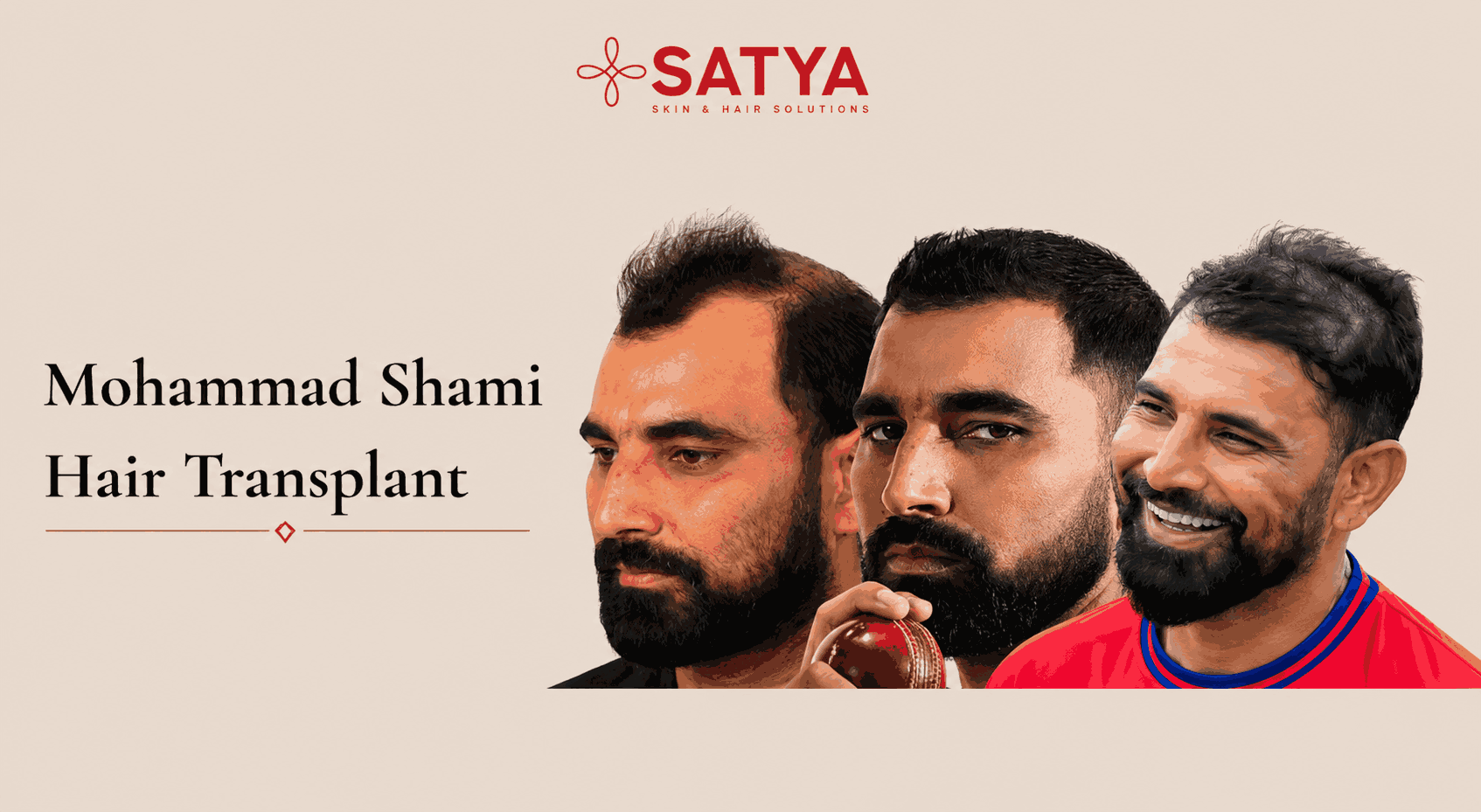
When Indian pace spearhead Mohammad Shami stepped onto the cricket field displaying a significantly denser, fully restored hairline, it triggered a massive nationwide conversation around male pattern thinning.
The dramatic change seen in the Mohammad Shami hair transplant journey quickly became a highly referenced case study, showing how modern medical procedures can reshape a person’s appearance and restore confidence.
However, a closer clinical review reveals that a hair restoration procedure is never an instant, isolated fix. Many individuals analyze the public Mohammad Shami hair transplant timeline and assume that a surgical procedure can maintain lifelong density on its own, without any ongoing medical care. At Satya Skin & Hair Solutions, led by world-class hair restoration specialist Dr. Shail Gupta, we prioritize giving patients absolute medical clarity.
To ensure a restoration result stands the test of time, you must look past simple social media buzz and understand the vital biological rules governing hair preservation.
Mohammed Shami Hair Transplant Before and After: Reading the Photographs Clinically
Based on publicly available photographs from approximately 2019 to 2022, Mohammad Shami showed a progressively receding frontal hairline with significant temple withdrawal. Using the Norwood-Hamilton scale the standard classification system for male pattern baldness his visible hair loss at that time appeared consistent with Norwood Stage 3 to Stage 4.
What Stage 3-4 Hair Loss Looks Like
- A clearly defined M-shaped recession at the temples
- Significant withdrawal of the frontal hairline, more than 2 cm in some zones
- Possible thinning at the crown, which is typical for Stage 4
- No complete bald zone but a substantial area requiring coverage
Stage 3-4 is what hair transplant surgeons refer to as moderate-to-significant loss. It is substantially more demanding than a subtle Stage 2 hairline refinement. It requires more grafts, more careful planning, and crucially a clear strategy for future loss progression.
“Stage 3-4 is not a simple hairline touch-up. At this stage, the surgeon is rebuilding a meaningful zone of the scalp typically requiring 2,500 to 4,500 grafts. Planning that accounts for where the patient’s hair loss is heading over the next 10-15 years is not optional at this stage; it is non-negotiable.” Dr. Shaiil Gupta, Hair Transplant Surgeon, Satya Skin & Hair
By publicly available reports and clinic communications, the Mohammad Shami hair transplant was performed using a DHT (Direct Hair Transplant) technique an advanced variant of FUE (Follicular Unit Extraction) at a well-known hair clinic in India.
Deconstructing the Mohammad Shami Hair Transplant Pattern
From a professional standpoint, Mohammad Shami experienced an advanced stage of androgenetic alopecia, frequently classified as a Norwood Grade 5V hair loss pattern. This advanced grade is defined by severe recession along the frontal hairline, deep temple thinning, and an extensive, circular bald area spreading across the vertex or crown at the top back of the head.
To properly address such a large balding area, a strategic surgical plan is required. This often involves extracting thousands of healthy follicular grafts from the permanent donor zone at the back of the scalp, supplemented by secondary grafts harvested from the beard area under the chin. Initially, the Shami hair transplant visual profile showed outstanding success, delivering incredible density and a sharply framed hairline within the first six to seven months.
However, as time progressed, public photos and hair restoration experts observed noticeable variations in his overall background thickness and hairline volume. These natural changes often cause uninformed onlookers to jump to conclusions, labeling these fluctuating phases as a Mohammed Shami’s hair transplant disaster. In reality, this timeline is a classic demonstration of a foundational clinical fact: a hair transplant cannot maintain its long-term aesthetic value without a disciplined, continuous medical protection plan.
Also Read: Virat Kohli Hair Transplant
Why Celebrity Hair Transplants Appear to Change Over Time
The shifting density observed in prominent celebrity transformations highlights an essential industry reality that commercial clinics often fail to explain to their clients.
When a patient undergoes a extensive hair restoration procedure, the ultimate visual result is a combined outcome of two entirely separate elements: the newly relocated hair grafts and the supportive medical therapies prescribed during post-op recovery.
The True Equation of Hair Volumization
{Total Visual Density} = {Surgically Transplanted Grafts} + {Medically Preserved Native Hair}
During the initial six to twelve months following a procedure, a patient’s overall hair volume reaches its peak. This happens because supplementary therapies such as topical solutions and systemic treatments temporarily revive and thicken the weak, thinning native hair that was already present on the scalp. This creates a remarkably full appearance.
However, if a patient stops following their supportive medical routine, that vulnerable, non-transplanted native hair will resume its natural genetic thinning process, causing a noticeable drop in background fullness.
The Non-Negotiable Role of Medical Preservation
As Dr. Shail Gupta emphasizes to patients visiting our Gurgaon and Delhi clinics, a surgical transplant permanently relocates hair, but it does not cure the underlying genetic disease causing the hair loss.
The Preservation Rule: In cases of progressive male pattern thinning, targeted medical treatment protocols account for up to 80% of your long-term native hair retention, while surgical intervention is designed specifically to rebuild the lost physical boundaries of the hairline.
The hair follicles taken from the permanent donor zone at the lower back of the head are genetically programmed to resist Dihydrotestosterone (DHT) the primary hormone responsible for pattern baldness. These transplanted hairs are permanent and will continue to grow naturally. However, the surrounding original hair on top of your head remains sensitive to DHT.
Without consistent medical protection, these native hairs will continue to shrink (miniaturize) and fall out, creating noticeable gaps right behind your newly transplanted hair.
Understanding the Hair Restoration Trajectory
In the field of clinical trichology, we frequently caution young patients about a predictable timeline shift that occurs when medical follow-ups are neglected.
Directly following a procedure, a patient receives close clinical supervision, routine growth factor treatments, and optimized medical therapies. By the sixth month, their hair often looks phenomenally thick and full.
However, if a patient becomes complacent and abruptly stops their prescribed medical routine, the original, non-transplanted hair will rapidly shed over the next year. The patient is eventually left with only the isolated, transplanted hair strands.
This dynamic can create a sparse, uneven appearance. This sudden contrast is why some observers mistakenly assume that a successful surgery turned into a Mohammed Shami’s hair transplant disaster. The surgical procedure did not fail; rather, the critical medical maintenance required to preserve the surrounding native hair was stopped.
Analyzing Mohammed Shami Hair Transplant Before and After Realities
A scientific, objective look at any Mohammed Shami hair transplant before and after reference demonstrates the absolute importance of skilled donor area management.
When addressing an advanced Norwood Grade 5V scalp, a surgeon must harvest a massive number of hair roots without depleting or damaging the back of the head. Shami’s procedure required a multi-source extraction strategy, blending scalp hair with beard hair to fill the extensive crown area.
While the early visual change was highly impressive, the enduring lesson for anyone studying his before-and-after journey remains unchanged: a surgical procedure can beautifully construct a new hairline, but lifelong medical therapies are vital to protect the background hair density as the years pass.
What Does a Genuinely Successful Hair Transplant at This Stage Require?
Whether discussing the Mohammad Shami hair transplant or any patient presenting with Norwood Stage 3-4 loss, the clinical requirements for a good outcome are the same. At Satya Skin & Hair, here is how Dr. Shaiil Gupta approaches this profile:
1. Accurate Norwood Staging and Donor Assessment
Before planning any transplant, the treating surgeon must confirm the exact Norwood stage through a detailed scalp examination not just visual inspection, but trichoscopy to assess miniaturisation ratio, donor density (measured in follicular units per cm²), and the realistic graft yield from the safe donor zone.
2. Graft Count Calibrated to Coverage Zone
For Stage 3-4 with frontal and temple recession, the typical requirement is 2,500 to 4,500 follicular unit grafts depending on the area of recession, the desired density, and the patient’s natural follicular unit size. Under-grafting a Stage 3-4 case is one of the most common reasons results look sparse.
3. The Future-Ready Transplant Framework
This is perhaps the most important and most frequently overlooked dimension of advanced-stage hair transplant planning. A 30 or 35-year-old at Stage 3-4 may be Stage 5 or Stage 6 by age 50. If the transplant only addresses current loss without reserving donor for future coverage, the patient can end up with an island of transplanted hair surrounded by progressive natural loss.
“At Satya, we call this Future-Ready Transplant planning. Before a single graft is placed, we map out the patient’s likely 15-year trajectory and build the transplant strategy around the outcome they need at 50, not just at 35. This changes everything the hairline position, the graft allocation, the density distribution.” Dr. Shail Gupta
4. Mimic Nature Hairline Design
A natural hairline is not a straight line. It has micro-irregularities, single-hair placement at the frontal margin, graduated density transitions, and temple angles calibrated to the patient’s facial structure. The goal of the Mimic Nature Hairline principle at Satya is a hairline that no one can identify as transplanted not because it is hidden, but because it is genuinely natural.
5. Zero-Pain Anaesthesia
For many patients, anxiety about the injection-based anaesthesia is a greater concern than the procedure itself. Satya’s Zero-Pain Anaesthesia protocol eliminates this barrier using topical numbing, micro-needle delivery, and vibratory distraction making the procedure as comfortable as any outpatient treatment.
Shami’s Documented Procedure vs. Satya Skin & Hair Approach: A Comparison
The table below compares what is publicly known about the Mohammad Shami hair transplant with the clinical approach at Satya Skin & Hair. This is provided for educational context, not as a critique of any clinic or procedure.
| Factor | Shami’s Documented Procedure | Satya Skin & Hair Approach |
|---|---|---|
| Norwood Stage at Time of Procedure | Stage 3–4 (frontal + temple recession) | Stage 3–4 (moderate) |
| Technique Used | DHT (Direct Hair Transplant FUE variant) | DSFT (Direct Stimulated Follicular Transplant) |
| Graft Count (estimated) | 3,500–4,500 grafts (publicly estimated) | Determined after trichoscopy & donor mapping |
| Hairline Design Philosophy | Clinic-specific approach | Mimic Nature Hairline — age and face calibrated |
| Donor Area Management | Standard harvesting | MHT — Maximum Harvesting with preservation focus |
| Future Loss Planning | Not publicly documented | Future-Ready Transplant framework |
| Pain Management | Standard anaesthesia | Zero-Pain Anaesthesia Protocol |
Protect Your Hair with Medical Honesty
The ultimate lesson from the Shami hair transplant story is that a lasting hair restoration result is built on a combination of surgical precision and consistent medical follow-up. Surgery can beautifully recreate a receding hairline, but keeping your hair looking full for decades requires honest, doctor-led care.
If you want to start your hair restoration journey with clear, realistic expectations and world-class surgical expertise, the team at Satya Skin & Hair Solutions is ready to guide you.
Take control of your hair restoration journey. Contact Dr. Shail Gupta at Satya Skin & Hair Solutions to book your comprehensive scalp analysis.
Frequently Asked Questions (FAQs)
Yes, the follicles moved from the permanent donor zone at the back of the head are naturally resistant to the hormones that cause balding and will continue to grow permanently. However, your surrounding natural hair remains vulnerable to genetic loss and requires ongoing medical protection.
This apparent loss of fullness is typically caused by stopping the prescribed post-transplant medical therapies. When these treatments are paused, the non-transplanted, native hair around the surgical site resumes its genetic thinning pattern and sheds, making the overall scalp look thinner.
Yes, advanced stages of pattern baldness can be completely restored by combining scalp hair with body or beard hair grafts. Achieving a natural, dense result requires an expert surgeon who can strategically place the grafts and manage your remaining donor hair responsibly.
The total investment varies based on the extraction technique used, the complexity of your hair loss pattern, and the experience of your operating surgeon. At Satya, we provide a completely transparent, itemized cost estimate following a comprehensive scalp and donor area examination.
Yes, harvesting hair from under the jawline using advanced FUE techniques is a highly safe and common practice. Beard hair is thick and robust, making it an excellent source for adding density to the crown or filling in sections behind a newly constructed front hairline.