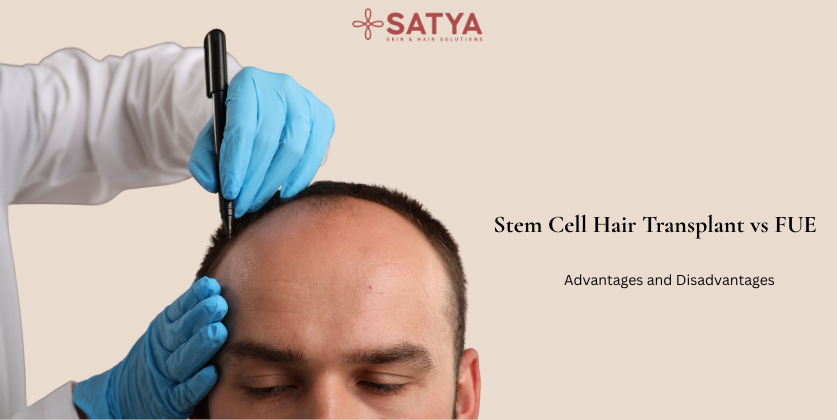
If you are researching Stem Cell Hair Transplant vs FUE, you are likely asking a simple question with a complicated answer: which hair loss treatment is genuinely better, safer and more permanent for you? The terms sound similar, but they describe very different things. FUE (Follicular Unit Extraction) is a well-established surgical method used in thousands of clinics worldwide. A Stem Cell Hair Transplant, on the other hand, is an emerging, largely regenerative approach that is still being studied. This guide explains the science clearly, without hype, so you can make an informed decision about FUE hair transplant in India and what “stem cell” treatments really offer today.
| In the Stem Cell Hair Transplant vs FUE comparison, FUE is currently the proven, evidence-backed surgical option that relocates your own permanent hair follicles to thinning areas. A true stem cell hair transplant, where follicles are multiplied or cloned in a lab, remains experimental and is not yet an approved standalone replacement for FUE. Most “stem cell” offerings in clinics today are actually regenerative therapies that support a transplant rather than replace it. For most patients in 2026, a skilled FUE hair transplant remains the more reliable choice. |
Why Hair Loss Feels So Confusing to Treat
Most people do not start by comparing techniques. They start with a worry, a receding hairline, a widening parting, or thinning crown that no longer hides. By the time you begin comparing options like Stem Cell Hair Transplant vs FUE, you have probably already tried shampoos, oils, or supplements with limited results.
The internet does not make it easier. Clinics use overlapping marketing terms, and “stem cell” is one of the most misused. Understanding what each method actually does, and what it cannot do, is the first step toward a result that looks natural and lasts.
What Is FUE Hair Transplant?
FUE (Follicular Unit Extraction) is a surgical procedure in which individual hair follicles are removed one by one from a “donor” area, usually the back and sides of the scalp, where hair is genetically resistant to balding, and transplanted into thinning or bald zones.
Because the relocated follicles keep their original genetic resistance, the results are considered permanent. Key features of FUE include:
- No linear strip scar, unlike the older FUT method
- Individual graft extraction for natural density and direction
- Suitable for the scalp, beard, eyebrows and select body areas
- A predictable recovery, with most patients resuming routine within a few days
FUE is the most widely performed modern transplant technique and the backbone of FUE hair transplant in India, where high surgical volumes and experienced teams have made outcomes both refined and accessible.
| “FUE works because we are not creating new hair , we are protecting and relocating hair the body already trusts. Skill decides whether that hair looks transplanted or completely natural.” Dr. Shail Gupta, Lead Hair Transplant Surgeon & Co-Founder, Satya Skin & Hair Solutions |
What Is a Stem Cell Hair Transplant?
The phrase “Stem Cell Hair Transplant” is used loosely, and that is exactly where confusion begins. In its truest scientific sense, it refers to hair multiplication, taking a small sample of follicular stem cells, multiplying them in a laboratory, and re-implanting them to grow new hair without depleting the donor area. In theory, this could treat people with limited donor hair. In reality, this remains experimental and is not an approved, dependable standalone treatment in 2026.
What most clinics actually offer under the “stem cell” label is regenerative support, such as:
- Stem-cell-enriched or growth-factor-rich solutions injected to strengthen existing follicles
- Therapies used alongside an FUE procedure to support graft survival and scalp health
- Non-surgical treatments aimed at slowing shedding in early-stage hair loss
These can be genuinely useful as part of a wider plan, but they are not a like-for-like replacement for transplanting permanent follicles. Honest expectation-setting matters here, because hair restoration is a long-term, medical decision.
| “Regenerative and stem-cell-based therapies have a real role in scalp health and supporting early hair loss. But patients deserve honesty: today they assist treatment, they do not yet replace a transplant.” Dr. Ruchi Agarwal, Consultant Dermatologist & Co-Founder, Satya Skin & Hair Solutions |
Stem Cell Hair Transplant vs FUE: Side-by-Side Comparison
This table compares the two approaches on the factors patients ask about most.
| Factor | FUE Hair Transplant | Stem Cell Hair Transplant |
|---|---|---|
| Status in 2026 | Established, widely performed surgical method | Emerging / largely experimental as a standalone |
| What it does | Relocates your own permanent follicles | Aims to multiply or regenerate hair cells |
| Permanence | Results considered permanent | Long-term reliability not yet proven |
| Evidence base | Strong, long clinical track record | Limited, still under research |
| Best suited for | Defined balding with adequate donor hair | Mostly supportive / early-stage use today |
| Typical role | Primary treatment | Add-on therapy in most clinics |
Which Hair Transplant Method Is Safer and More Permanent?
Is FUE or stem cell treatment better?
For someone with clear hair loss and a usable donor area, FUE is generally the better and more dependable choice today. Stem cell and regenerative therapies are most valuable as supportive treatments, strengthening existing hair, supporting scalp health, or helping early thinning, rather than rebuilding a hairline on their own.
Are these procedures safe?
When performed by qualified doctors in a sterile, accredited setting, FUE has a strong safety profile. As with any procedure, outcomes depend heavily on diagnosis, technique and aftercare. There is no credible evidence that a properly performed hair transplant causes serious illness; most side effects are minor and temporary, such as mild swelling or redness. Regenerative therapies are also generally well tolerated, but should always be assessed case by case.
How long do results last?
Because FUE uses follicles that are genetically resistant to balding, transplanted hair is considered permanent. The long-term durability of true stem-cell-grown hair has not yet been established in routine practice, which is another reason FUE remains the standard.
The Satya Approach: Less Medicine. Less Donor. Maximum Skill.
At Satya Skin & Hair Solutions, established in 2005, our philosophy is simple: protect your donor area, avoid unnecessary intervention, and let surgical skill do the heavy lifting. We believe in health bhi, hair bhi, treating the whole patient, not just the bald spot.
Rather than chasing trends, we use refined, outcome-led techniques, including:
- DSFT (Direct Stimulated Follicular Transplant) for precise graft handling
- MHT (Maximum Harvesting Technique) to make the most of a limited donor area
- Mimic Nature Hairline design for soft, undetectable results
- Zero-Pain Anaesthesia Protocol for a more comfortable experience
- Future-Ready Transplant Planning so today’s work suits tomorrow’s hair loss pattern
- Min-Made Microdosing for measured, conservative medical support
Our two co-founders bring complementary expertise: Dr. Shail Gupta leads surgical hair transplant procedures, while Dr. Ruchi Agarwal focuses on dermatology, scalp health and non-surgical management, including the regenerative therapies sometimes marketed as “stem cell” care. Where such treatments genuinely help, we use them honestly and selectively, never as an over-promise.
| Not sure which option is right for you? The best way to compare Stem Cell Hair Transplant vs FUE for your hair loss is a proper diagnosis. Book an honest, no-pressure consultation with our doctors at our Gurgaon or Delhi clinic to understand your donor area, your pattern of hair loss, and a plan suited to you. Call [+919999570494]. |
Frequently Asked Questions
Not as a standalone treatment in 2026. FUE is the proven method that relocates permanent follicles, while true stem cell hair transplantation is still experimental. Stem cell and regenerative therapies are best used to support hair health, not to replace a transplant.
FUE surgically moves your own permanent hair follicles to thinning areas. A stem cell hair transplant aims to multiply or regenerate hair cells, a promising but unproven approach. In short, FUE relocates existing hair, while stem cell methods try to create more of it.
Cost depends on the number of grafts, the technique used and the complexity of your case, so it varies from patient to patient. FUE hair transplant in India is generally considered good value relative to many countries. We share a transparent, personalised estimate only after assessing your hair loss in consultation.
Yes. FUE uses follicles from a donor area that is genetically resistant to balding, so transplanted hair is considered permanent. Existing non-transplanted hair can still thin over time, which is why long-term planning matters.
Most side effects are minor and temporary, such as mild swelling, redness or tenderness that settles within days. Serious complications are uncommon when the procedure is done by qualified doctors in a sterile setting with proper aftercare.
Often, yes. Regenerative and growth-factor therapies are sometimes used alongside FUE to support scalp health and graft survival. Whether this suits you is a clinical decision made during your consultation.