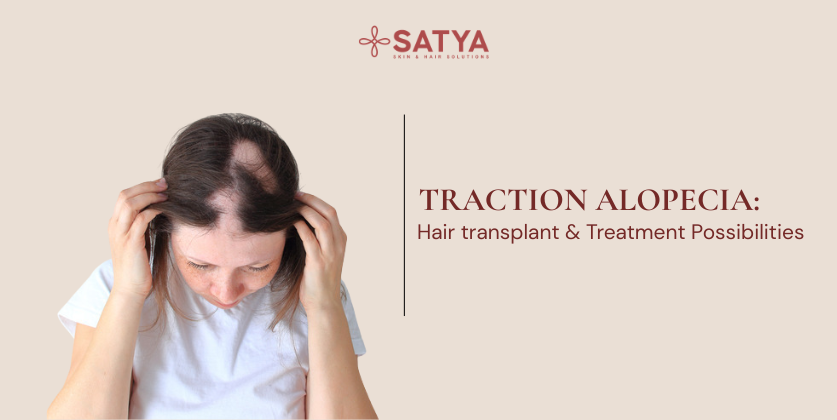
Tight ponytails. Daily buns. Braids that pull at the hairline. Hair extensions worn for months. For many patients in Delhi and Gurgaon, these everyday styling habits are the quiet, long-term cause of a very specific type of hair loss, Traction Alopecia.
It often starts with a thinning temple, a receding hairline, or small bald patches along the edges of the scalp, and most people only notice it when the hair no longer grows back.
The most common question we hear at Satya Skin & Hair Solutions is simple: “Will a hair transplant help Traction Alopecia?“ The honest answer is sometimes yes, sometimes no. It depends entirely on the stage of the condition and whether the follicles are still alive.
This blog explains what Traction Alopecia is, its causes and symptoms, when it can be reversed with treatment, and when a hair transplant becomes the right solution.
What Is Traction Alopecia?
Traction Alopecia is a form of hair loss caused by repeated, long-term tension on the hair follicles. Unlike genetic hair loss (androgenetic alopecia), this is a mechanical problem where the follicle is physically pulled again and again until it becomes inflamed, weakens, and finally stops producing hair.
In the early stages, the hair loss is reversible. In the later stages, the follicle scars and dies, and only a hair transplant can restore the hairline.
Traction Alopecia is most often seen along the frontal hairline, temples, and the area above the ears exactly where styling tension is highest.
Also Read: How to Repair Damaged Hair Naturally
Common Causes of Traction Alopecia
Understanding the “Traction Alopecia” causes is the first step to stopping the damage. The most common triggers we see in our Delhi and Gurgaon clinics include:
- Tight ponytails, top knots, and buns worn daily for years
- Tight braids, cornrows, and weaves
- Hair extensions especially clip-ins, glue-ins, and tape-ins worn continuously
- Turbans, tight hijabs, or helmets that rub the same area
- Chemical relaxers and repeated heat styling that weaken the shaft before tension breaks it
- Hair accessories such as tight rubber bands and metal clips
- Certain religious or cultural hairstyles that require lifelong tight pulling
The problem is rarely one bad hairstyle; it is the cumulative effect of tension repeated over months and years.
Traction Alopecia Symptoms: How to Spot It Early
Catching this condition early is critical, because early-stage hair loss can often be reversed without surgery. The classic Traction Alopecia symptoms include:
- A receding hairline around the temples, often in a symmetrical pattern
- Thinning hair along the edges of the scalp
- Small bumps, redness, or itching where the hair is pulled
- Broken short hairs along the hairline (called the “fringe sign” a ring of tiny hairs that resisted the pull)
- Tenderness or soreness of the scalp after tying the hair
- Shiny, smooth skin in the affected area in advanced cases a sign that follicles may have scarred
If you are noticing any of these signs, it is worth consulting a dermatologist before the follicles are permanently lost.
Can Traction Alopecia Be Reversed Without Surgery?
Yes but only if caught in time. Early-stage Traction Alopecia treatment focuses on removing the cause and supporting follicle recovery. At Satya, Dr. Shail, typically builds a conservative, medicine-first plan that may include:
- Immediate change in hairstyling looser ties, scarves instead of tight bands, avoiding extensions
- Topical minoxidil to stimulate dormant follicles
- Anti-inflammatory treatment if the scalp is irritated
- PRP (Platelet-Rich Plasma) therapy to improve follicle health
- Nutritional correction iron, vitamin D, protein, and thyroid screening
- Low-level laser therapy in selected patients
This phase usually runs for 6–12 months. If follicles are still alive, hair often grows back without any surgical intervention. This approach aligns with Satya’s core philosophy Less Medicine. Less Donor. Maximum Skill. We do not rush to surgery when medicine alone can solve the problem.
Will a Hair Transplant Help Traction Alopecia?
This is the central question and the answer depends on one thing: are the follicles still alive, or have they been scarred?
A hair transplant will help Traction Alopecia when:
- The hair loss has been present for several years
- The scalp shows no regrowth despite stopping tight hairstyles
- There is no active inflammation on the skin
- The skin in the affected area looks smooth and shiny (a sign of scarring, meaning the follicle is gone permanently)
- The donor area (back and sides of the scalp) is healthy and has enough grafts
A hair transplant is not the right first step when:
- The hair loss is recent (less than a year)
- The scalp is still red, itchy, or inflamed
- The patient has not yet stopped the tight hairstyles or extensions
- Medical treatment has not been given a fair trial
At Satya, every Traction Alopecia patient is first evaluated to confirm that the condition has stabilised. Operating on an actively inflamed scalp risks graft failure which is why Dr. Shaiil Gupta insists on a quiet, stable scalp before any surgery is planned.
How Satya Approaches Traction Alopecia Hair Transplant
Traction Alopecia almost always affects the hairline and temples, the most visible and most technically demanding zones of the scalp. A poorly designed transplant here is instantly recognisable. This is where Satya’s surgical philosophy matters:
- Mimic Nature Hairline design irregular, soft, age-appropriate hairline that does not look “planted”
- Single-hair follicular units used at the front edge for natural density gradient
- DSFT (Direct Stimulated Follicular Transplant) for better graft survival
- MHT (Maximum Harvesting Technique) to protect the donor area for the long term
- Zero-Pain Anaesthesia for patient comfort during the procedure
- Future-Ready Transplant planning we design the hairline with a 10–15 year horizon, not just today’s result
Because Traction Alopecia often affects women, hairline design is especially important. Women’s hairlines follow a different shape and density pattern than men’s, and must be planned accordingly.
Also Read: How to Stop Hair Loss Due to PCOS
Traction Alopecia Treatment in Delhi and Gurgaon
For patients across Delhi NCR, Satya Skin & Hair Solutions offers evaluation and treatment at two locations Pitampura (Delhi) and DLF Phase 4 (Gurgaon). Founded in 2005 by Dr. Shaiil Gupta and Dr. Ruchi Agarwal, the clinic has treated a large number of Traction Alopecia cases, from early reversible thinning to advanced scarring requiring restoration surgery.
Every consultation begins with a detailed scalp analysis, medical history, donor area mapping, and an honest discussion about whether medicine, PRP, or a hair transplant is the right path. We do not push surgery, we recommend it only when it is genuinely the best option.
Frequently Asked Questions
Yes, in early stages. If you stop the tight hairstyles quickly and the follicles are still alive, hair can regrow in 6–12 months. Once the follicle scars, natural regrowth is no longer possible and a hair transplant becomes the only restoration option.
If the bald area has been present for over a year, the skin looks smooth and shiny, and there is no regrowth despite stopping tight styling, the follicles are likely scarred. A dermatologist can confirm this with trichoscopy.
No. If the same mechanical tension continues, the transplanted hair will also be pulled and lost over time. Changing styling habits is essential for long-term results.
Yes. Women are more commonly affected due to tight ponytails, buns, braids, and extensions. However, men who wear turbans, tight helmets, or man-buns can also develop it.
It depends on the area. A small frontal hairline correction may need 1,200–2,000 grafts, while more extensive temple and hairline restoration can require 2,500–3,500 grafts. This is confirmed only after in-person evaluation.
PRP can help if the follicles are still alive. It improves blood supply and stimulates dormant hair. In scarred areas, however, PRP cannot bring dead follicles back; only a transplant can.
The surgical technique is similar, but hairline design, graft angulation, and density planning are more delicate because the affected zone is the most visible part of the scalp.