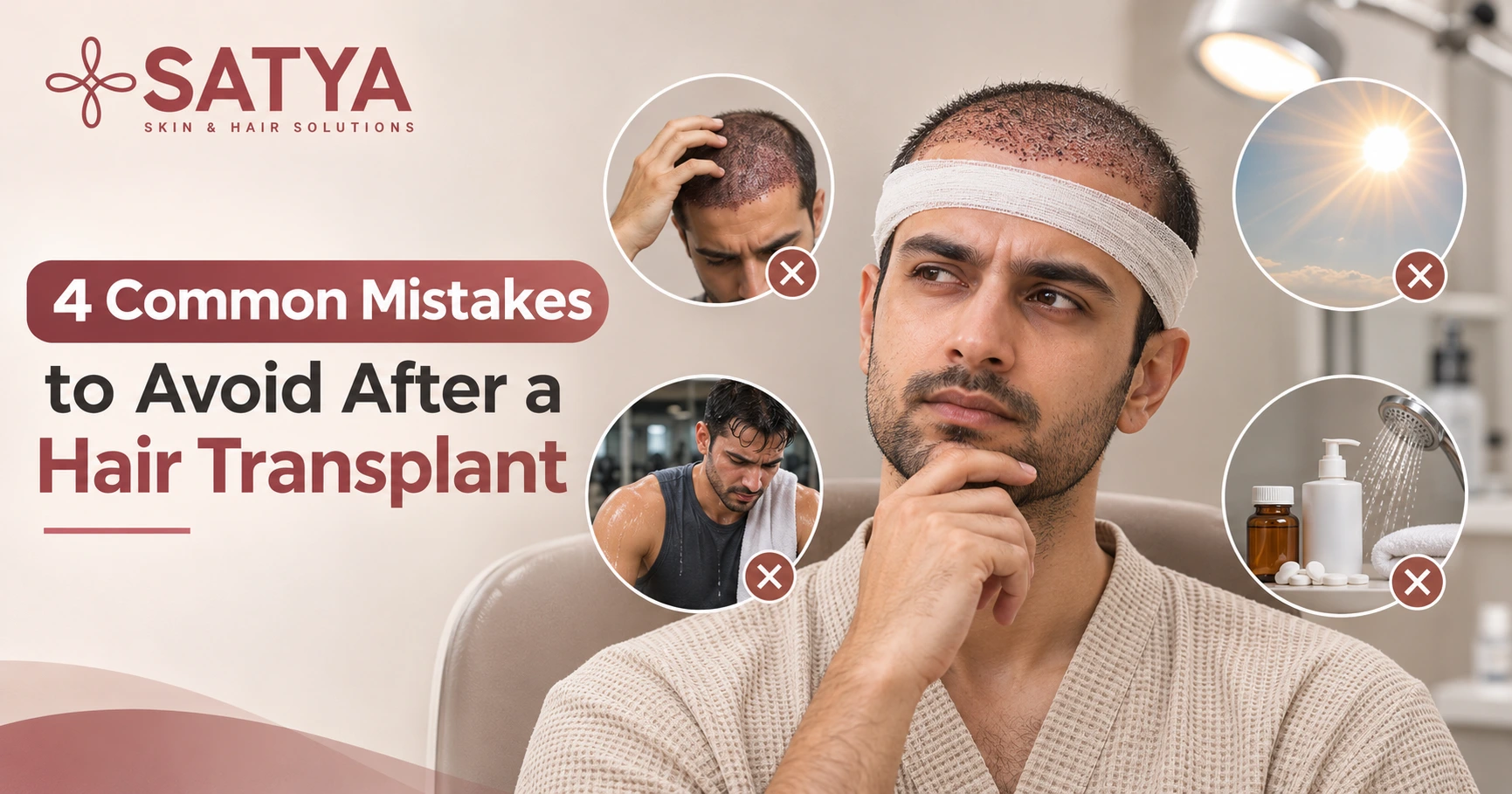
The most common mistakes after a hair transplant are ordinary and avoidable: touching the grafts, washing badly, returning to old habits too soon, and judging the result too early. Most of the outcome is shaped in the operating room, but the first weeks still affect healing, and the first year affects how you read the result.
Quick Answer
The four mistakes to avoid after a hair transplant are: (1) disturbing the grafts before they are secure, commonly the first 10 days; (2) delaying the first wash, or washing too roughly; (3) returning too early to smoking, alcohol, heavy exercise, heat and sun; and (4) judging the result before about 12 months and abandoning the plan. Shedding between weeks 2 and 8 is expected and is not a sign of failure [2, 3, 4]. Your surgeon’s written instructions always come first.
Each section below explains what goes wrong and what to do instead. For a full week-by-week plan, see our guide to hair transplant recovery.
One honest note: post-operative advice rests on a small number of studies and a lot of clinical practice, so exact timings differ between clinics. Where the evidence is thin, we say so.
Why the First Days After a Hair Transplant Matter
A new graft is a tiny piece of living tissue sitting in a small incision. It has no blood supply of its own at first, and it depends on the surrounding skin until new vessels grow in.
One of the few direct studies of how quickly grafts settle is a 2006 paper by Bernstein and Rassman. Researchers deliberately pulled grafts in 42 patients during healing to find when they could no longer be dislodged [1].
| Days after surgery | What the study found [1] |
|---|---|
| Days 1 to 2 | Pulling on a hair always dislodged the graft |
| Days 3 to 5 | Risk from pulling a hair began to fall, but pulling an attached crust still always dislodged the graft |
| Days 6 to 8 | Pulling a hair no longer dislodged the graft; risk from pulling a crust kept falling |
| Day 9 onwards | Grafts were no longer at risk of being dislodged |
This is one small, older study, and it tested deliberate pulling rather than everyday contact. A light brush against a pillow is not the same thing. It does explain why many clinics treat about day 10 as the point at which grafts are secure [3], and why crusts matter as much as hairs.
Mistake 1: Disturbing the Grafts Before They Are Secure
This is the most direct way to lose a graft after surgery.
How It Usually Happens
- Scratching: itching commonly starts around days 3 to 7 [2]. Scratching can dislodge grafts and introduce infection [2].
- Picking crusts: crusts usually form around days 2 to 3 and clear by about days 7 to 10 [2]. Pulling an attached crust in the first days can bring the graft with it [1].
- Pressure and friction: sleeping on the grafts, a tight cap or a helmet can press or rub the recipient area.
- Accidental knocks: car roofs, cupboard doors, children and pets. One protocol advises keeping pets and children away for 10 days [3].
What to Do Instead
- Keep your head raised for the first few nights [3], usually sleeping on your back. A travel pillow helps stop you rolling onto your side.
- Tell your clinic about itching instead of scratching. Saline sprays and cool compresses are commonly used [2], but use only what your clinic advises.
- Let crusts soften and lift away during washing. Crusts still present beyond about two weeks need a clinical check [2].
- Wear a cap only when your clinic allows it, usually a loose, clean one after a few days [3]. Lift it straight on and off.
- Plan around a two-wheeler helmet, which most clinics restrict for about 10 to 14 days.
Mistake 2: Delaying the First Wash, or Washing Too Roughly
Many patients avoid washing because they are afraid of harming the grafts. The published evidence points the other way.
A 2026 review of complications after follicular unit excision (FUE) reports that washing delayed beyond three days was linked to more folliculitis, an inflammation of the hair follicles [2]. In a series of 1,090 patients, delayed washing was also an independent risk factor for moderate to severe redness around the grafts [2].
The review recommends gentle cleansing within 48 to 72 hours [2]. The American Society of Plastic Surgeons says gentle washing can begin within two days [4], and some protocols start the morning after surgery [3]. Follow the day your clinic gives you.
The opposite error also matters: a wash that is on time but rough.
| Common error | What usually works better |
|---|---|
| Skipping the wash out of fear | Start on the day your clinic advises, commonly within 48 to 72 hours [2] |
| Rubbing shampoo into the grafts | Pour or dab the diluted cleanser your clinic provides; pat, do not rub [3] |
| Strong shower pressure on the grafts | Pour lukewarm water gently from a mug |
| Towel rubbing or a hot hair dryer | Let the scalp air dry |
| Hair oil, home remedies or products bought online | Avoid unnecessary topical irritants [2]; use only what your clinic supplies until it confirms healing |
Normal shampooing commonly resumes at about day 10 [3].
Dr. Ruchi Agarwal: Myth and Fact
Myth: A scalp with new grafts should be left alone until the crusts fall off.
Fact: Crusting prolongs the period when grafts are at risk [1], and poor scalp hygiene is a listed risk factor for infection [2]. Gentle, early cleansing is part of protecting the grafts. Redness and small bumps can have different causes, including folliculitis and irritation from a product, and they need different treatment. Show your clinic before you apply anything.
One thing to remember: clean the scalp, but do not rub it.
Mistake 3: Going Back to Smoking, Exercise, Heat and Sun Too Soon
Feeling well is not the same as being healed. Many people feel normal within days.
The table lists things to avoid after a hair transplant. These timings are clinical conventions, not proven cut-offs, and sources differ: one clinic allows light gym work from days 4 to 9 [3], while the American Society of Plastic Surgeons advises at least three weeks away from vigorous exercise [4]. We show the more cautious reading; your surgeon’s sheet takes precedence.
| Habit | Why it matters | Commonly advised timing |
|---|---|---|
| Smoking | A listed risk factor for tissue necrosis (skin death) and for poor growth [2] | Stop at least 1 month before surgery [2]; stay off for at least 2 weeks after [3]; quitting altogether is better |
| Alcohol | Can increase bleeding risk [2] | Avoid for at least 3 days [3] |
| Light exercise | Heavy sweating and strain can irritate healing sites | About 7 days, without heavy sweating |
| Heavy weights, running | Strenuous activity raises scalp blood flow and can cause bleeding [4] | At least 3 weeks [4] |
| Contact sports | Risk of direct impact and bleeding [4] | At least 3 weeks [4]; many clinics advise about 4 |
| Swimming, steam, sauna | Chlorine, salt water, heat and bacteria on healing skin | About 3 to 4 weeks |
| Direct sun | Sunburn on healing skin | Cover with a hat in strong sun; sunscreen after 2 weeks [3] |
Medicines: Do Not Decide Alone
Blood thinners, vitamin E and some herbal supplements can increase bleeding [2]. Never stop a prescribed blood thinner on your own, because that decision weighs bleeding against clotting risk [2].
A Note for Delhi NCR
Summer procedures are a listed risk factor for folliculitis [2]. In a Delhi or Gurgaon summer, keep the scalp clean and cool, avoid heavy sweating, and plan your commute around any helmet restriction.
Mistake 4: Judging the Result Too Early and Abandoning the Plan
This mistake does not harm the grafts, but it can lead to costly decisions. The 2026 review notes that dissatisfaction often arises in the first months, over low density or slow regrowth, and typically improves by 6 to 12 months as hair matures [2].
Panicking Over Shedding
Most transplanted hairs shed between weeks 2 and 8 as the follicles enter a resting phase [2, 3, 4]. The American Society of Plastic Surgeons describes this as normal and almost always temporary [4].
Some patients also have shock loss, a temporary shedding of existing hair near the treated area. Reported incidence ranges from 0.15% to 15%, and regrowth usually begins at around three months [2].
Assessing the Result at Month 3 or 6
| Time after surgery | What is commonly seen |
|---|---|
| About month 3 | Fine new hairs begin to appear [3, 4] |
| About month 6 | Hair is long enough to groom, but still thickening [3] |
| About month 12 | Roughly 90% of the final appearance is visible [3] |
| Year 1 to 2 | Some further fullness may still develop [3] |
Poor growth can only be assessed at about 6 to 12 months [2]. For help reading your own progress, see reading hair transplant results.
Booking Another Procedure Too Soon
Secondary procedures should be considered only once final growth is achieved, usually around 12 months [2]. Donor hair is a finite resource: a graft taken early to settle a month-six worry cannot be taken again. See should you undergo a second FUE hair transplant before you decide.
Forgetting the Hair That Was Not Transplanted
A transplant moves hair. It does not stop androgenetic alopecia (pattern hair loss) in the native hair around it [5]. The International Society of Hair Restoration Surgery notes that non-surgical treatment should be considered first or alongside surgery, to stabilise the pattern of loss [5].
That does not mean every patient needs lifelong medicine. It means the decision belongs to you and your doctor, at the lowest effective dose. Do not stop, start or change a medicine on your own, and do not begin minoxidil until your surgeon says the scalp is ready; one protocol restarts it at day 10 [3]. See can I stop taking medicines after a hair transplant and is finasteride mandatory after a hair transplant.
Dr. Shail Gupta on Patience and the Donor Area
Donor hair is finite, so I ask patients not to spend it on a worry at month six. Bring that worry to us. We will examine the scalp and tell you honestly where things stand. If growth is truly poor at 12 months, we first look at why. Only then do we discuss whether more surgery is right, or whether it is needed at all. Think 20 years, not 20 months.
If You Think You Have Already Made a Mistake
A single slip does not automatically mean a lost result. If you have scratched, knocked or rubbed the area, do this:
- Stop and look. A small bleed at one spot may mean a graft has come out.
- If it is oozing, press gently and do not wipe. Gentle, steady pressure on that spot with sterile gauze for 5 to 10 minutes usually controls minor oozing [2].
- Do not try to push anything back in. Leave the area clean and untouched.
- Send your treating clinic a clear photo with the date and what happened.
- Keep to your aftercare routine. Do not add extra products.
When to Contact Your Clinic Promptly
- Bleeding that continues despite steady pressure [2]
- Yellow pus, a foul smell, fever, or redness, warmth or pain that is spreading or worsening. Infection occurs in under 1% of cases, usually in weeks 1 to 4 [2]
- Many painful pustules. Folliculitis affects about 12% of patients and is treatable [2]
- Dark or black areas of skin, or thick crusts lasting beyond about two weeks [2]
- Swelling that is still increasing after about day 5
- No new growth at all by about six months
If a past procedure has not gone as you hoped, our guides to side effects of hair transplants in India and bad hair transplant repair explain the next steps.
Unsure About Something You Have Noticed?
If you had your transplant elsewhere, your treating clinic should be your first call. If you are planning a transplant, or want an independent view of your progress, schedule an evidence-based consultation with our hair restoration team in DLF Phase 4, Gurgaon, or Pitampura, Delhi. We will examine your scalp and donor area and explain what we find. Recovery and results vary from person to person.
Frequently Asked Questions
Do not touch, scratch or rub the grafts, pick crusts, or put pressure on the area for about the first 10 days. Do not delay the first wash your clinic advises. Avoid smoking, alcohol, heavy exercise, swimming and direct sun for the periods your surgeon sets, and do not judge the result before about 12 months.
The most careful period is about the first 10 days, until the grafts are secure. Restrictions on heavy exercise, contact sports and swimming commonly last 3 to 4 weeks.
A light touch is unlikely to do harm. In the first days, though, rubbing, scratching or pulling at a crust can dislodge a graft. If you notice bleeding from one spot, apply gentle, steady pressure there with sterile gauze and contact your clinic.
Sleep on your back with your head raised for the first few nights. A travel pillow can stop you rolling onto your side. Follow the position your clinic advises.
Yes. Most transplanted hairs shed between weeks 2 and 8, while the follicles rest under the skin. New growth commonly begins at around 3 months. Some nearby native hair may also shed temporarily.
Aftercare is one factor. Published causes of poor growth also include follicle injury during surgery, long out-of-body time, dehydration of grafts, smoking and vascular disease. Growth can only be assessed fairly at about 6 to 12 months.
Secondary procedures should generally be considered only after final growth, usually around 12 months. Because donor hair is finite, a doctor should first examine why the result fell short and whether more surgery is needed at all.